A Sishi Gallery project in Paris
Where Tea Happens
Là où le thé prend place
12–19 September 2026
Open daily, 10:30–18:30
8 Rue du Général Guilhem
75011 Paris
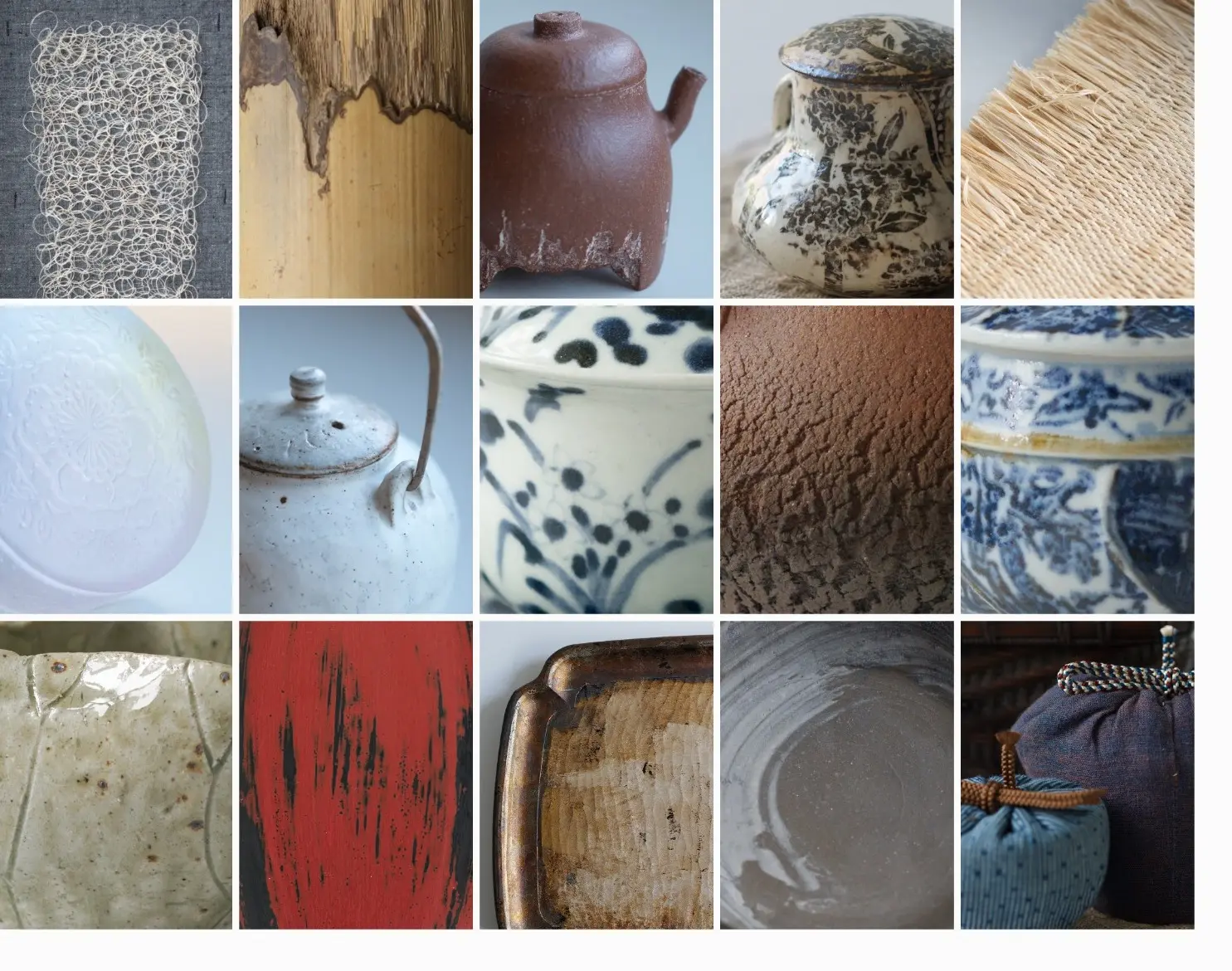
A tea leaf. A setting of vessels. A pair of hands. A table. The space among a few people. A room.
This is where tea happens—and where objects gradually expand to the scale of a space for living.
About the exhibition
This exhibition brings together fifteen artists from China, Japan, South Korea and Mexico. Ceramics, glass, bamboo, wood and textiles meet within the space, each retaining its own texture and voice, yet entering into relation through tea.
- Introductory essay
- Minoru Shimizu
- Curator
- Qianzhe Fei
- Special presentation
- Eiko Shimizu
Curatorial textWhere Tea Happens
Where Tea Happens
Sishi was founded in Beijing in 2019. Since April 2025, I have been living in Paris as a sojourner. “Sojourning” is a subtle state: it is neither a brief journey nor yet a true settling-in. One lives in a city while still retaining a certain distance from which to observe it. As its streets, seasons and everyday rhythms gradually become familiar, it is precisely this condition—between familiarity and strangeness, staying and leaving—that has led me to reconsider the relationship between people and space.
How do we build, little by little, an order for living in a city? And within a space that is not entirely our own, how do we make room for everyday life, find our place and form connections with those around us?
Since arriving in Paris, I have often wondered: as someone living here only for a time, what might I bring to this city? And what might I take away from it?
For years, my work has revolved around objects. It does not begin with a grand idea, but with very concrete acts: meeting a maker, visiting their studio, feeling the scale of a vessel as it settles into the hand, placing it within a space, bringing it into relation with visitors, and imagining how it might enter another person’s life and surroundings.
An object may be small, yet it can hold something far larger than itself. It connects maker and user, but also material, body and time. Through an object, we sense the hand of another; through daily use, we leave traces of our own lives within it.
Paris is a city that continually creates temporary interiors within public space. Café terraces spill out into the street; covered passages lie between indoors and outdoors; a small table facing the pavement allows someone to sit alone while remaining within the flow of other people’s lives. Strangers share light, sound and time. One may read, write, drink coffee or watch the street; one has not truly joined those nearby, yet is not cut off from them either. It is a particular form of “shared presence”: alone, but not isolated; side by side, without needing to know one another.
I gradually realised that the space created by tea has something in common with this. This was the initial impulse behind Where Tea Happens.
This exhibition brings together fifteen artists from China, Japan, South Korea and Mexico. Ceramics, glass, bamboo, wood and textiles meet within the space, each retaining its own texture and voice, yet entering into relation through tea until, together, they form a setting for tea.
During the exhibition, three tea practitioners from different countries, each having come to tea by a different path, will present their own tea gatherings. At the same table, their differing understandings of tea, objects and gathering will each shape a distinct rhythm and order.
In this exhibition, therefore, tea is not itself the final object of attention, but a medium. It passes through the vessels, bringing once-still forms into action; allowing weight, scale, texture and temperature to be felt by the body; and turning relationships between people into gestures of pouring, waiting, offering and receiving.
A tea leaf. A setting of vessels. A pair of hands. A table. The space among a few people. A room.
This is where tea happens—and where objects gradually expand to the scale of a space for living.
What can I bring to Paris?
Perhaps not a complete account of Asia or tea, nor a readily recognisable image of the East. I would rather bring a table, a few objects and a passage of time that moves at a different pace from the city’s everyday rhythm, so that people from different places might pause here for a moment, feel the work of the hand and, for the duration of a cup of tea, be present together.
Introductory essayKissako
Tea at the Confluence of Eastern and Western Cultures
Kissako
Tea at the Confluence of Eastern and Western Cultures
In In Praise of Shadows, Jun’ichirō Tanizaki compares the aesthetic sensibilities of the “West” and the “East”. If the former is drawn to diamonds and glass, he writes, the latter cherishes jade and celadon.
Indeed, in The Classic of Tea, composed around 780, Lu Yu (c. 733–804) of the Tang dynasty (618–907) compared the beauty of Yue celadon to jade. He considered Yue ware superior to Xing ware: Xing ware was like silver, while Yue ware was like jade; Xing ware was like snow, while Yue ware was like ice. Tea drunk from Xing white porcelain appeared reddish, whereas in Yue celadon it took on a green hue.
Among the most celebrated descriptions of Yue ware’s mise, or “secret-colour” celadon, are the lines by the late-Tang poet Lu Guimeng (d. 881):
When the Yue kilns open amid autumn’s wind and dew, they capture the emerald colour of a thousand peaks.
As the kiln doors open amid the clear winds and dew of late autumn, it is as though the fresh green of early spring surges from the depths of the kiln fire. The poem vividly captures the wonder and emotion of that instant.
Later, during the final years of the Tang and the Five Dynasties period, Xu Yin (849–938) wrote:
Emerald and blue-green melt into an auspicious colour newly born; the bright moon, deftly hollowed, is tinted with spring water; thin ice, lightly turned, holds a cloud of green.
The so-called “secret colour” was not simply emerald green. It was as though blue-green itself had melted into the glaze, or as though a green cloud were suspended upon a layer of thin ice. Its colour was subtle, lucid and impossible to define with certainty.
In 1987, among the objects excavated from the underground palace of the Famen Temple near Xi’an, Shaanxi Province, were vessels explicitly identified as Yue-ware mise. For the first time, it became possible to glimpse the true appearance of this mysterious glaze. It was a light and gentle blue-green, later inherited and further developed by Ru and Longquan wares.
The ideal colour pursued in Ru celadon came to be known as “the sky after rain”. It was not the clear, transparent blue of a sky washed clean, but a hazy, opaque sky-blue in which both air and sky still retained the dampness of the rain that had just ceased. Within this ambiguous tone—neither simply green nor blue, not even a colour that could be named with certainty—an infinity of colours could be seen.
The history of Chinese ceramics underwent an important transformation between the Song dynasty, founded by the Han Chinese, and the Yuan dynasty, founded by the Mongols. As an empire spanning Eurasia, the Yuan brought aesthetic sensibilities from the “West” into China, where they ultimately blossomed into the magnificent art of blue-and-white porcelain.
With its pure white, hard and thin porcelain body, transparent glaze and high-temperature firing, it embodied the beauty of what came to be known as porcelain. Following Tanizaki’s distinction, this was a beauty of light and transparency, Western in character, transmitted to the East through the Islamic world.
The “sweet white” glaze favoured by the Yongle Emperor of the Ming dynasty, and hotarude, or “rice-grain” porcelain, which makes full use of porcelain’s translucency, are representative examples. Against a dazzling ground of pure white porcelain, brilliant colours unfolded: blue-and-white, wucai, red overglaze enamels, kinrande gold decoration and more. This world was refined and developed to extraordinary heights during the Ming dynasty, gradually relegating the aesthetic sensibility represented by jade and celadon to the past.
At the same time, a tea culture that had once regarded secret-colour celadon, sky-blue glazes and even tenmoku-glazed wares as its highest ideals—and that centred on matcha, with its opaque tea liquor— gradually gave way to a culture of clear, steeped tea served in white porcelain. The culture of matcha, left behind by the changing times, was preserved on a distant island nation in the East Sea—Japan—where it was ultimately transformed into what would later be known as wabi-cha.
Meanwhile, from the Yuan empire that stretched between East and West to the Ming dynasty, which actively pursued global trade through the maritime expeditions of Zheng He and other ventures, the emerging culture of steeped tea travelled outward alongside fine white porcelain, eventually becoming a global cultural standard.
Let us return to the age of Lu Yu. At the time, tea was drunk primarily in Chan Buddhist monasteries. The Chan monk Zhaozhou Congshen (778–897), who lived one generation after Lu Yu, left behind a celebrated phrase: “Go and have some tea.”
It is often understood as an invitation open to everyone: “Have a cup of tea before you go.” Yet Zhaozhou was, after all, a philosopher renowned for kōans such as the one concerning a dog’s Buddha-nature. Such an interpretation may therefore be somewhat too ordinary. “Go and have some tea” may itself be a kōan.
In the original account, Zhaozhou asked two travelling monks, “Have you been here before?”
One replied, “No, I have not.”
Zhaozhou said, “Go and have some tea.”
The other replied, “Yes, I have.”
Again, Zhaozhou said, “Go and have some tea.”
The head monk then asked, “Why do you say ‘Go and have some tea’ both to the one who has been here and to the one who has not?”
Zhaozhou replied once more, “Go and have some tea.”
What is revealed here is Chan’s thoroughgoing rejection of every form of dualism. Affirmation and negation—having been here and not having been here—are both set aside. Then even the dualism of the “self” standing in opposition to this “world” is denied.
“Neither arising nor ceasing, neither impure nor pure, neither increasing nor decreasing…” Through this, Chan transcends all oppositions.
This philosophical implication might be considered alongside an idea proposed by the medieval French scholastic philosopher Nicholas of Autrecourt (1299–1369). When he stated that “God exists” and “God does not exist” have the same meaning, what he touched upon was the neutrality of meaning.
It may also evoke Edmund Husserl’s epoché, as well as the “nonsense” discussed by Gilles Deleuze in relation to Lewis Carroll: a condition beyond both sense and nonsense, and opposed to the mere absence of sense.
To be liberated from all dualism, and from the “meaning” produced by dualism—Zhaozhou’s name for this was simply: “Go and have some tea.”
It is often said that “tea and Zen are of one taste”. Yet perhaps what lies at the very heart of tea is precisely this freedom: freedom of the spirit, and the freedom attained from within the spirit itself.
Lu Yu, Zhaozhou and the Tang poets mentioned above all lived in the profoundly turbulent period following the An Lushan Rebellion of 755. Japanese wabi-cha is generally considered to have begun with Murata Jukō and to have reached its culmination with Sen no Rikyū; its historical background was likewise the age of civil war that followed the Ōnin War of 1467.
In both China and Japan, tea emerged and developed in times of upheaval. The freedom embodied in the words “Go and have some tea” cannot, therefore, be separated from these turbulent historical circumstances.
Later, with the arrival of the Yuan empire spanning Eurasia, Western aesthetic sensibilities flowed eastward and mingled with Eastern traditions. Tea culture underwent an immense transformation and spread still further across the world.
Yet no matter how the forms of tea changed—whether it appeared through celadon or white porcelain, matcha or steeped tea—and no matter how many borders it crossed or how many different cultures it entered, the original essence of tea never changed.
It is this: amid the currents and upheavals of history, to preserve a place of freedom for the spirit.
And this, perhaps, is the true meaning of “Go and have some tea”.
Participating artists
01Ge Baojian
Ceramics
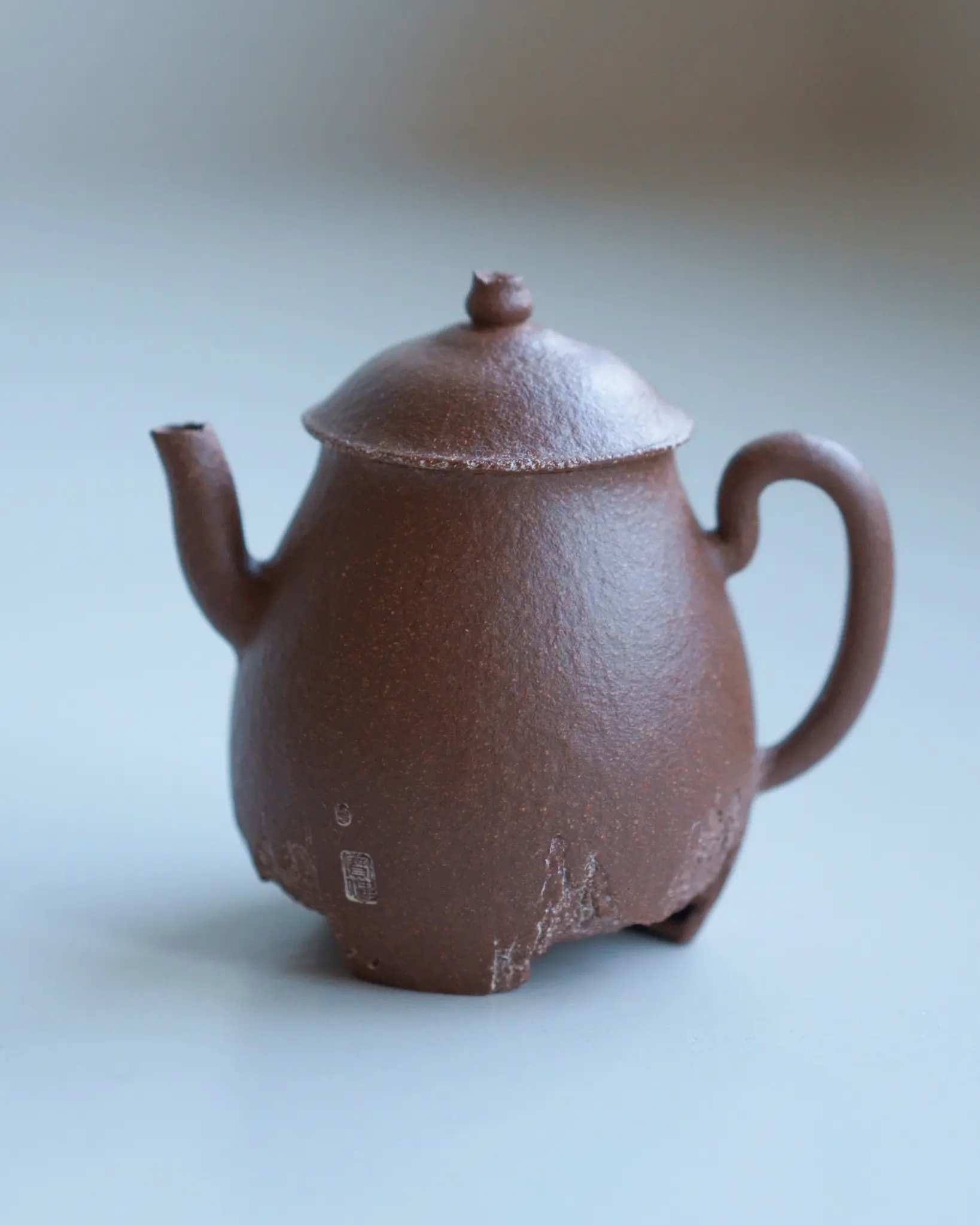
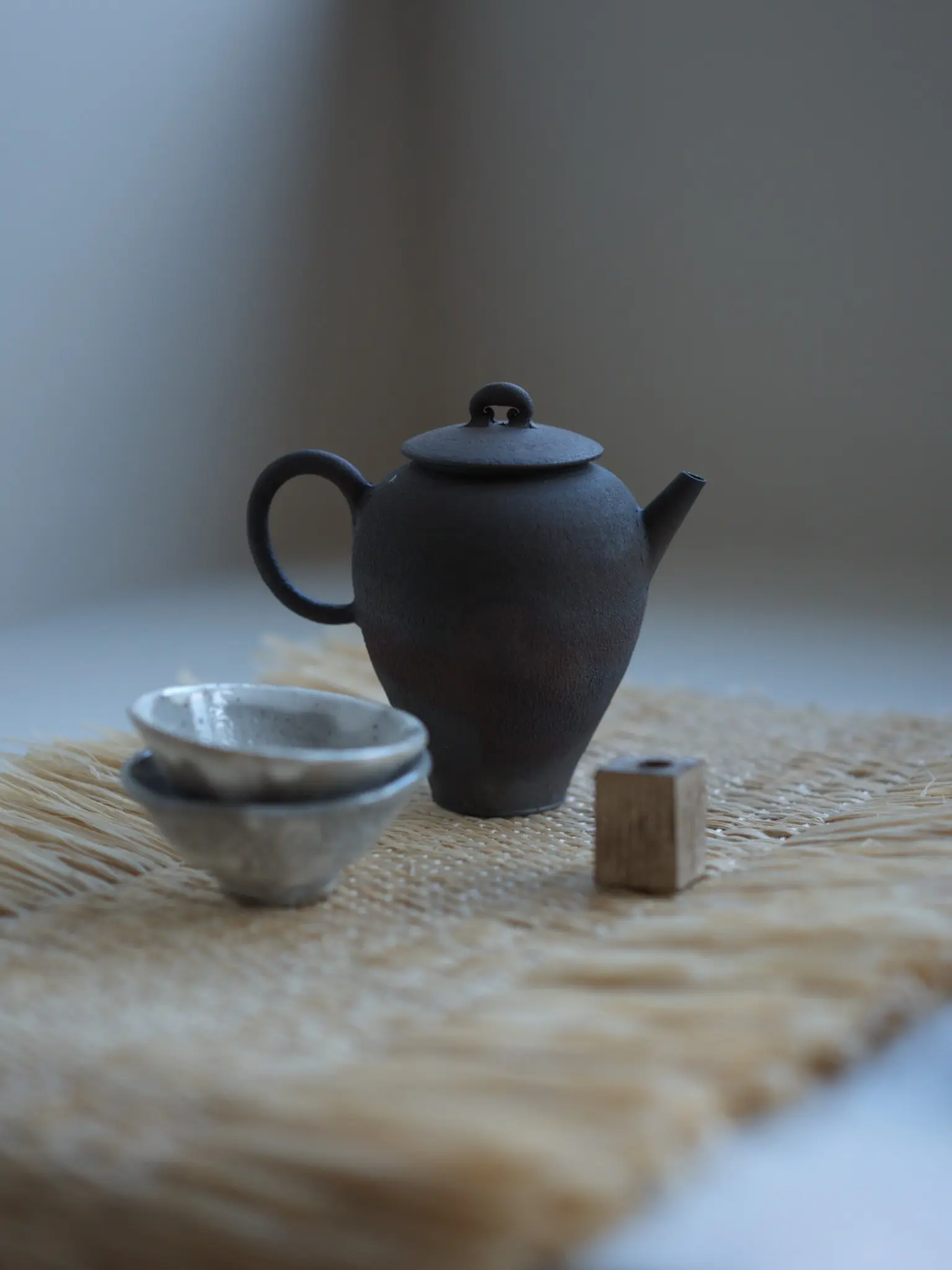
Ge Baojian was born in Qingdao, Shandong Province, China, in 1982. In 2001, he moved to Suzhou to study Environmental Art Design and subsequently worked in photography and related fields. He began working systematically in ceramics in 2015 and, from 2017 onwards, focused primarily on zisha teapots and teaware. In 2025, he relocated from Suzhou to Izu, Japan, where he continues his practice.
Ge makes his teapots from zisha clay from Yixing, China. Rather than using the paddling and slab-building techniques commonly associated with traditional Yixing teapots, however, he throws his vessels on the potter’s wheel. With its relatively low plasticity and pronounced granular texture, zisha is not an easy clay to throw. Controlling the material as it rotates, maintaining an even wall thickness and achieving a precise relationship between the body, spout, handle and lid all require years of practice and careful judgement. The rotational force of wheel-throwing also gives his work its fluid, full-bodied and quietly dynamic contours.
Ge’s teapots feel light yet stable in the hand. They pour smoothly, and the flow stops cleanly. More importantly, the tea brewed in them often has a remarkably satisfying taste and mouthfeel. The unglazed zisha body, the carefully judged thickness of the walls and the relationship between the interior volume and the rhythm of the pour allow the tea’s aroma, temperature and texture to emerge in a balanced way. For the tea drinker, this quality is not abstract: it can be felt directly in every pour, every interval of waiting and every sip.
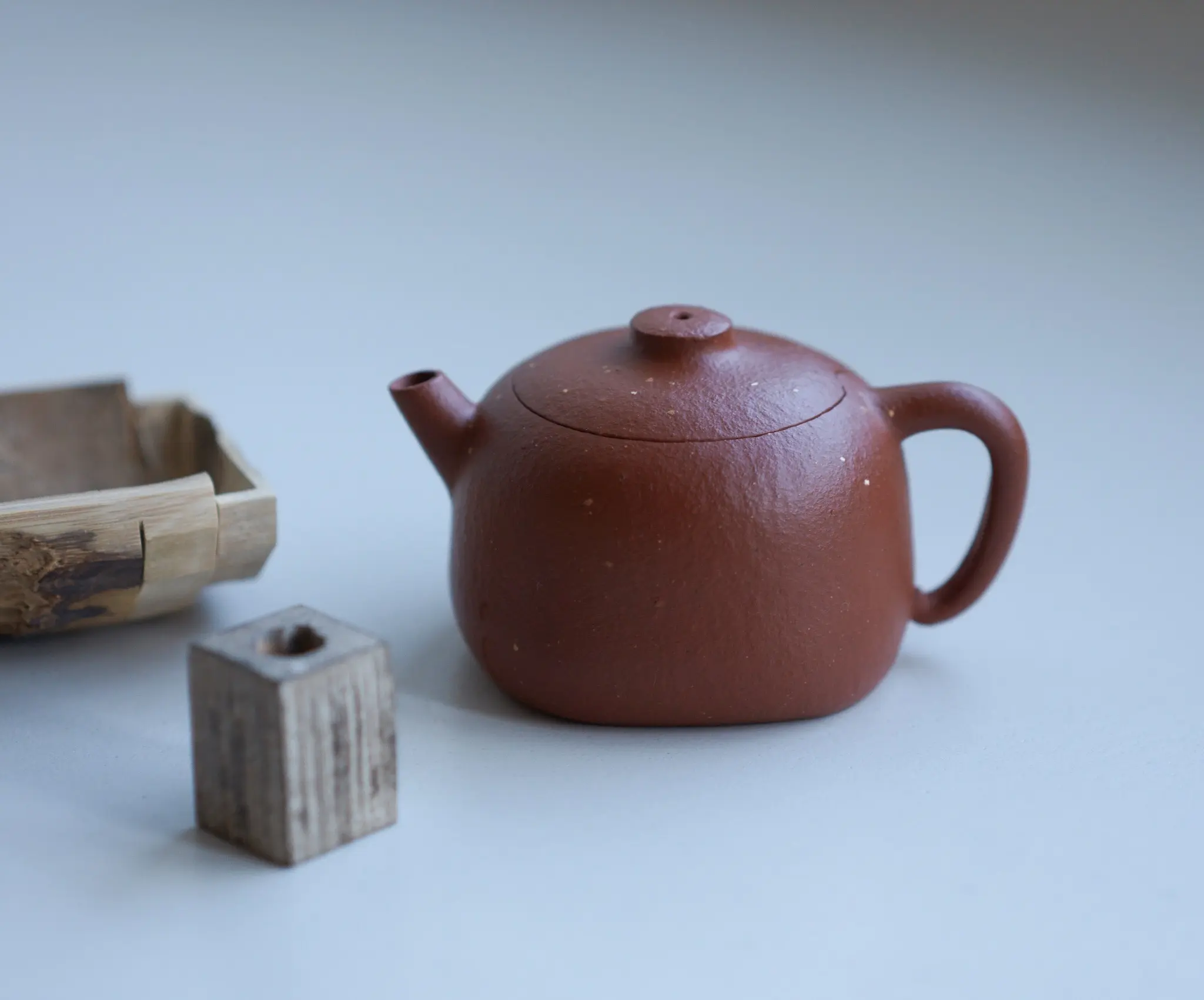
Upon this rigorous functional foundation, Ge has developed his most distinctive body of work: the Weathering series. This visual language first arose from an accident during the making process. While cutting back a thicker section of clay at the base of a teapot, he noticed that the exposed cross-section resembled layers of rock eroded by wind and water. Marks that would ordinarily have been smoothed away and concealed were instead preserved, gradually becoming an integral part of his creative method. He does not deliberately manufacture damage; rather, within a mature and disciplined process, he leaves room for the material’s own contingencies.
Two opposing forces are always present in his work. The rotation of the wheel tends towards wholeness, continuity and the circle; the cuts of Weathering interrupt that circular order, leaving areas that are rough, flaked and asymmetrical. One force constructs the form, while the other erodes it. The body of the teapot thus recalls rocks, landforms and the landscapes of Chinese ink painting: scenery enters the very volume and texture of the object. A teapot becomes a landscape that can be held in the hand.
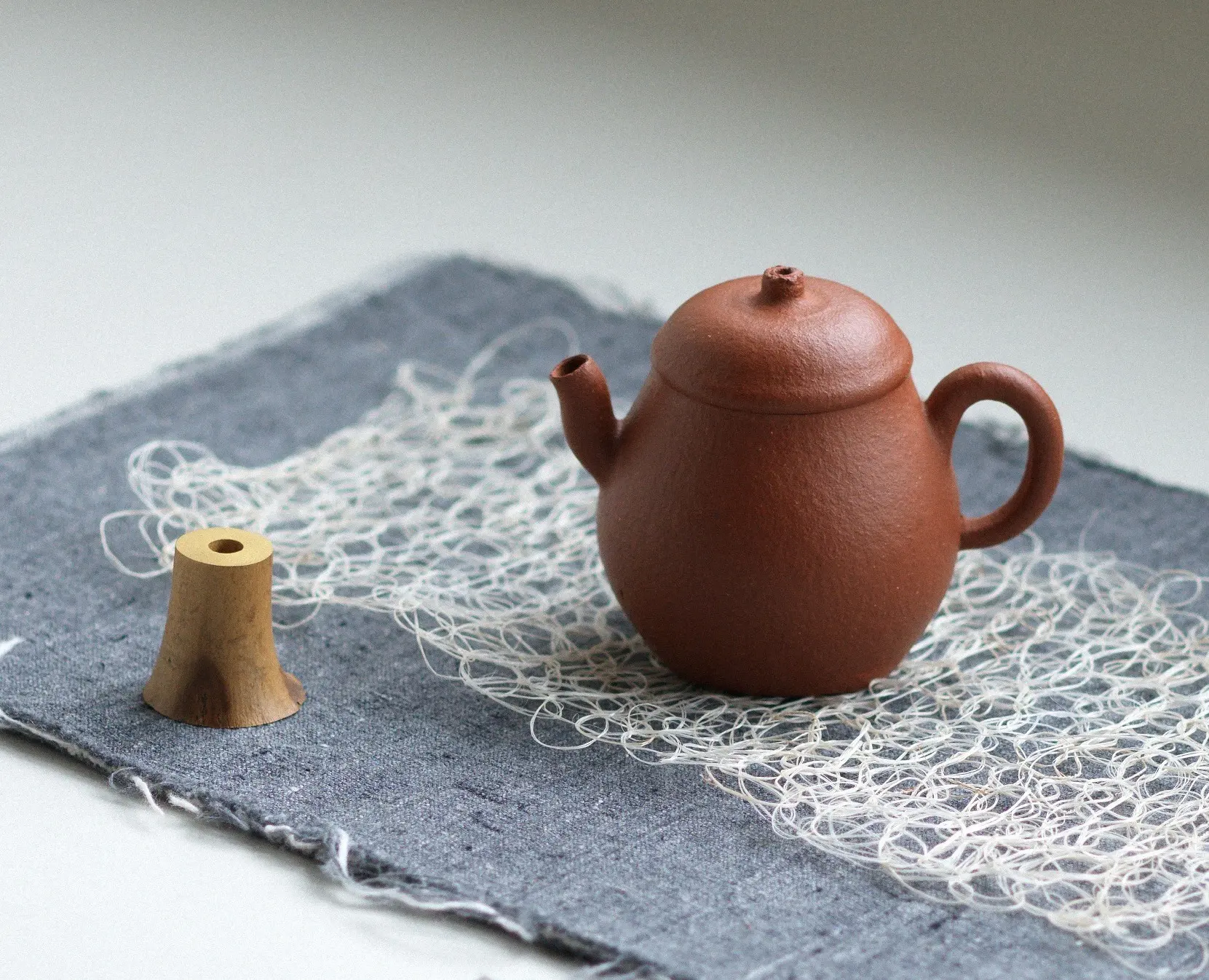
Ge also deliberately unsettles the formal composure traditionally associated with zisha teapots. Some pieces appear to tilt slightly, as though caught at the moment just before losing their balance. In fact, their centres of gravity are precisely calibrated, and the teapots remain entirely functional. Balance need not arise from absolute symmetry; it can also emerge from the exact counterpoise of several asymmetrical
parts. His work does not use regularity as proof of craftsmanship. Instead, it establishes another kind of stability within the appearance of instability.
His miniature teapots reduce the tea setting to one person, one pot and one cup. Their significance lies not merely in being small and finely made, but in reaffirming that small interval of private time that remains one’s own. Ge has neither departed from the tradition of zisha nor repeated its established forms. Instead, he returns it to the most direct criteria: Does the teapot feel natural in the hand? Does it pour comfortably? Does the tea brewed in it taste good? And would someone wish to live with it every day?
02Kajihara Yasumoto
Ceramics
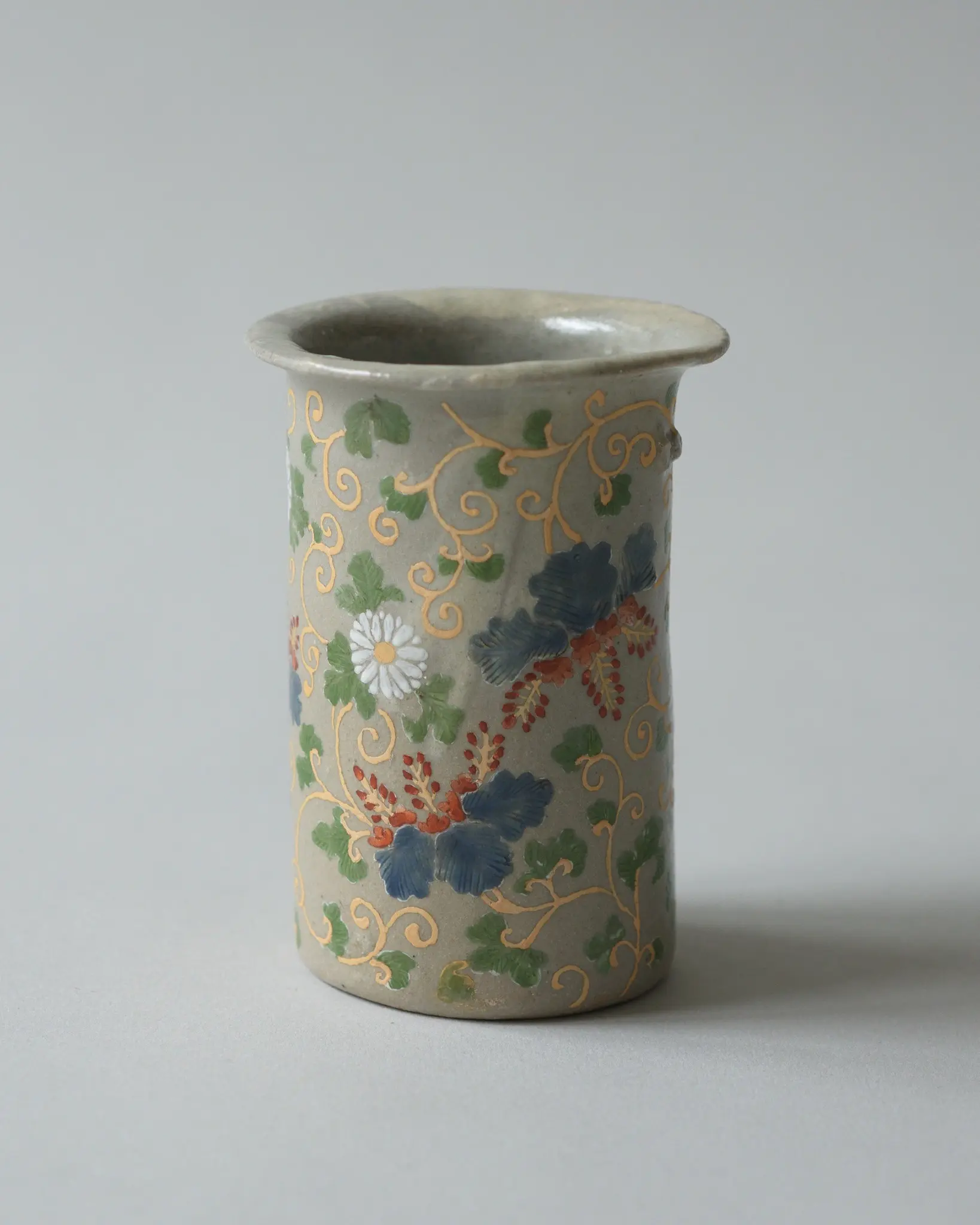
Kajihara Yasumoto was born in Imari, Saga Prefecture, Japan, in 1962. After graduating from the Department of Design at Arita Technical High School in 1980, he entered the field of ceramics. He trained at the Taikō Sannomaru Kiln and later studied under Daimaru Hokuho, learning to make utensils for sencha. Kajihara established himself independently in Karatsu in 1995 and completed an anagama kiln in 1997. Since then, he has continually investigated historic kiln sites, geology and ceramic materials across Japan, Korea and China, becoming a significant figure in contemporary Karatsu ceramics as both an artist and a researcher.
Kajihara’s practice begins with an inquiry into Ko-Karatsu, or early Karatsu ware. When examining an old ceramic object, he is concerned not only with the colours and mottled surfaces that have emerged over centuries, but with how the object first came into being: from which stratum of rock its materials were taken, which plant ashes formed its glaze, how its kiln was constructed and how the flames acted upon its surface. To answer these questions, he studies historic kiln sites and excavated sherds, gathers sandstone, shale and other rocks, then crushes and levigates them to create clay bodies. He formulates his own glazes, constructs his kilns and carries out the firings himself. Rather than imitating the appearance that old ceramics have acquired today, he re-establishes, in the present, the conditions from which they were originally born.
This approach also determines the distinctive beauty of Kajihara’s work. The subtle variations of colour across the surface are not produced through artificial ageing or added decoration, but through the interaction of rock, ash glaze and kiln fire. The body may appear as dense and solid as stone, or reveal grains of sand and minute fissures. The glaze moves with the flames, shifting between milky white, grey-green and brown-black. Each object resembles a piece of land transformed into a new state through crushing, water, shaping and fire, carrying within it a specific geological and firing history.
Kajihara does not regard tradition as a set of answers waiting to be repeated. He questions material formulas and firing methods that have come to be accepted as common knowledge, then tests them one by one through the act of making. His research in Korea and China has also allowed him to place Karatsu within the broader history of East Asian ceramics. Materials, techniques and aesthetic ideas have always travelled across the sea; local traditions themselves were formed through continuous exchange and transformation.
Some of the works in this exhibition were created collaboratively by Kajihara Yasumoto and the Arita ceramic painter Miwako Murakami. Murakami is a First-Class Certified Skilled Worker in Ceramic Decoration and a recognised Traditional Craftsperson in Imari–Arita Ware, accomplished in both sometsuke underglaze blue and overglaze enamelling. With expansive, lively brushwork, she paints classical patterns, plants, flowers and imagery drawn from folk painting upon Kajihara’s vessels. Karatsu and Arita—traditions that have developed over four centuries along different paths of material, technique and aesthetics—are thus brought together anew within a single object.
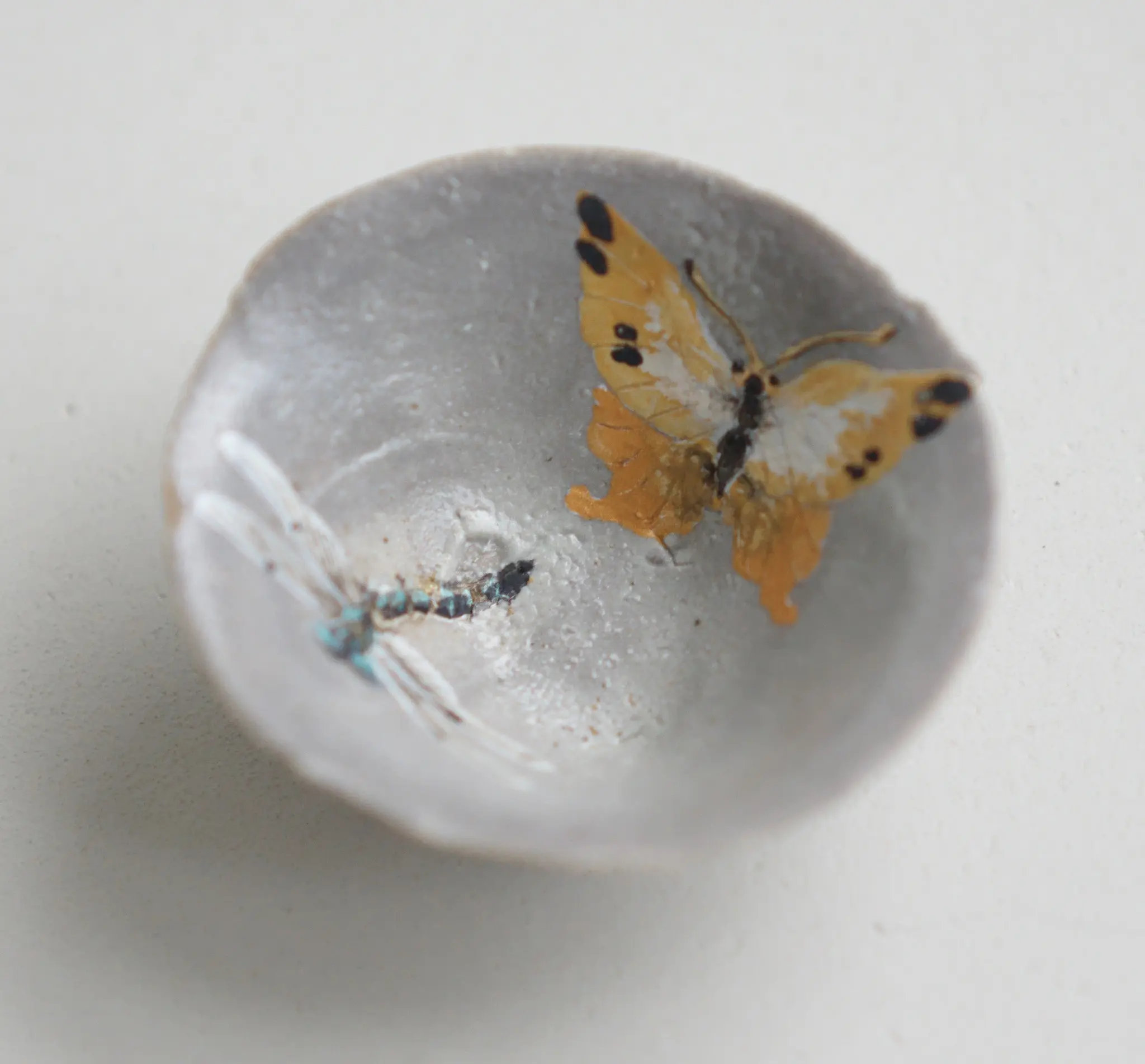
Karatsu and Arita are geographically close, yet represent two distinct traditions within Hizen ceramics: one is a stoneware culture shaped by rock, ash glaze and kiln fire; the other is a porcelain culture distinguished by intricate painted decoration. Their collaboration crosses established classifications of material, technique and history, allowing a single object to contain both roughness and refinement, chance and control. Once placed within a tea setting, these works return to their most direct purpose: to be lifted by the hand and filled with tea, continuing to change between being viewed and being used.
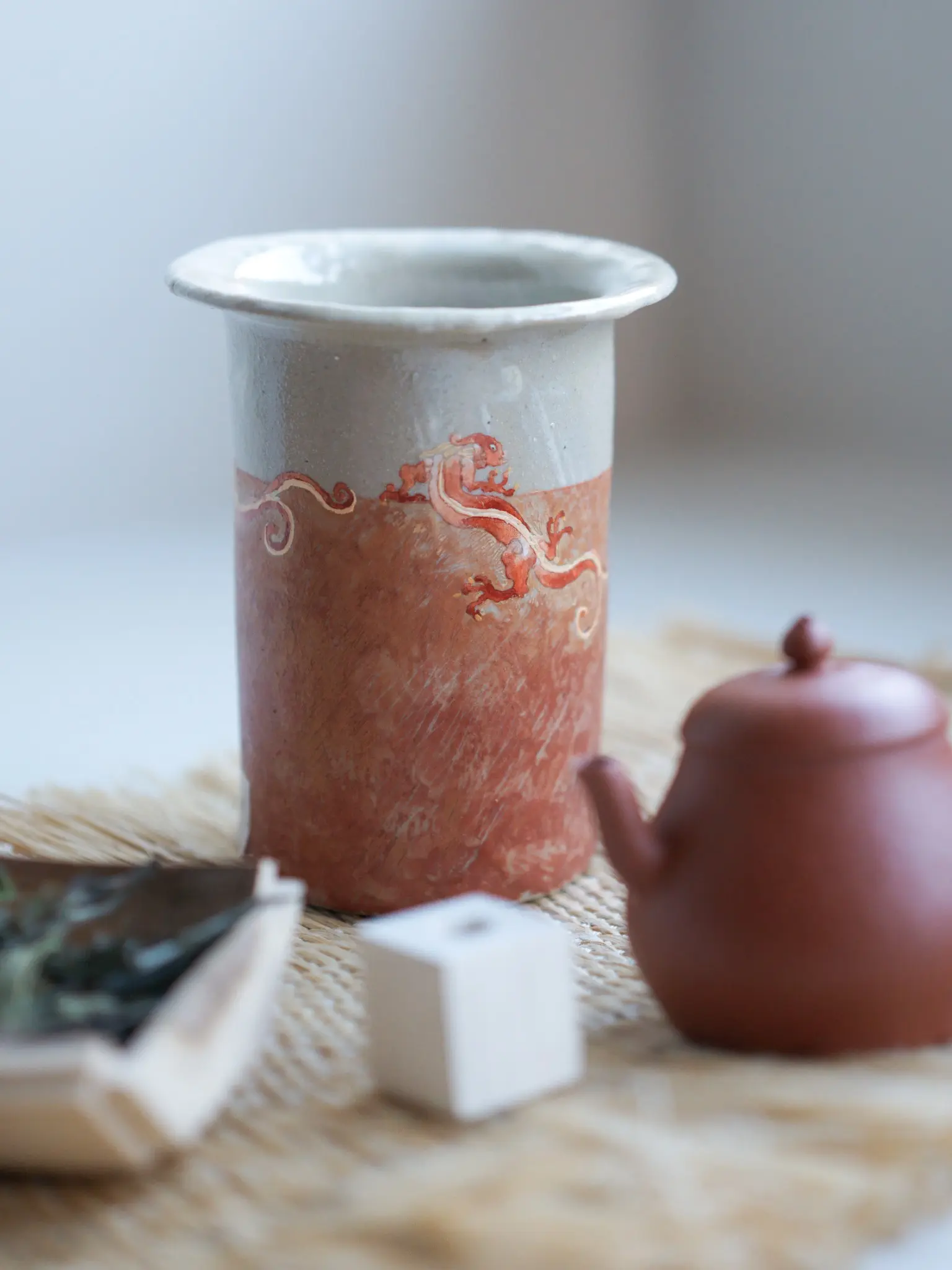
03Kang Young-jun
Ceramics
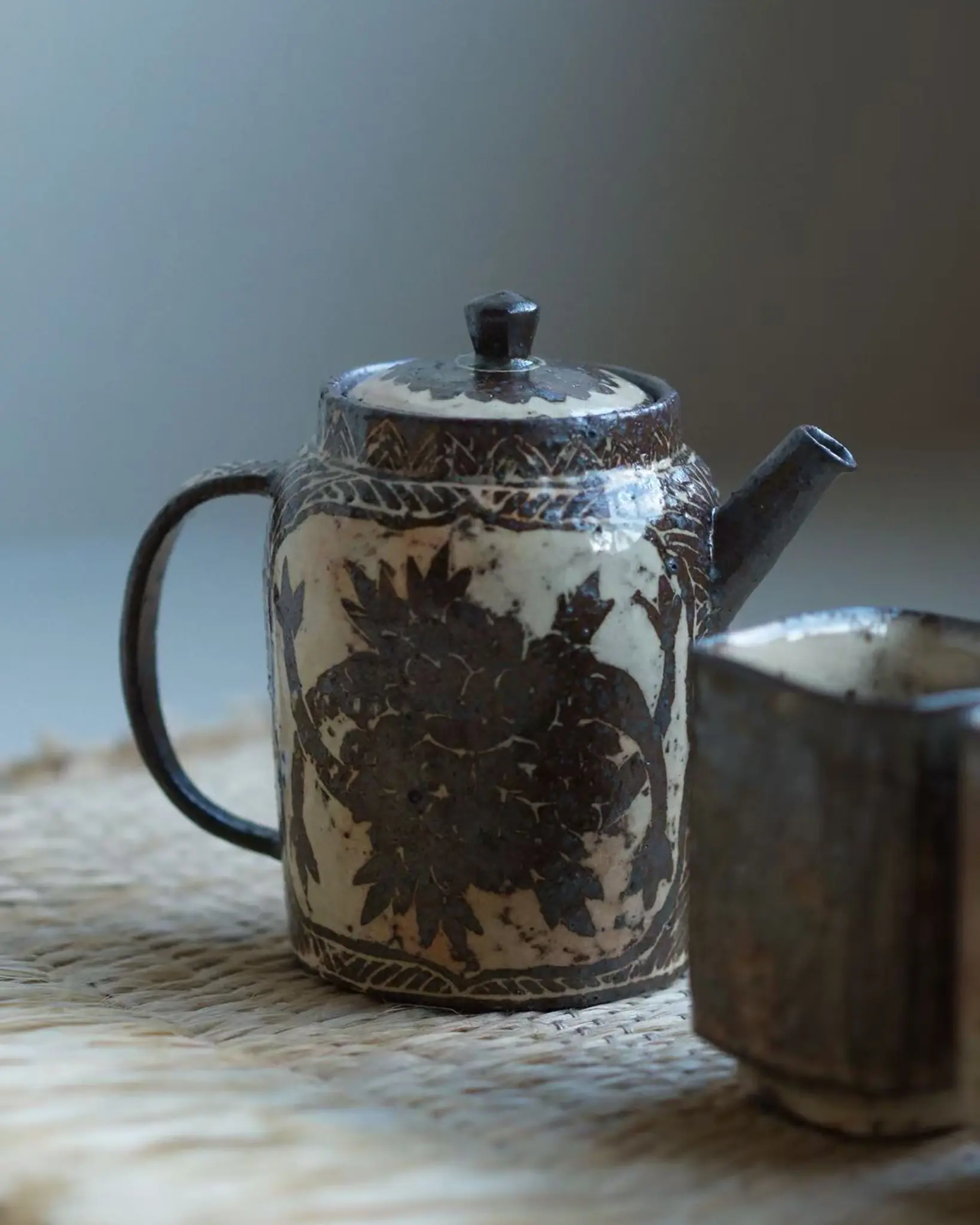
Kang Young-jun was born in Busan, South Korea, in 1975. He graduated from the Department of Industrial Crafts at Kyungil University in 2001 and established Danjangyo in Miryang, South Gyeongsang Province, in 2005. He continues to live and work there today. Drawing upon the tradition of buncheong ware, he creates teapots, cups, tea bowls and other vessels for preparing and serving tea. The material language of traditional buncheong, the naturally relaxed forms of Joseon-dynasty ceramics and his own long experience of drinking tea and living with vessels together form the starting point of his practice.
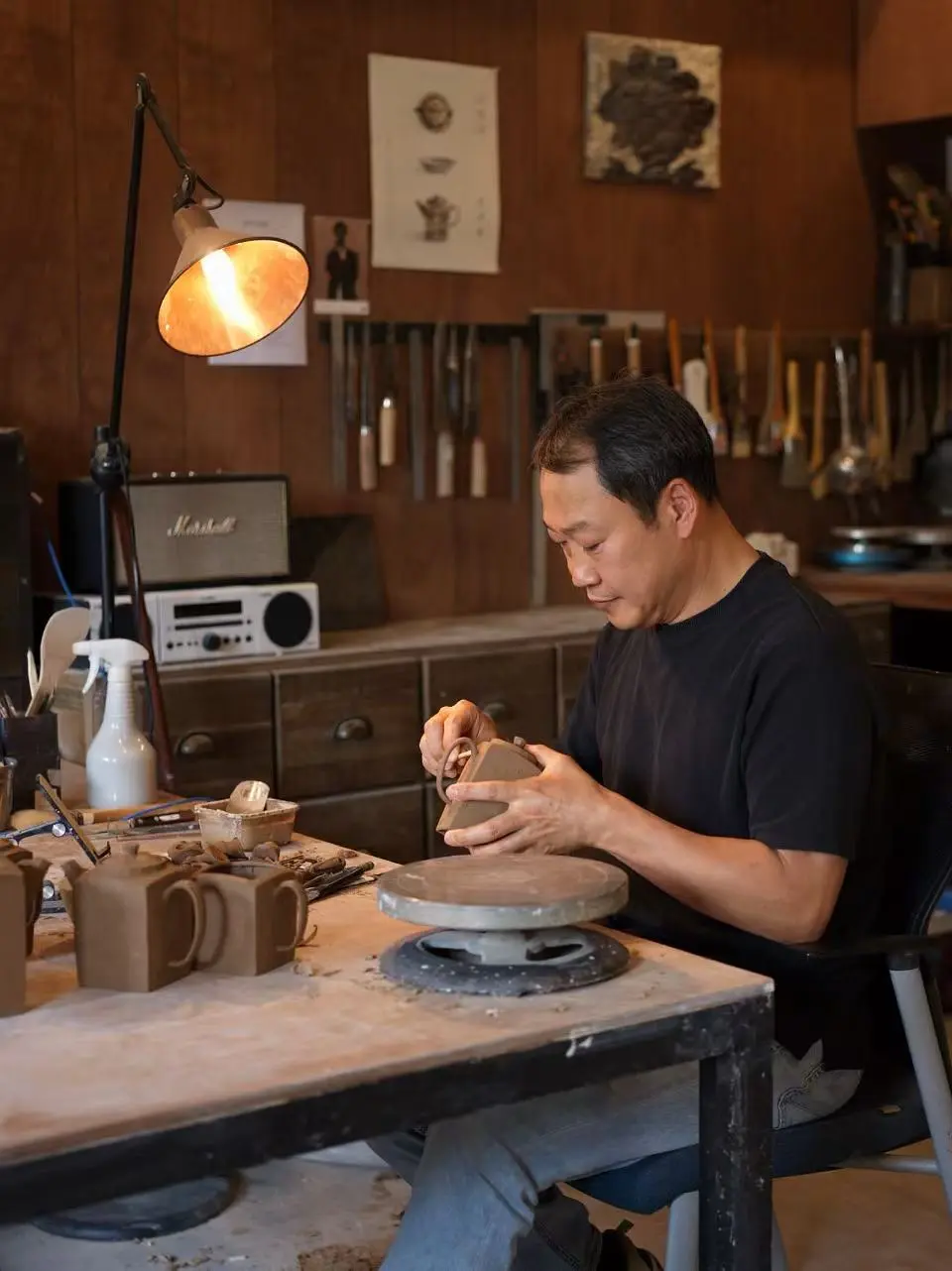
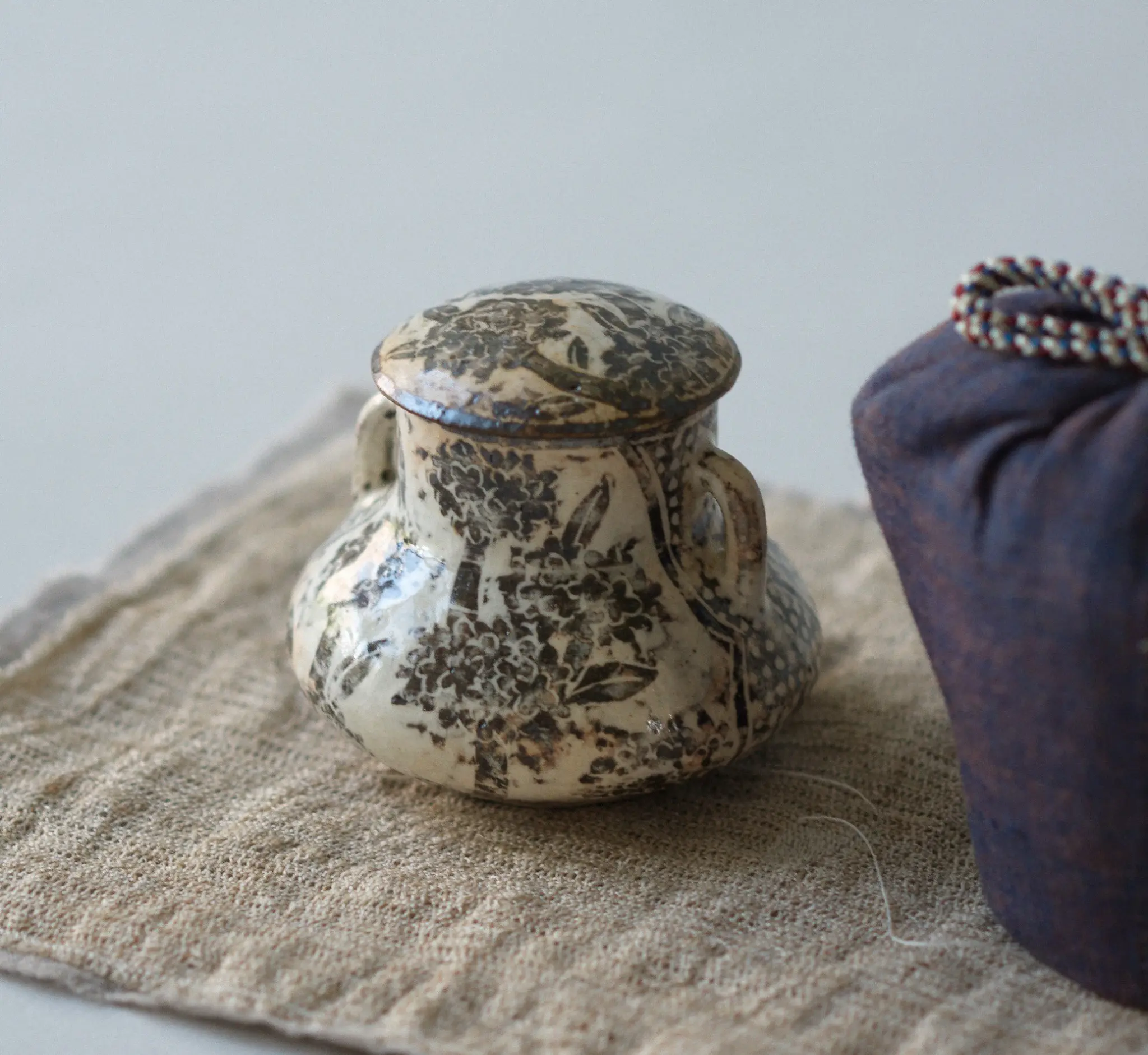
Buncheong ware is one of the most representative ceramic traditions of the early Joseon dynasty. It is typically formed from a grey-brown clay body and covered with white slip. Decoration is then created through techniques such as incision and sgraffito before the vessel is glazed and fired. Kang often uses a fine pointed tool to draw into the white slip, then removes sections of the surface to reveal the darker clay body beneath. The pattern is not applied to the vessel afterwards; through the acts of incising and scraping, it enters the very skin of the object.
The flowers, leaves, birds and geometric motifs in Kang’s work are largely derived from historic Korean ceramics, but he does not pursue antiquarian reproduction. He removes extraneous detail and redraws the motifs with concise, slightly awkward lines. Flowers vary in size, and branches and leaves are not necessarily symmetrical. It is precisely these pauses, shifts and imperfections that preserve the speed and emotion of the hand, as though the patterns had grown naturally during the making process.
This sense of naturalness does not imply casualness. The body of a teapot may lean slightly, while its spout, handle and lid need not conform to an absolutely regular axis; nevertheless, every component must counterbalance the others. The true difficulty lies in relaxing control after technique has been mastered, allowing the vessel to remain alive while retaining an appropriate centre of gravity, a comfortable grip and a precise pour.
Kang is particularly fond of small teapots. Their volume is limited, yet they must accommodate form, structure, pattern, glaze and function; every proportion therefore becomes especially visible. Their significance lies not merely in being small, delicate or charming. When a teapot is reduced to a scale intended for one or two people, the making of tea moves away from formal ritual and returns to an intimate, everyday form of companionship. The pot is cupped in both hands, and the fingers repeatedly encounter the incised patterns across its surface. The motifs are no longer perceived by the eye alone: they are also read by the body through lifting, turning and pouring.
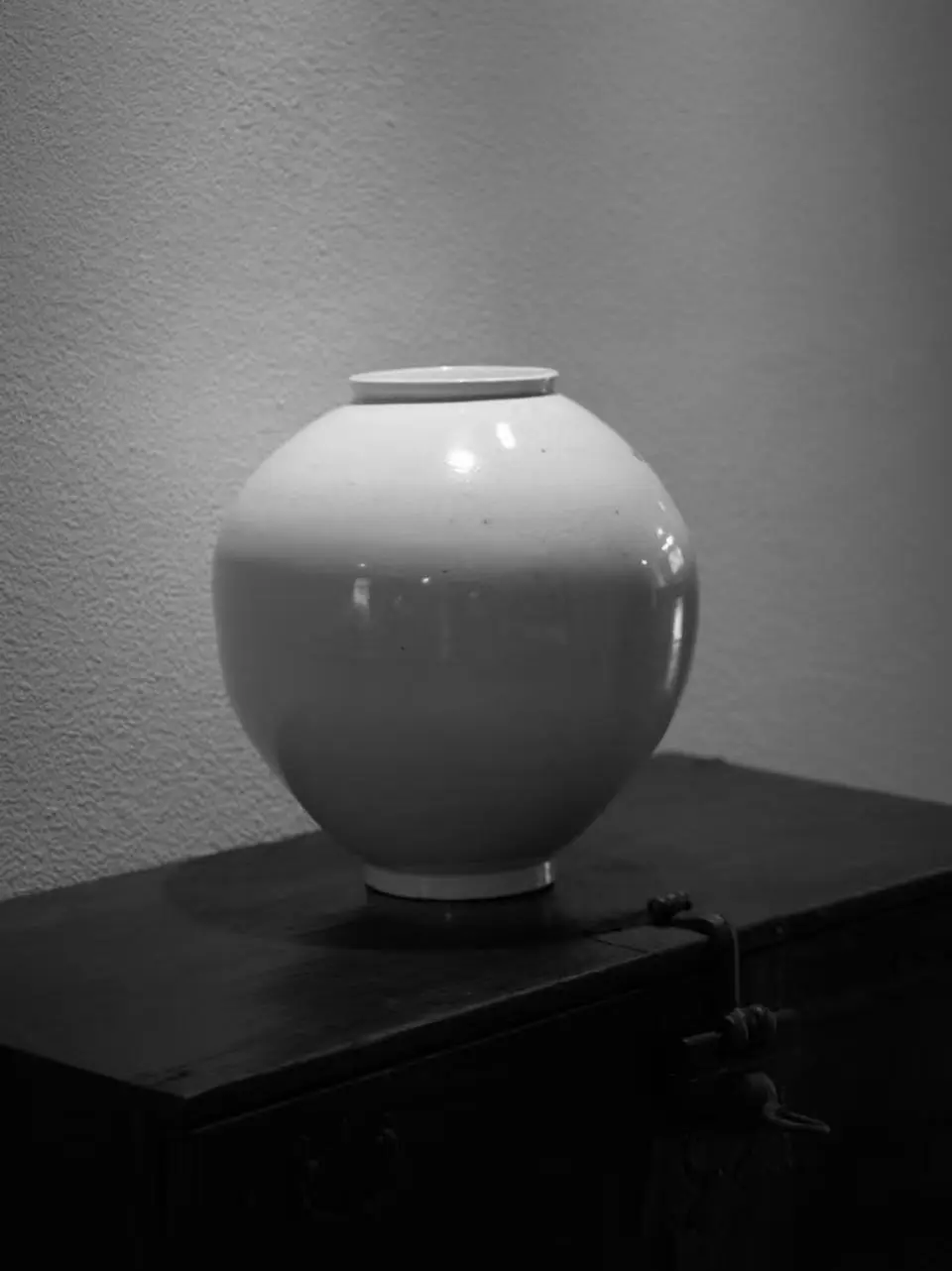
This exhibition will also present a moon jar. Originating in the large white porcelain jars of the late Joseon dynasty, the moon jar is full and rounded like the moon, yet is rarely a perfectly regular sphere. Traditionally, its upper and lower halves are thrown separately and then joined; gravity, shrinkage and kiln fire introduce subtle shifts into its outline. Kang’s moon jar continues this asymmetrical equilibrium. Unlike the small teapot, which can be enclosed by both hands, the moon jar enters the surrounding space through its larger volume. The viewer must move around it to perceive the gradual changes in its contour. While the small teapot draws tea and the individual closer together, the moon jar establishes a quiet background for the tea setting.
Kang does not preserve the tradition of buncheong as a fixed style. Instead, he allows its ancient motifs to enter contemporary life. His work possesses both the simplicity of clay and white slip and a lightness and humour reminiscent of a child’s drawing. Rather than creating distance through perfect symmetry or dazzling displays of technique, his vessels invite us to lift them, use them and gradually become familiar with them over the course of a cup of tea. Tea happens wherever object and hand meet; for Kang, it is through precisely this contact that tradition regains a contemporary life.
04Kikuchi Katsu
Ceramics
Kikuchi Katsu was born in Tokyo in 1972. After graduating from the Faculty of Economics at Aoyama Gakuin University in 1996, he moved to Spain and encountered ceramics at a local art school. It was while living far from Japan that he came to see the beauty of historic Japanese ceramics anew and decided to pursue pottery. After returning to Japan in 2001, he studied in Karatsu under Nakagawa Jinenbo. In 2008, he left Karatsu and built a noborigama climbing kiln on the Kunisaki Peninsula in Oita Prefecture, establishing his studio, Tou Kasho.
Kunisaki is not a renowned centre of ceramic production. Its local clay has a high shrinkage rate and is prone to warping and cracking. Kikuchi blends it with locally sourced sand and conducts repeated test firings. He works primarily with simple stone-and-ash glazes, yet variations in the clay, the position of each piece within the kiln and the movement of the flames produce markedly different colours. The grey-white, blue-green and brown-black tones that appear to have formed naturally across the surfaces are underpinned by years of meticulous observation.
Kikuchi does not begin by deciding upon a style and then demanding that the clay submit to it. Instead, he starts with the material, judging whether it is better suited to unglazed firing or kohiki, and whether it should become a tea bowl or a flower vessel. Although his work moves across the languages of Karatsu, Goryeo, buncheong, celadon and white porcelain, it is not an anthology of historic ceramic styles. What runs through it is his continuing inquiry into materials, use and the reasons earlier makers chose to make objects as they did.
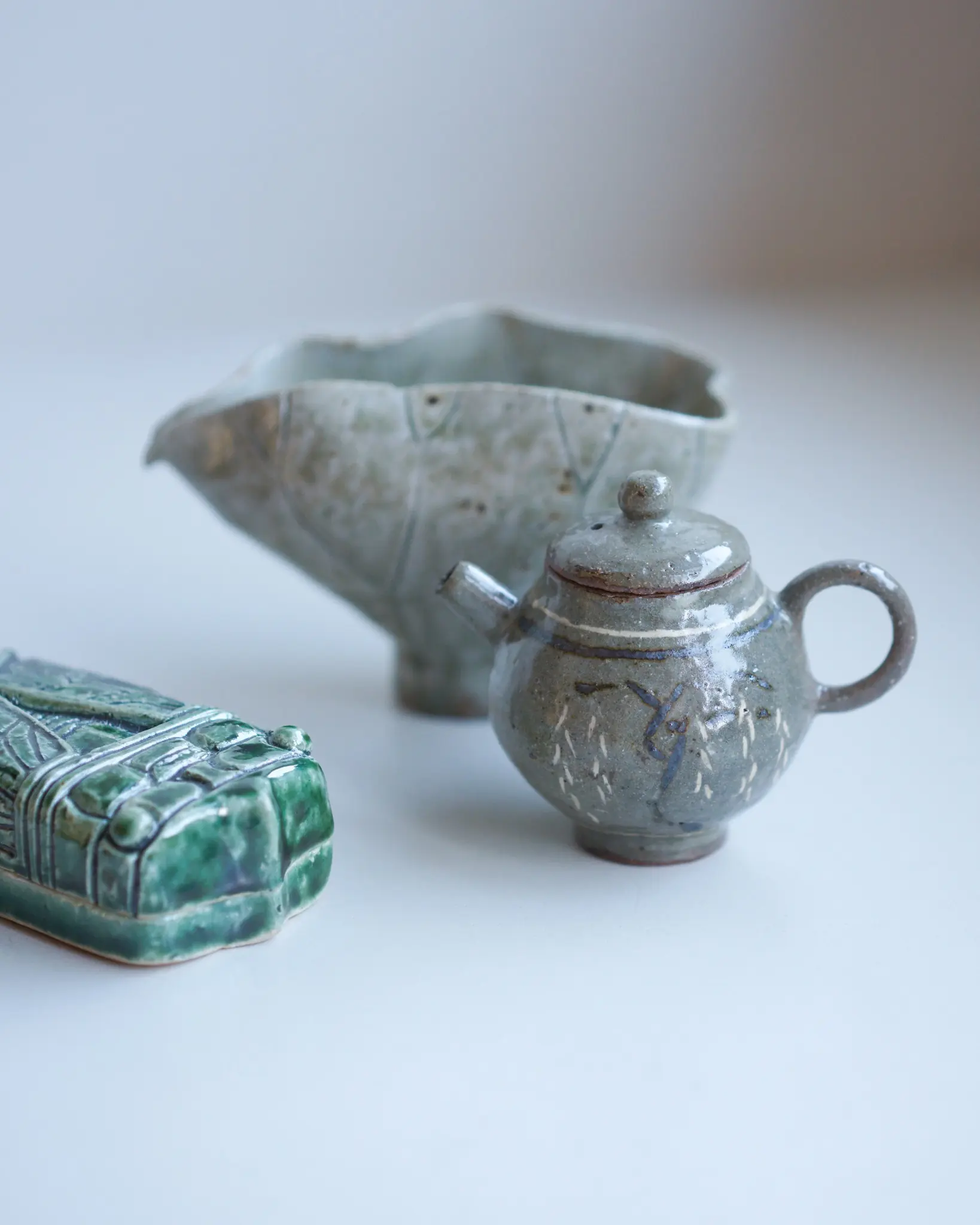
This exhibition is not centred exclusively on teaware. It also includes objects associated with calligraphy, dining and incense, as well as small ceramic works depicting the baku, cicadas and Bodhisattva Hands. The objects thus enter different gestures and sensory experiences, allowing tea drinking to connect naturally with writing, burning incense, eating and conversation.
Kikuchi draws from ancient imagery and the folk imagination, yet always finds a point of entry into the present. The “Cow’s Drool” motif on his tea bowls derives from a small-pattern design created by the Edo-period writer and artist Santō Kyōden, retaining a sense of wit within its historical character. The baku is a mythical creature believed to devour nightmares, while the cicada is associated with the idea of shedding one’s earthly form and ascending to immortality. Kikuchi once recorded that a friend took one of his cicada pieces to Mexico and used it at a tea gathering during the Day of the Dead. Removed from its original context, the object did not lose its meaning. Instead, it found a new place within another culture concerned with death, memory and rebirth. The uses of an object continue to unfold through the imagination of those who live with it.
Bodhisattva Hands is a form Kikuchi has developed over many years. In 2022, he began making the hands of the Thousand-Armed Kannon and made a vow to complete one thousand of them. Each hand requires considerable time, while his other work must continue alongside the project; he has sometimes wondered whether it can ever be completed. Yet within a finite life, if one has the opportunity to undertake such a challenge, one should begin. The first group of more than one hundred hands has now been completed. Repetition here is not reproduction, but a practice born of a vow. With every hand, the gesture, the clay and the maker’s state at that particular moment are subtly different, while an extended duration is gradually stored within the work.
Seen through the lens of senchadō, none of these works lies outside the realm of tea. Japanese sencha culture developed among the literati, for whom tea existed alongside calligraphy and painting, poetry, flower arranging, incense and food. The place where tea happens need not be composed solely of a teapot and cups: an inkstone, a water dropper, an incense burner or a vessel holding food may all take part.
Kikuchi takes Nendo Bishō—“Taking Up Clay, Smiling”—as the guiding thought of his practice: to respect the classical without being weighed down by it; to study materials deeply without allowing knowledge to replace feeling. The land of Kunisaki, ancient imagery and the everyday practices of calligraphy, incense, tea and food ultimately come together in the hands of those who use his vessels.
Baku | The Beast That Devours Nightmares
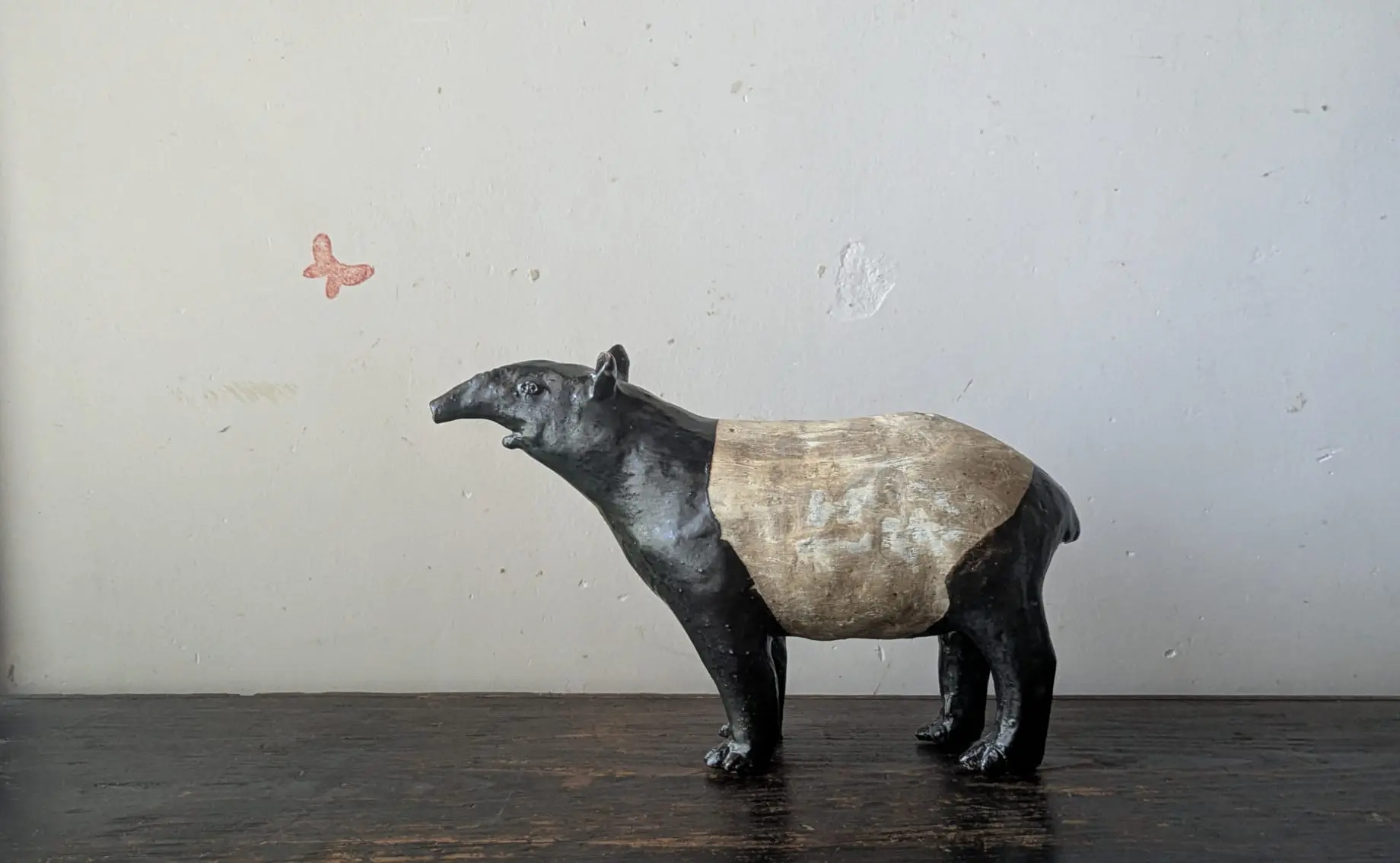
The baku is a mythical creature in East Asian folklore said to devour nightmares. Its image was once placed beside the pillow or upon everyday objects in the hope that it would watch over one’s sleep and prevent troubling dreams from returning.
The baku is also said to eat copper and iron. If it were to consume all of these materials, there would be no means left in the world to manufacture weapons. For this reason, the baku is also regarded as a symbol of peace.
Kikuchi Katsu’s baku do not possess the imposing bearing of sacred beasts. Their bodies are quiet and softly rounded, with even a touch of gentle humour. The appearance of two baku, one large and one small, also transforms the idea of “driving away nightmares” from a mysterious power into a form of companionship: when someone awakens from a dream, a silent creature is still there, keeping watch beside them.
A tea setting, too, can be a place where one temporarily withdraws from the outside world and turns inward. Placed within it, the baku need not serve any clearly defined function, yet it quietly alters the atmosphere of the space—before tea is poured and conversation begins, it first takes in those dreams that cannot be put into words.
Cicada | Casting Off the Mortal Form and Ascending to Immortality
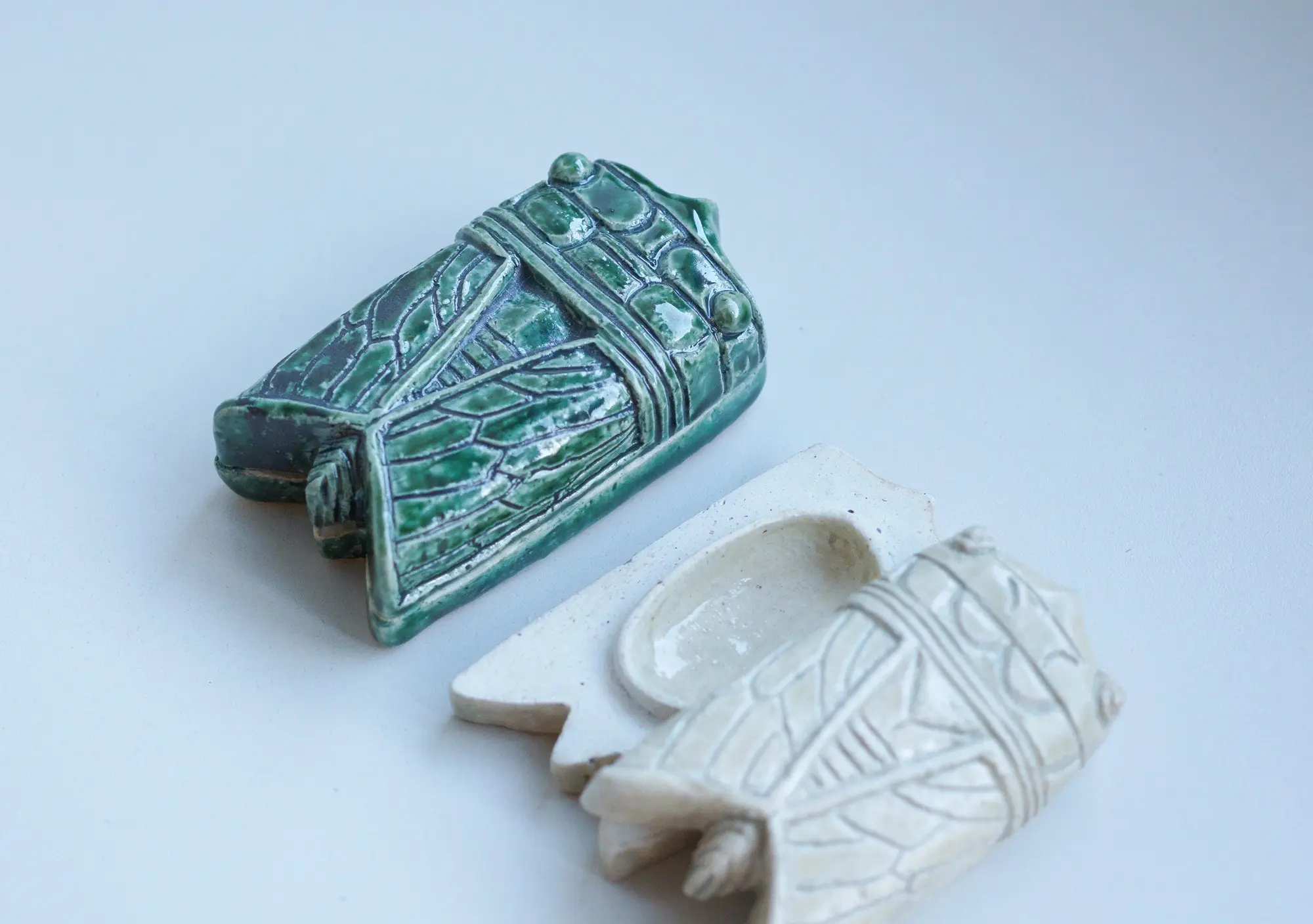
The cicada emerges from beneath the earth, sheds its former shell and lives briefly but resoundingly within the summer. In East Asian culture, it evokes both the brevity of life and the idea of shedding one’s form, undergoing transformation and ascending to immortality.
Kikuchi Katsu assigns no fixed purpose to his ceramic cicadas. They may become small presences within a tea setting, or be lifted, given to another person and carried into a different ritual. The artist once recorded that a friend used these cicadas at a tea gathering during Mexico’s Day of the Dead. When a Japanese image of transformation encountered a Mexican festival concerned with death, memory and reunion, the work acquired a new meaning that even its creator could not necessarily have determined in advance.
An object is not completed when the kiln fire goes out. It must still pass through human choice and use, continuing to change as it moves between different cultures and ways of life.
“Cow’s Drool” Pattern | Humour from the Edo Period
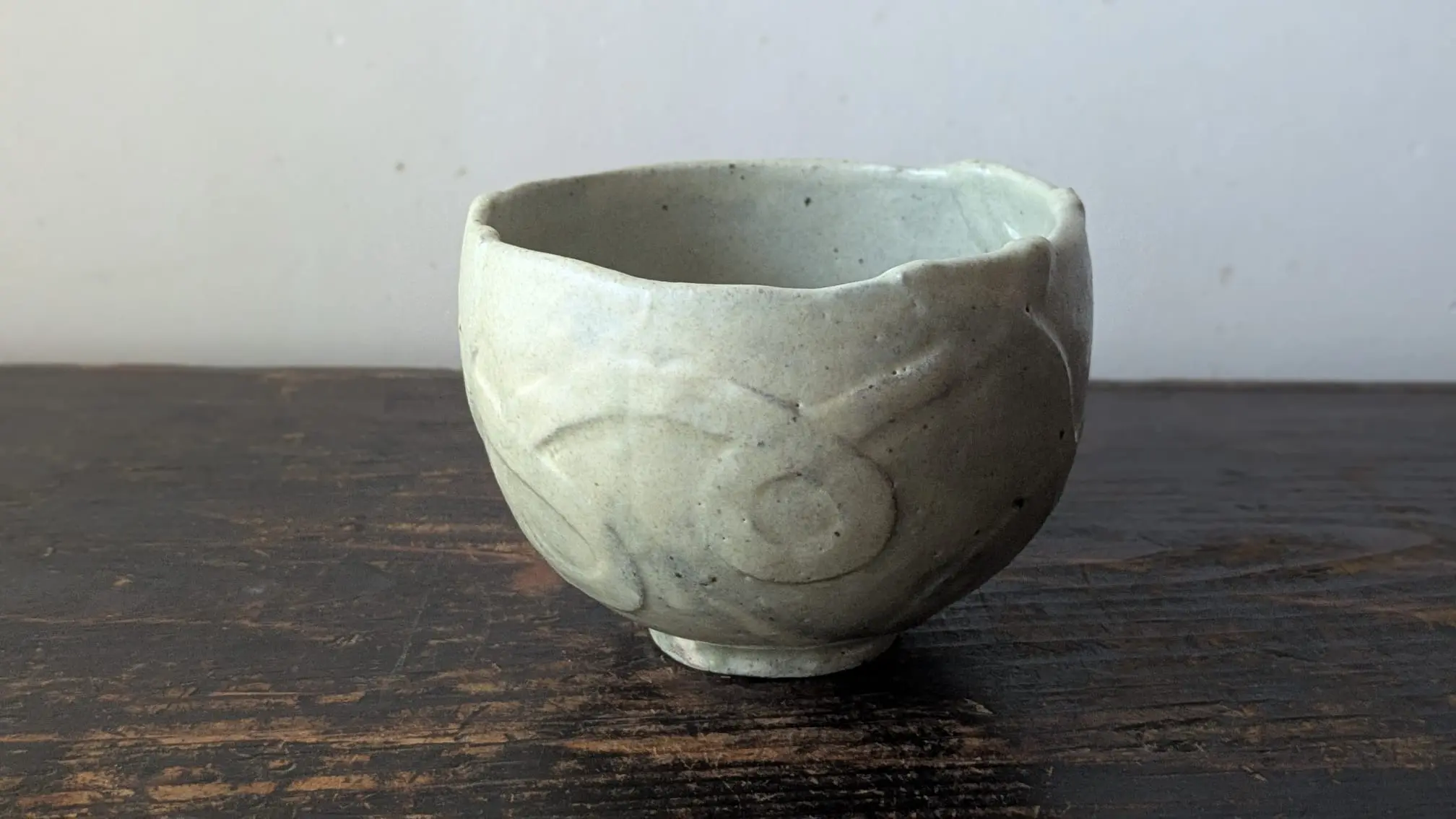
The “Cow’s Drool” pattern on this work originates in a small repeating motif devised by the Edo-period writer and artist Santō Kyōden. Its long, continuous lines were said to resemble strands of saliva hanging from a cow’s mouth. Kyōden also used the pattern to parody Dutch writing, which appeared indecipherable to many Japanese people at the time, bringing together everyday observation, imaginings of the foreign and playful experimentation with written forms.
Kikuchi Katsu transfers this motif, originally closer to the language of textiles and printed design, onto the surface of ceramics. Coarse, unrefined clay meets seemingly casual lines, allowing the work to retain a touch of humour alongside its historical character. It reminds us that tradition is not always solemn or inaccessible: Edo-period design could also be light-hearted, worldly and even mischievous.
What Kikuchi inherits is not only the forms of historic ceramics, but also the ability of earlier makers to observe everyday life, form unexpected associations and create humour from what they saw.
Bodhisattva Hands | A Vow of Compassion in a Thousand Hands
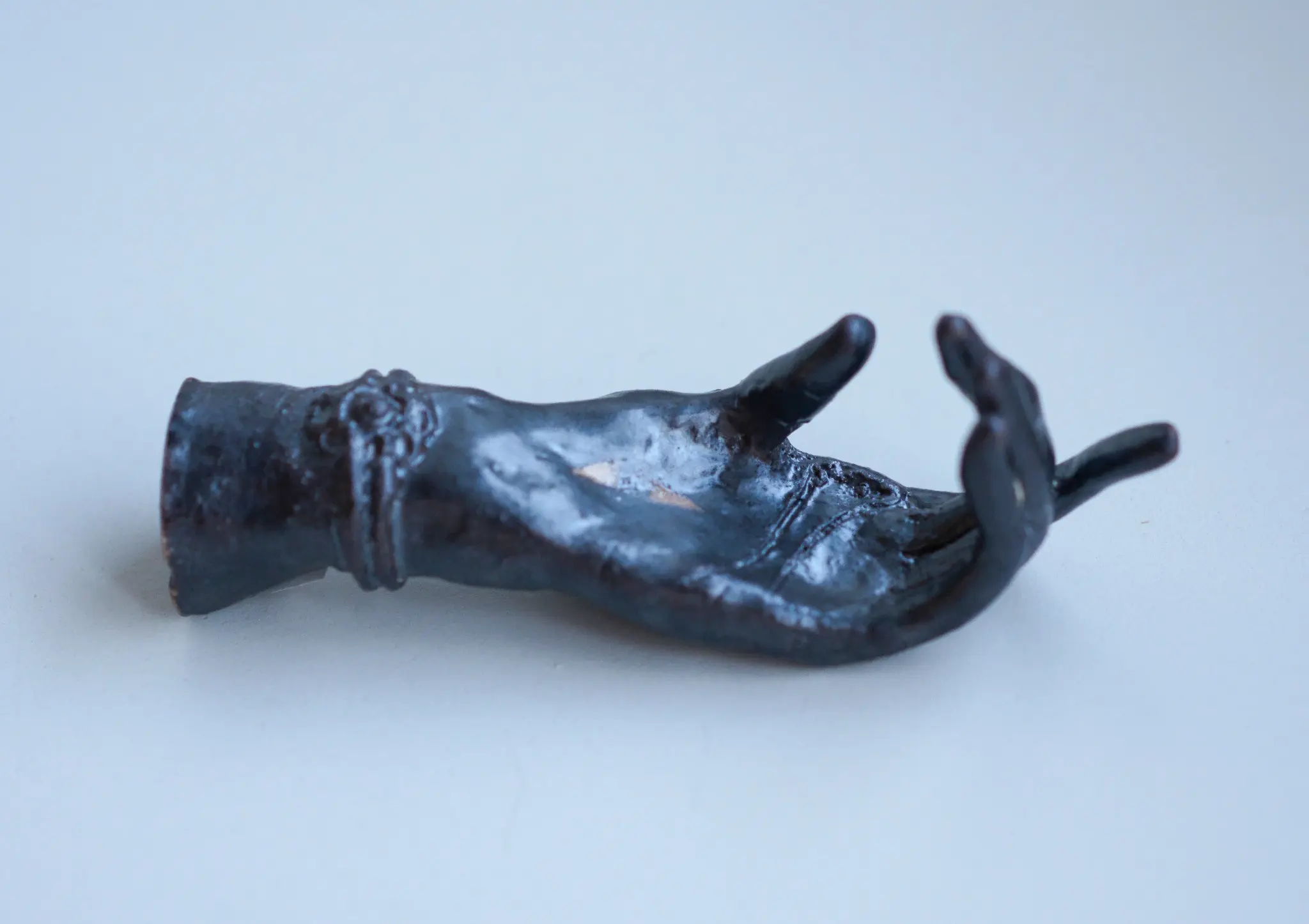
Kikuchi Katsu began making “Buddha Hands” approximately ten years ago. In 2022, he developed this practice further by sculpting the Bodhisattva Hands of the Thousand-Armed Kannon and making a long-term vow to himself: to complete one thousand hands.
A single hand already requires a considerable amount of time. While continuing to make teaware, calligraphy objects and other works, one thousand may seem an almost unreachable number. Yet Kikuchi believes that human life is finite, and if the opportunity to undertake such a challenge remains, one should begin. The first group of more than one hundred hands has now been completed.
These hands are not identical symbols reproduced from a mould. The gestures of the fingers, variations in the clay and traces left by the firing make each one subtly different. Repetition here is not a matter of productive efficiency, but a devotional practice born of a vow: with his own finite body, the maker shapes, time and again, a hand reaching towards another.
It remains unknown when the thousand hands will be completed. Perhaps what matters is not the final destination, but the time, encounters and awareness accumulated throughout the long process of making.
05Park Sung-Wook
Ceramics
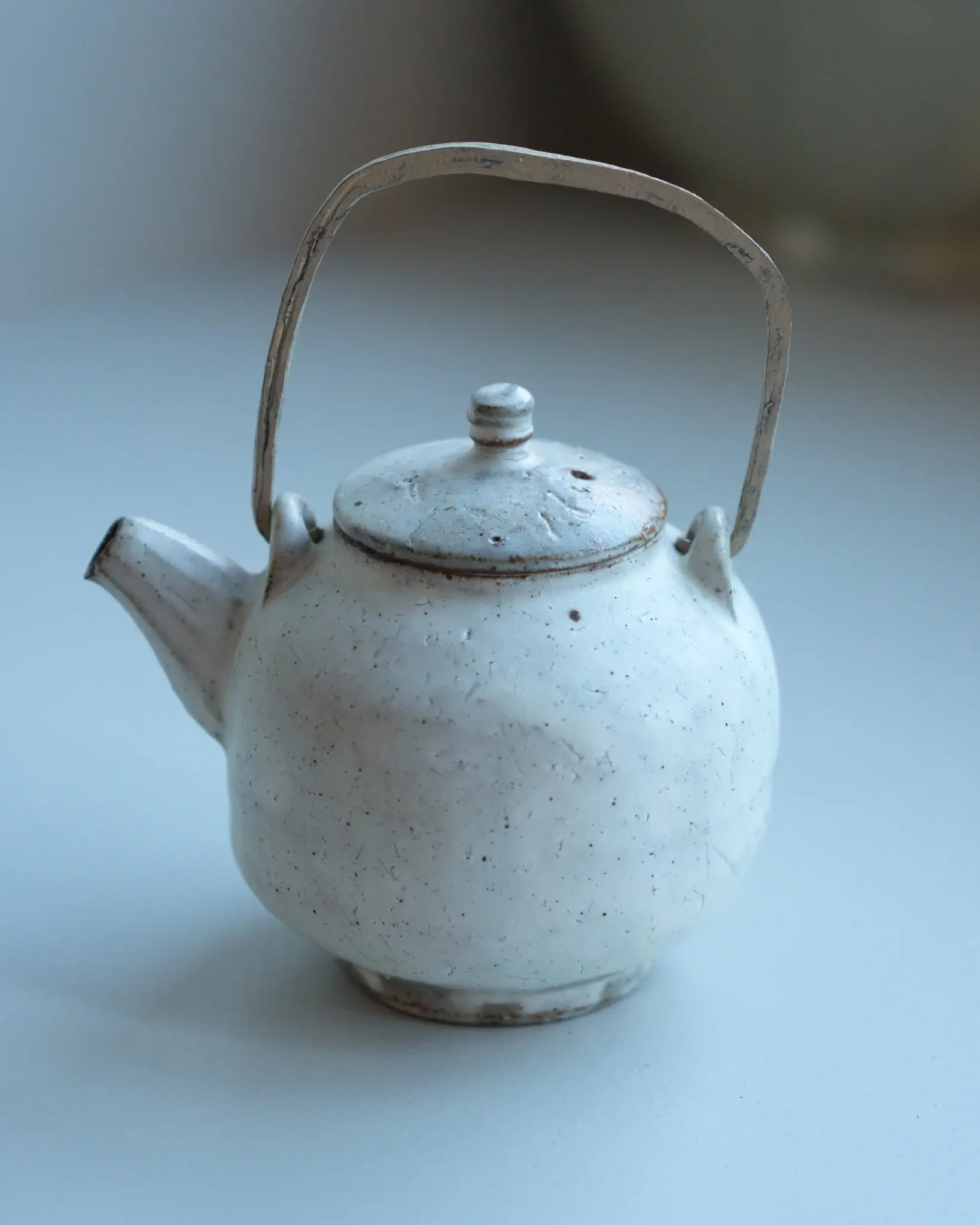
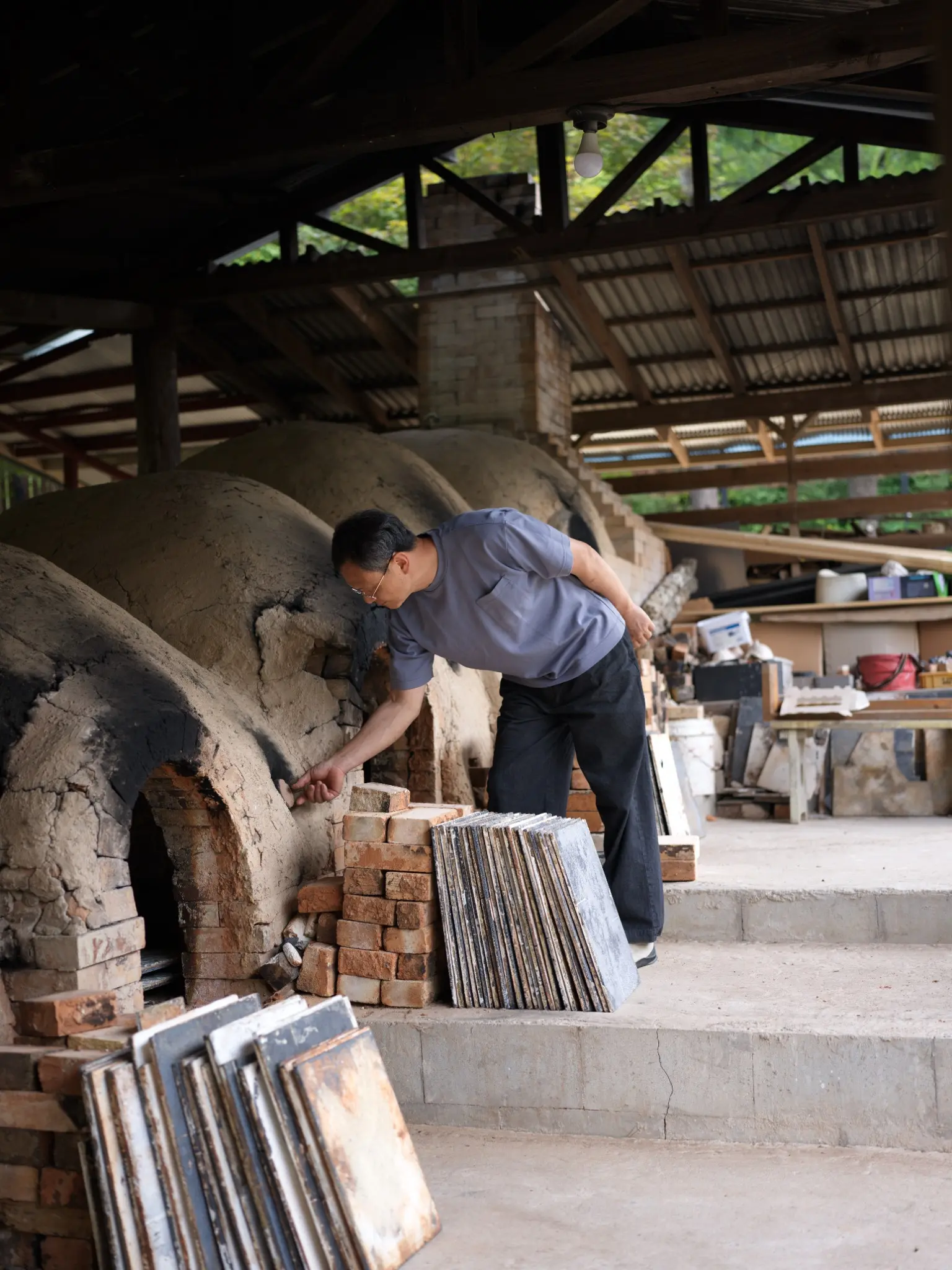
Park’s practice encompasses buncheong teaware, functional vessels and the Pyeon, or Fragment, series. Running throughout these bodies of work is deombeong, a technique associated with Korean buncheong ware. A fully formed vessel is immersed in white slip and then quickly withdrawn. The slip flows and gathers across its surface, sometimes exposing the darker clay body and sometimes developing minute cracks during the wood firing. The angle at which the vessel enters and leaves the slip, the speed of the movement and the length of immersion all become part of its final expression.
Although the action appears direct and simple, it leaves little room for later correction. The form must be fully controlled before it is dipped; once it enters the white slip, the maker must accept the results left jointly by gravity, fluid movement and fire. The white in Park’s work is therefore not a uniform or pristine covering, but a material presence possessing thickness, temperature and direction. In some places it approaches milky white; elsewhere it shifts towards blue-grey or earthy brown. Between flowing slip, exposed clay and deposits of wood ash, the movements of the maker’s body remain visible.
This thinking finds its clearest expression in Park’s Pyeon series. While at university, he encountered ceramic shards from different periods at historic kiln sites and realised that even after a fragment has lost the vessel’s original form, it continues to preserve traces of clay, firing, use and time. He subsequently began crushing and levigating clay from Yangpyeong, forming it into thin pieces of varying sizes, coating them with white slip and firing them in a wood-burning kiln. Reassembled in new arrangements, large numbers of distinct fragments form wall works, circles and structures resembling paintings.
Park does not break completed vessels to create these works. Instead, each pyeon exists as an independent unit from the outset. Every fragment possesses its own colour, edge and traces of fire. When brought together, their local differences do not disappear; rather, they establish a new whole. Ceramics moves from the three-dimensional vessel into the plane, and from a complete form towards a meditation on time, memory and reassembly.
This exhibition in Paris focuses primarily on teaware. The teapots in particular reveal an atmosphere closely connected to that of the moon jar. Their full, rounded bodies are not perfectly regular circles, but maintain equilibrium through subtle shifts in form. Milky white, grey-white and glimpses of the clay beneath resemble moonlight falling across clouds, earth and an old wall: the light and shadow are uneven, yet possess a quiet luminosity.
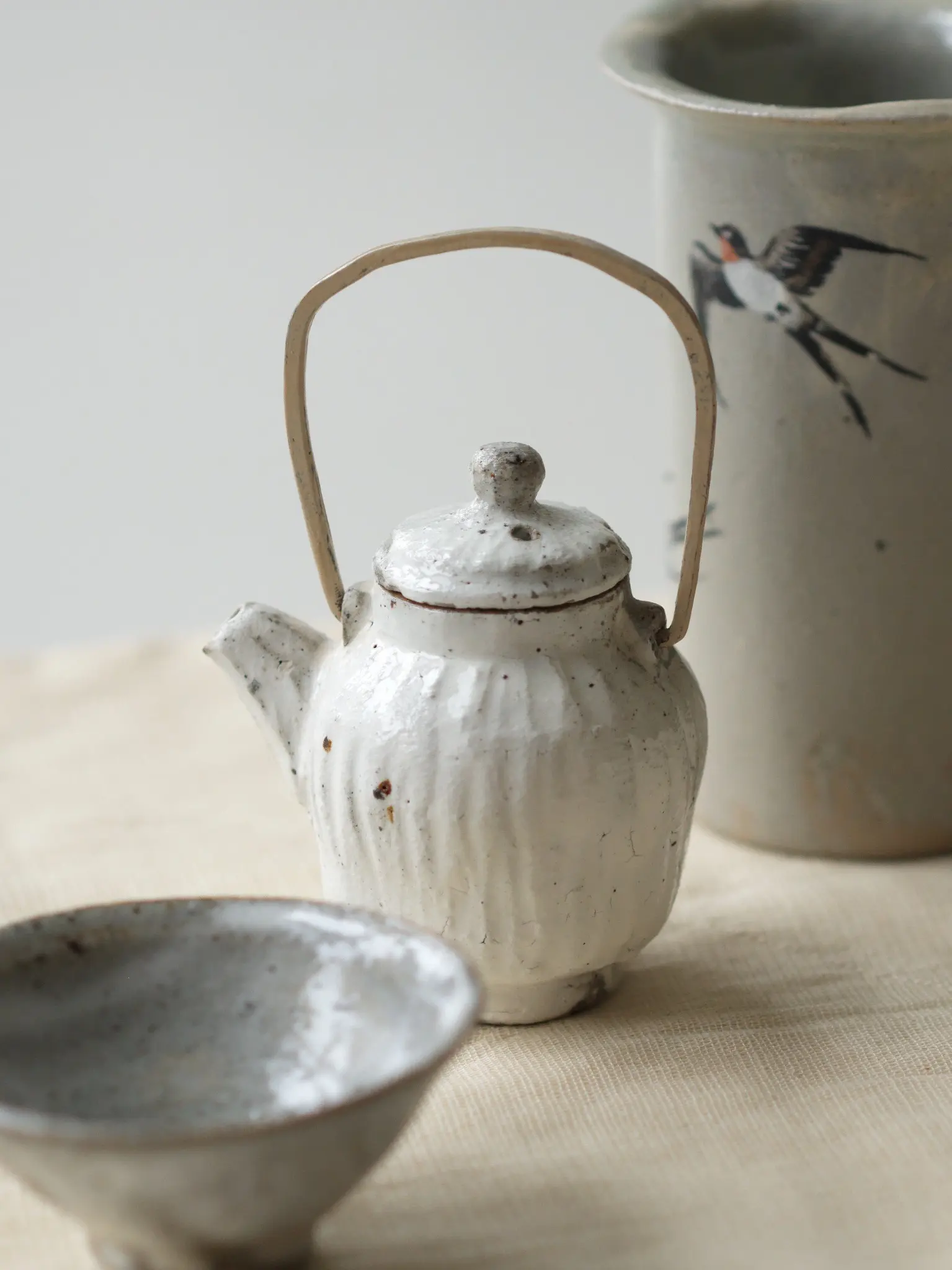
These teapots are not miniature moon jars, nor do they depict the moon directly. The moon is closer to a measure held within the maker’s mind: a completeness that allows for absence, a stillness that retains change and a whiteness through which earth and fire remain visible. Placed within a tea setting, the pot appears like a moon that can be cupped in both hands. Once filled with water, its weight changes, steam rises and tea flows from the spout. An image that once seemed distant enters the gestures of everyday life.
The Pyeon series asks the viewer to move between distance and proximity. From afar, each work appears as a whole; only upon approaching does one discover that it is composed of countless differences. The teaware brings this experience into the palm of the hand. One touches the undulations of the white slip, observes the boundary where slip meets the darker clay body and continually changes one’s angle of view while holding the pot, pouring water and drinking tea. Details that must be approached to be seen in the larger works become elements that the fingers can perceive directly.
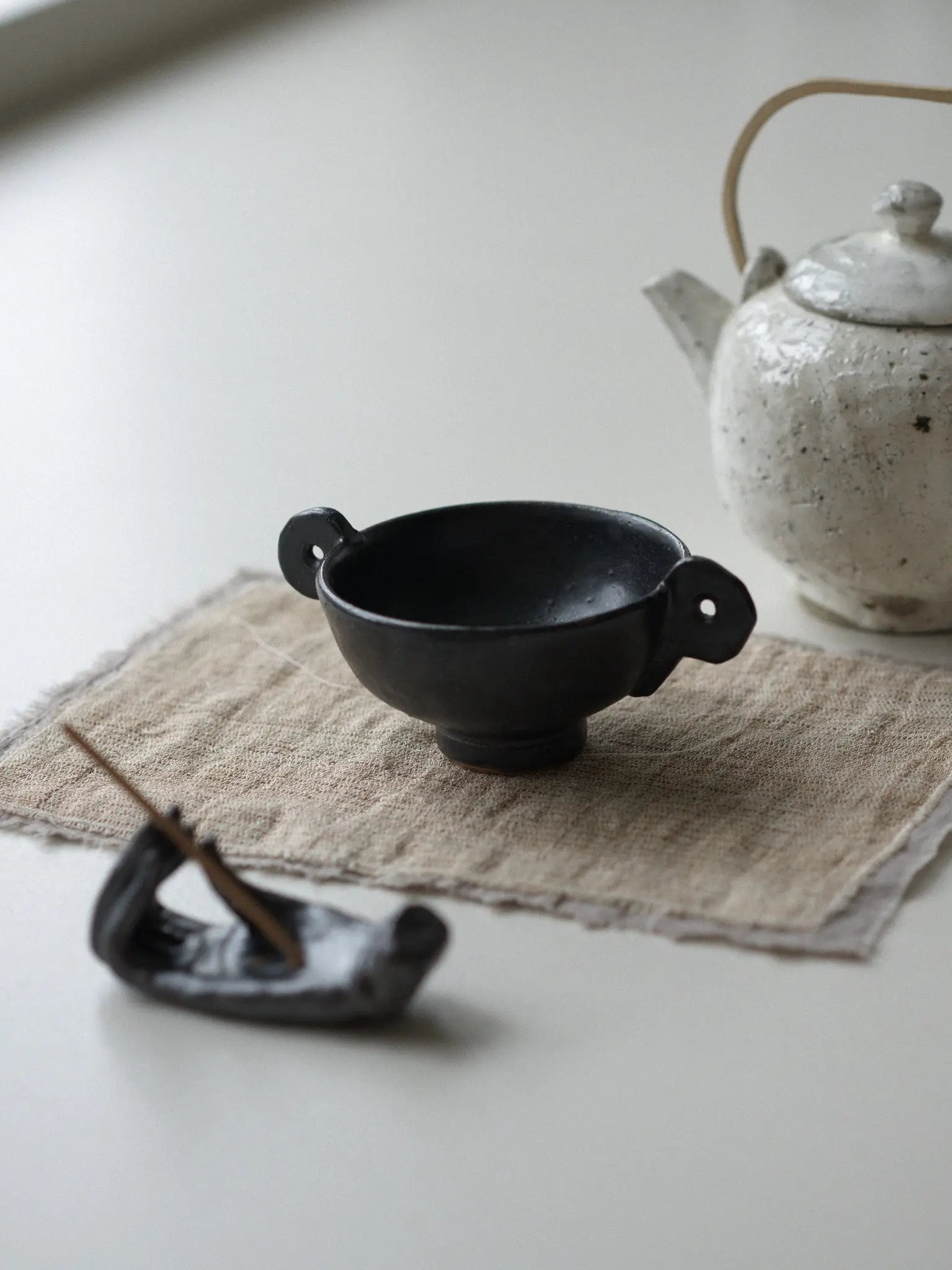
A tea setting, too, is composed of many independent “fragments”: a teapot, several cups, tea, water and the people who meet at a particular moment. They gather temporarily to form a complete experience; when the gathering ends, they separate once more and await the next occasion. The moon is thereby transformed into a sensation within the tea setting. It need not remain suspended in the distance—it may also rest upon the table and enter the human hand.
06Toyomasu Kazuo
Ceramics
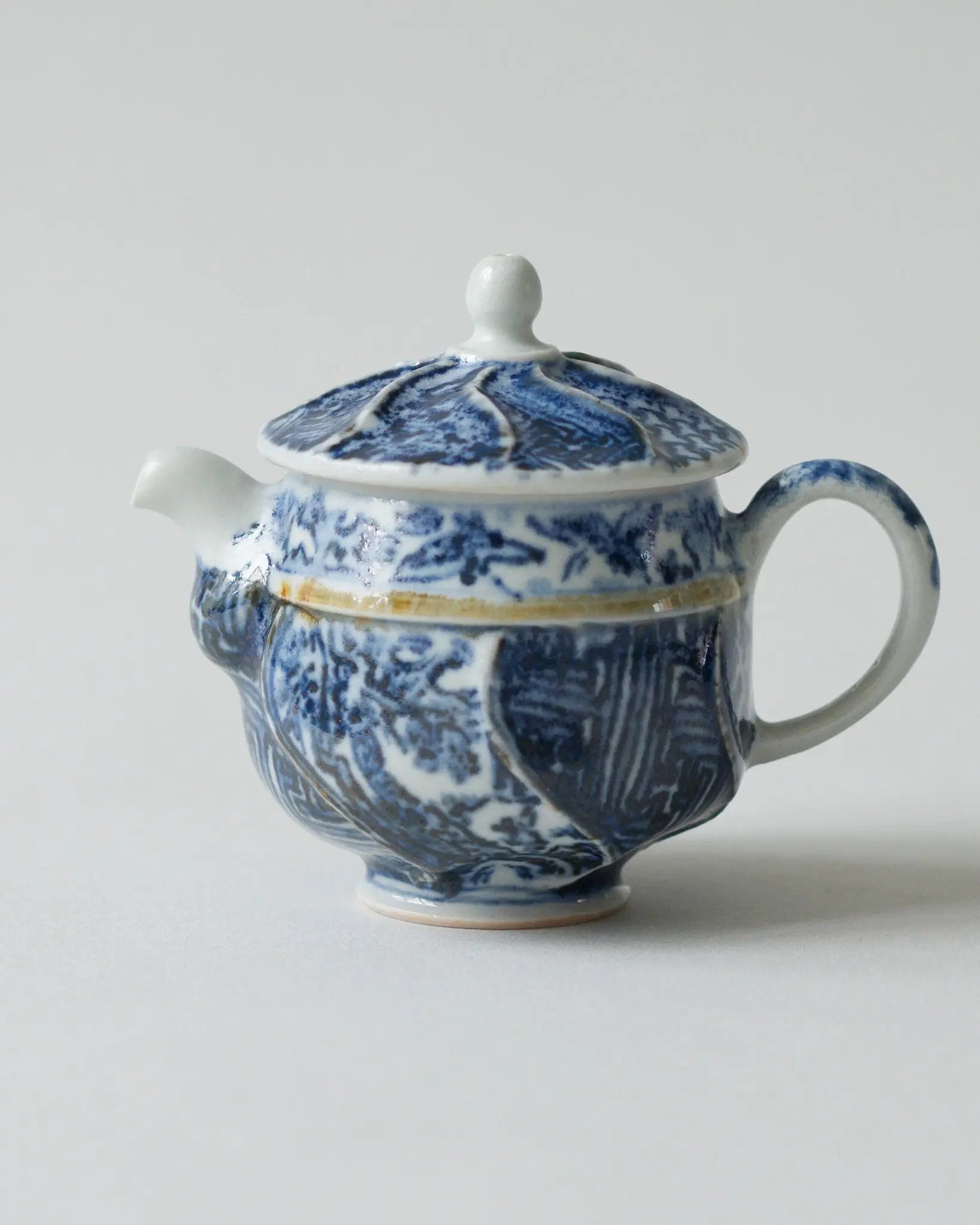
Toyomasu Kazuo was born in Shanghai, China, and returned to Arita, Japan, at the age of ten. He speaks fluent Mandarin with a faint Shanghai accent and is also an accomplished calligrapher. His father, Toyomasu Ansei, taught for many years at the Jingdezhen Ceramic Institute in Jiangxi Province, China, and was himself an accomplished ceramic artist. As a young man, Toyomasu returned to China and studied gongbi flower-and-bird painting in the Department of Chinese Painting at the China Academy of Art. He later returned to Japan, trained at the Kyoto Prefectural Ceramic Training School and studied under eighth-generation Takahashi Dōhachi, whose lineage dates back to the late Edo period. These unusual trajectories through life have become the roots and bones of his vessels.
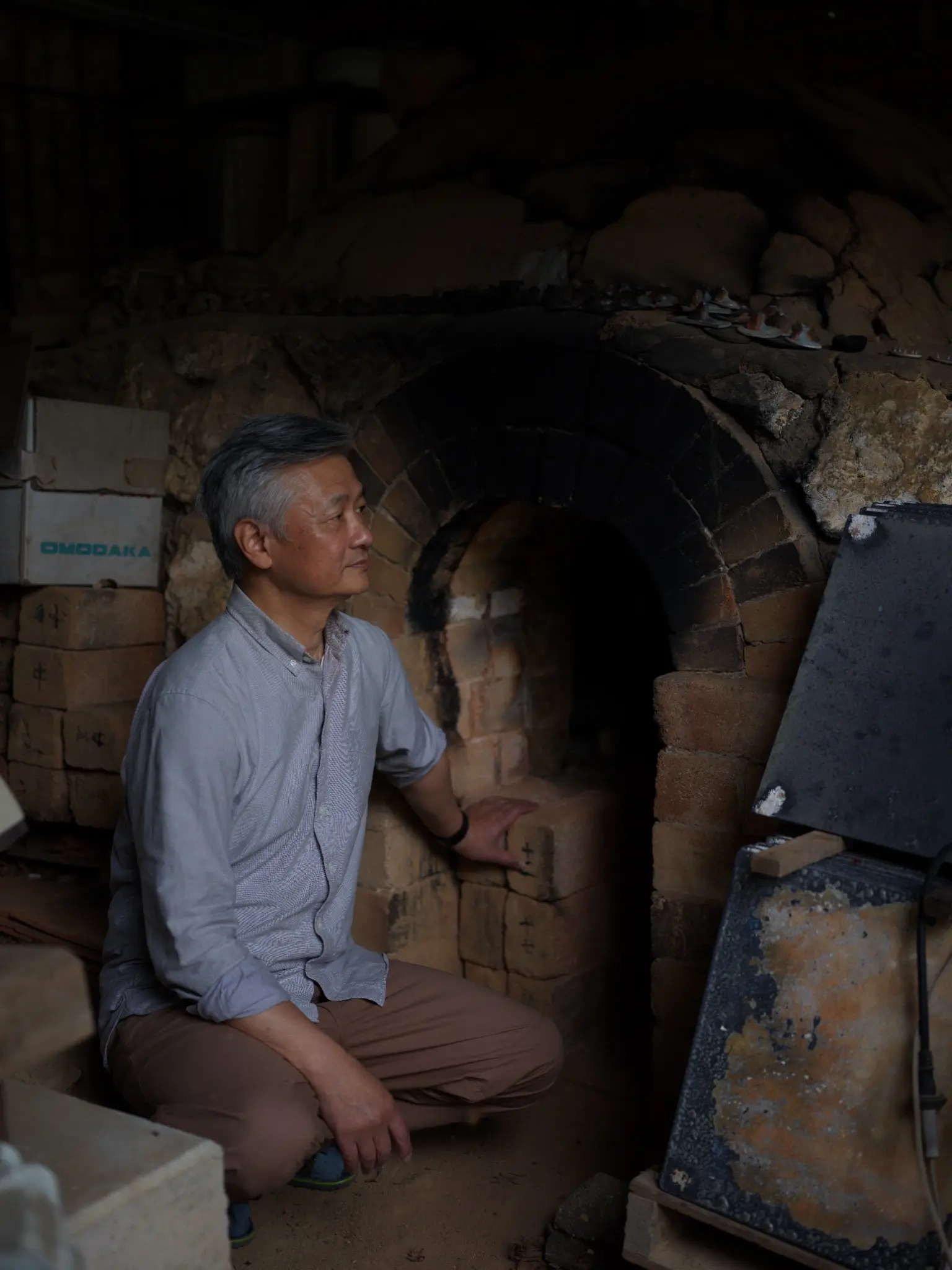
The search for origins lies at the heart of Toyomasu’s practice; he does not reproduce the outward appearance of historic ceramics. Taking Arita as his point of reference and working from qualities found in Chinese porcelain, he pursues a decorative principle in which “clay body, firing and glaze are integrated as one”. Toyomasu has repeatedly visited historic kiln sites in China and Korea to investigate ceramic materials and firing methods. He does not stop at identifying the date, form or decoration of an ancient vessel, but attempts to trace its history further back: before a particular style came into being, how did the local stone, earth, glaze, fire and way of life together give birth to an object? This search for origins keeps his work continually facing the classical without being confined by its outward forms.
His practice encompasses white porcelain, celadon and underglaze-blue porcelain. He works primarily with Izumiyama porcelain stone from Arita and formulates glazes from natural materials such as plant ash. Porcelain is usually fired inside protective saggars, isolating it from smoke, wood ash and direct flame to produce a clean and stable surface. Toyomasu removes this layer of protection. He places the porcelain body deep within the wood-fired kiln, directly exposing it to the movement of the flames and the falling ash. The direction travelled by the fire, the places where ash settles, and the distinct temperature and atmosphere of each kiln position are all preserved upon the vessel.
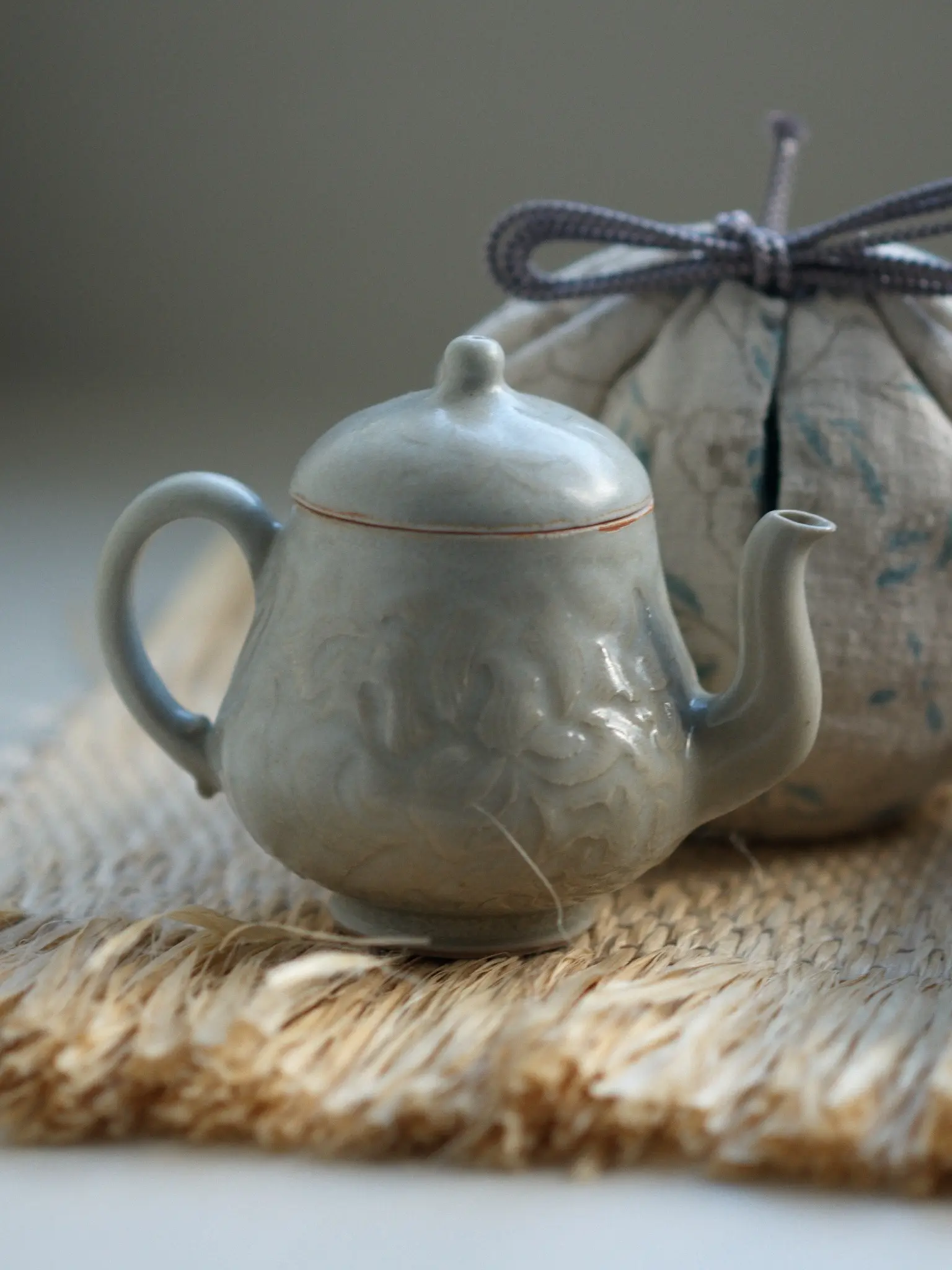
Toyomasu’s work does not lose its rigour by accepting the transformations of wood firing. The proportions of the form, the thickness of the body, the fit between lid and vessel, and every painted or incised detail must be established with sufficient precision before firing. He constructs the skeleton of each piece through meticulous and assured craftsmanship, then entrusts the final part to the fire. Precision and variation no longer cancel one another out: the former gives the work its clear form, while the latter grants it an expression that cannot be drawn in advance.
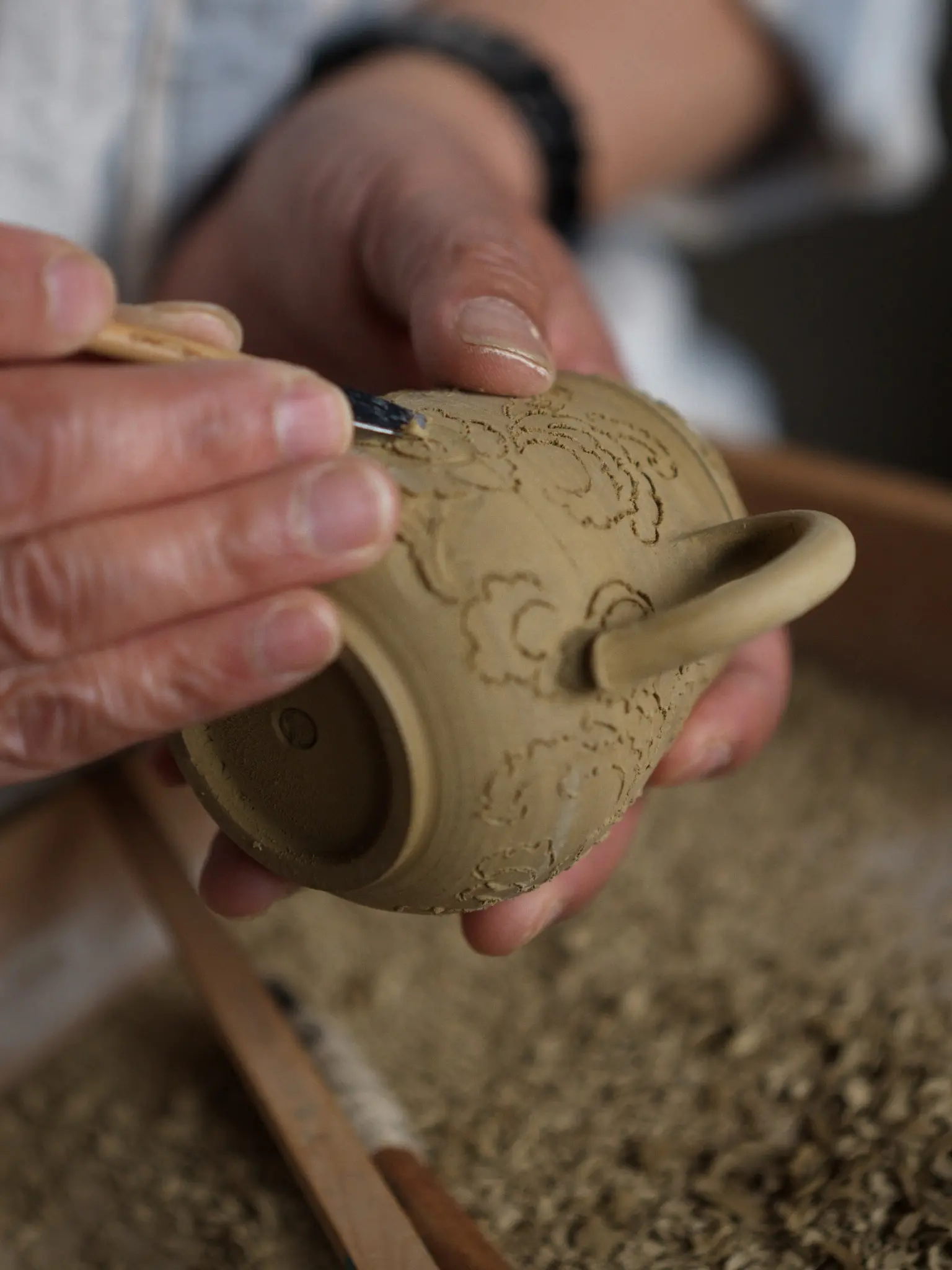
This relationship is especially subtle in his shonzui works. Shonzui originated as a type of blue-and-white porcelain made in Jingdezhen during the late Ming dynasty for Japanese tea culture. Traditional examples are distinguished by their vivid cobalt blue and dense, finely executed patterns. Toyomasu retains the rigorous, layered compositions of shonzui, but places them in a wood-fired kiln without saggars. Through the action of flame, falling ash and the changing glaze, the once-clear underglaze blue is no longer uniformly sharp. Some lines remain distinct; some colours gently diffuse; other brushstrokes sink into the glaze as though seen through a veil of moisture.
The ancient blue has not disappeared; it has simply been softened by fire and time. Toyomasu’s shonzui possesses the patience of Chinese gongbi painting while retaining the openness of freehand brushwork.
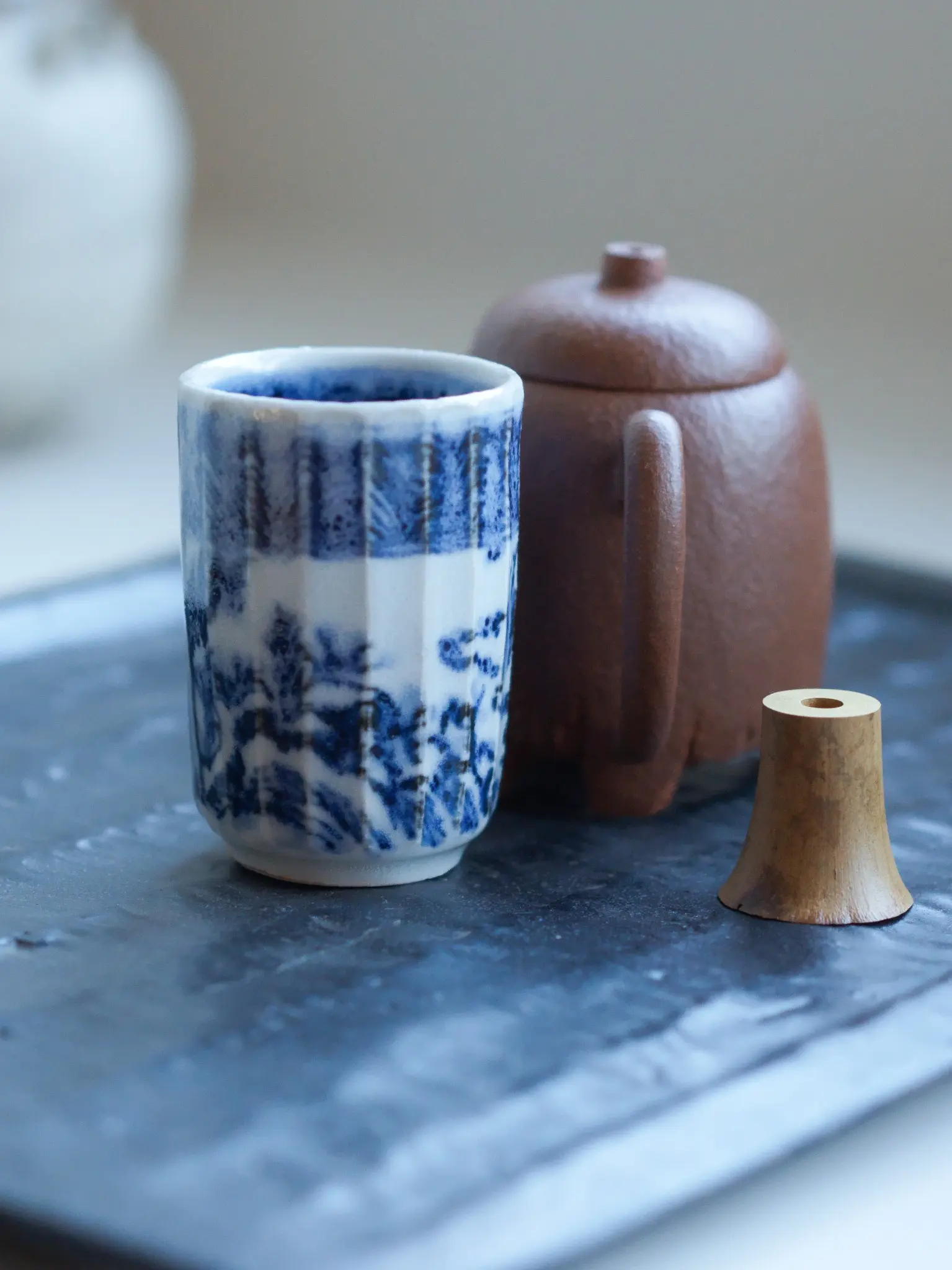
Dense patterns are no longer merely demonstrations of technique, but resemble scenes held in memory: their outlines remain, while certain edges have already begun to blur. What Toyomasu presents is not the appearance of an ancient vessel before time has touched it, but the way the classical re-emerges after passing through personal experience, material and kiln fire.
When these patterns enter the form of a teapot, they no longer function as images with a fixed front. They travel around the body and extend between the rim, lid, spout and handle. The entire composition cannot be seen at once; its details must gradually be read through lifting, turning and pouring. The hand-painted brushstrokes, the colours left by the flames and the weight of the vessel in the palm all become part of the act of drinking tea.
As the teapot is slowly turned within the tea setting, patterns that cannot be taken in at a single glance gradually reveal themselves through the movement of water and hands.
07Yamamoto Ryōhei · Hirakura Yuki
Ceramics
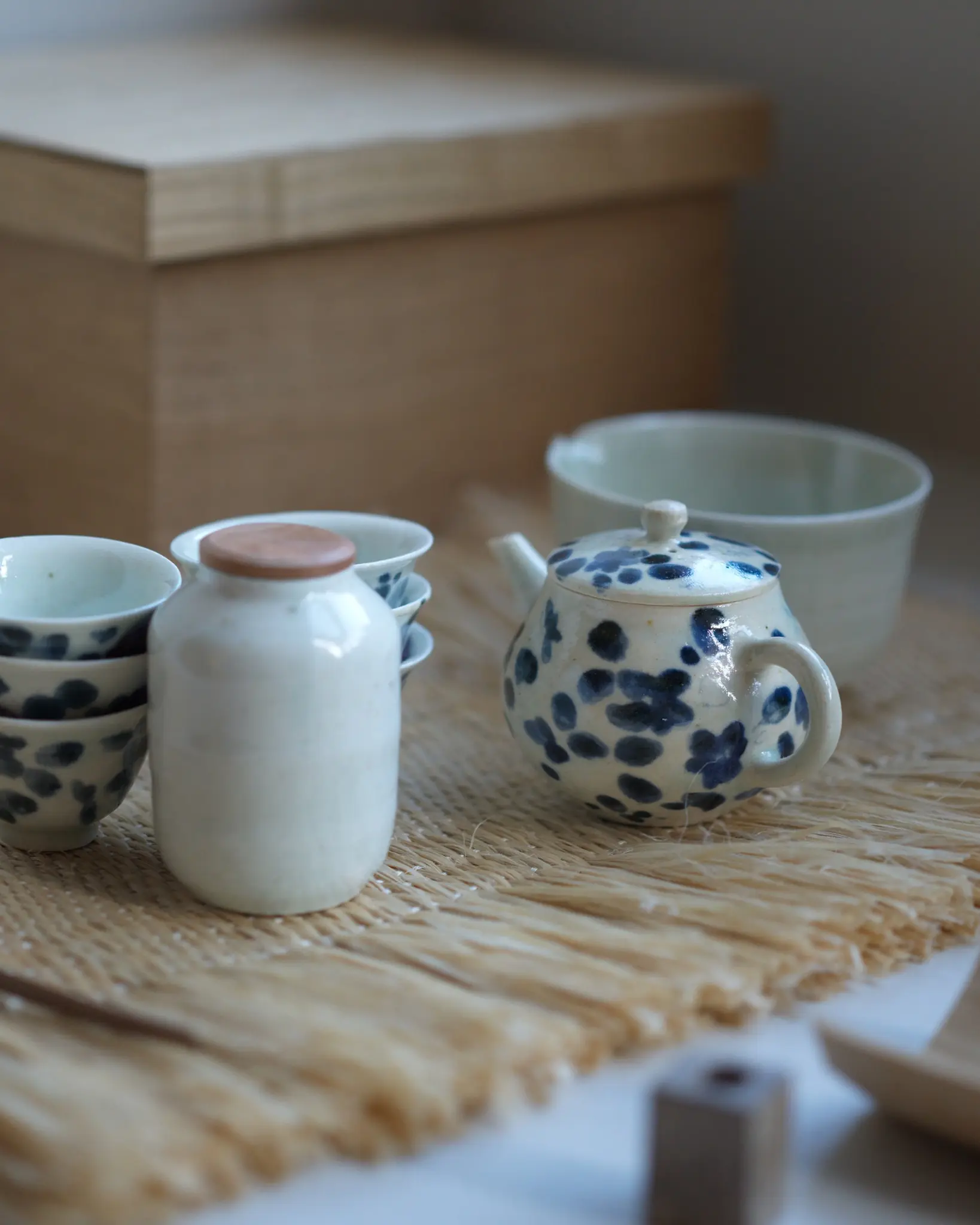
Yamamoto Ryōhei
Hirakura Yuki
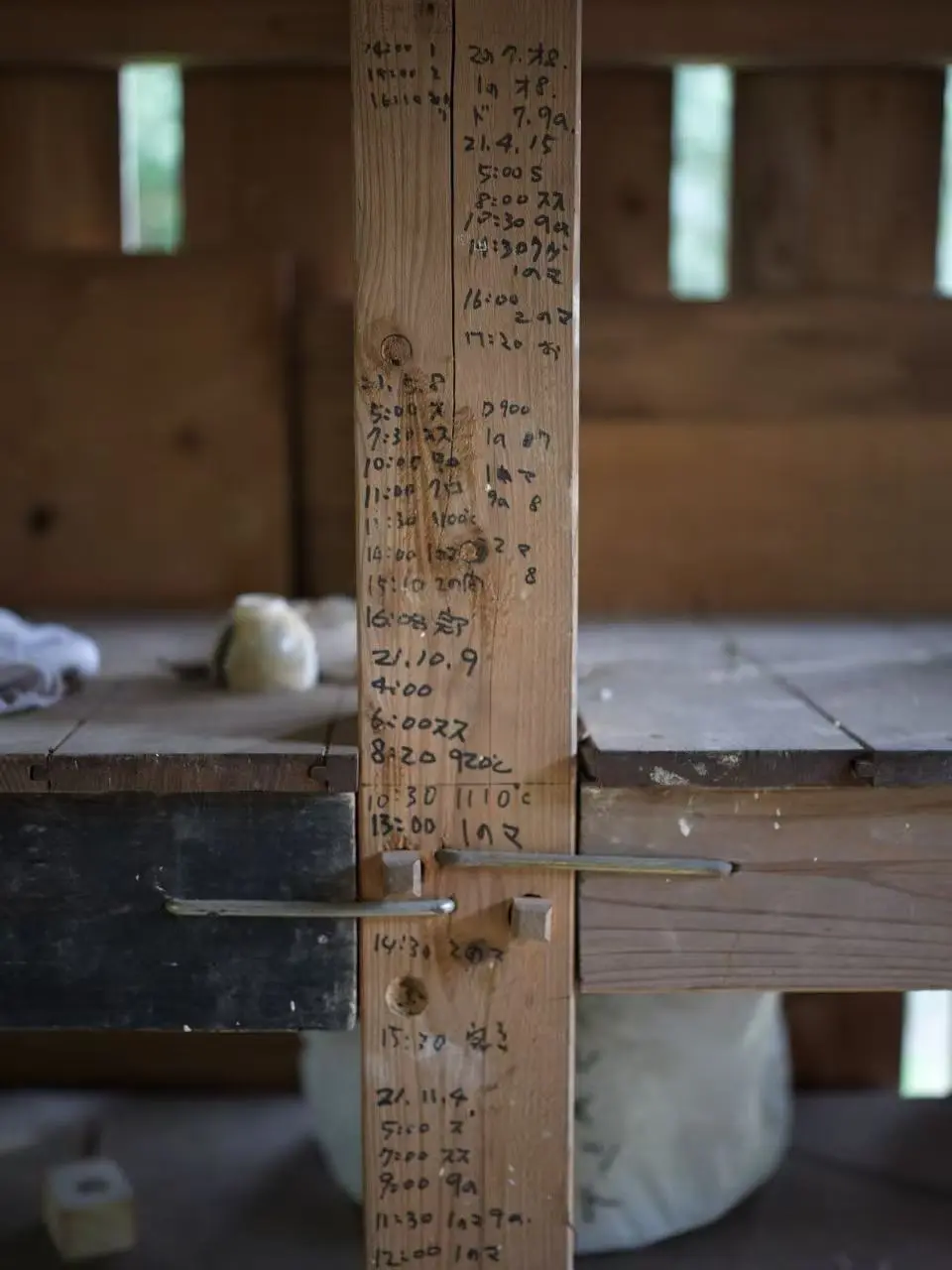
Yamamoto Ryōhei was born in Tokyo in 1972 and graduated from Tama Art University with a specialisation in oil painting. He subsequently moved to Arita to study wheel-throwing and ceramic decoration. In 2006, he established his studio there; in 2020, together with Hirakura Yuki, he completed the Komononari-gama.
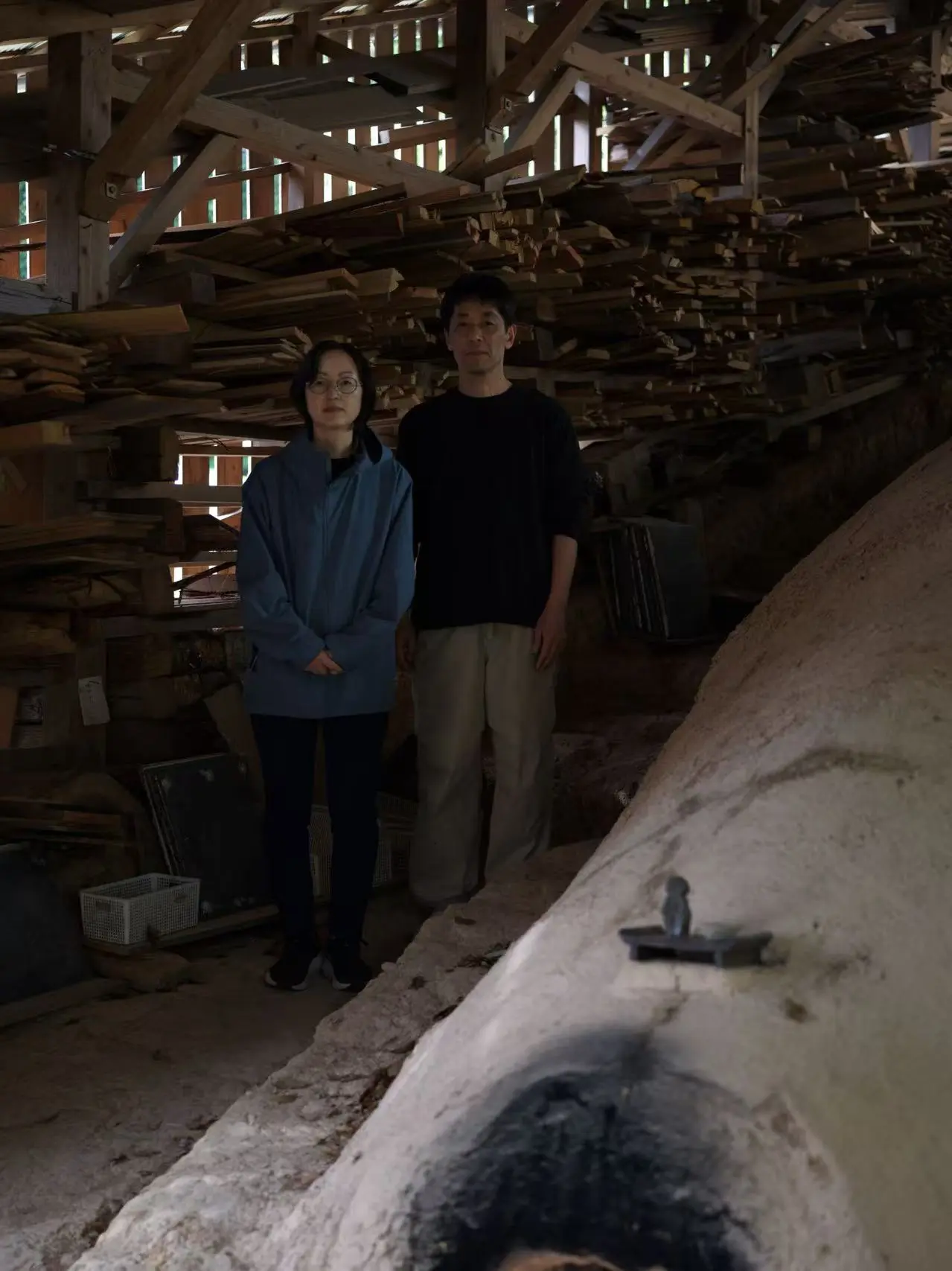
Yamamoto turns his attention towards the period in which Japanese porcelain was first emerging. In early Imari ware, raw materials and firing methods had not yet been fully standardised. Forms could appear slightly naïve, the white porcelain carried a grey cast, and traces of flame and falling ash remained naturally upon the surface. Rather than reproducing the outward forms of historic vessels, Yamamoto reconsiders the conditions from which early porcelain arose, beginning with the processing of porcelain stone and research into raw materials, and continuing through wood firing. What he pursues is not the appearance of early Imari, but the experimentation and freedom retained at the birth of porcelain, when its materials and techniques had not yet settled into fixed conventions.
The Komononari-gama takes its name from the historic Komononari kiln site in the hills opposite the studio, connecting the present kiln with the history of porcelain production on this land. Yamamoto and Hirakura built the internal framework using trees felled from the surrounding mountain. They then covered it, layer by layer, with earth excavated while preparing the kiln bed, repeatedly compacting each layer. When the kiln was first lit, the wooden framework burned away and the raw earth gradually hardened through firing. During subsequent firings, sections of the walls flake and crack; these are repaired, then made stronger by the next passage of fire. The entire kiln resembles an enormous ceramic object. It was not completed in a single moment, but continues to grow through repeated use.
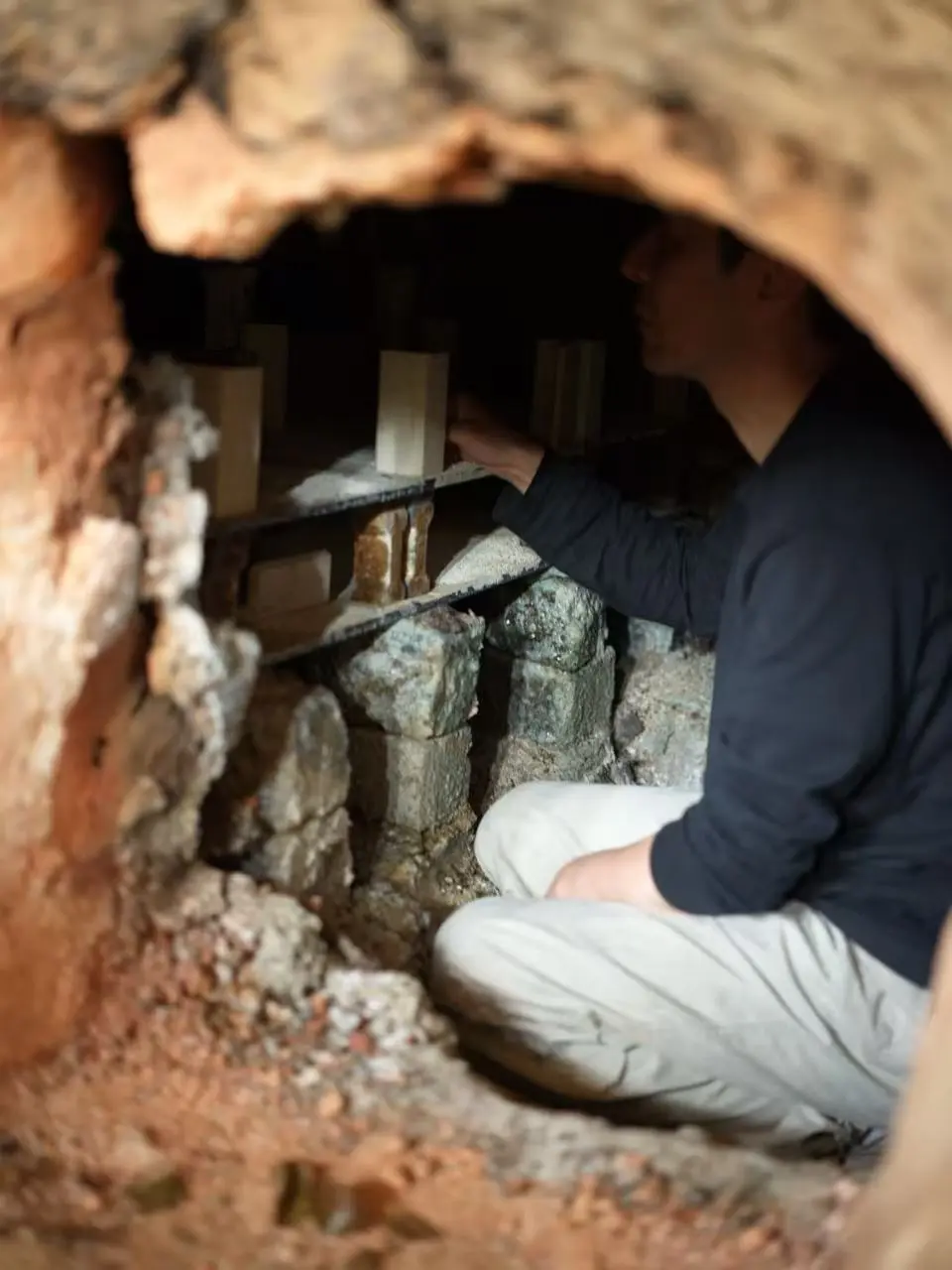
During firing, Yamamoto places great importance on directly observing the flames, smoke, sounds and movement of air. Fragments from the earthen walls, wood ash and fire act directly upon the vessels, giving the white porcelain varying shades of grey, traces of flame and distinct surface textures. The ash produced by the burning wood is then collected, washed and transformed into glaze. The objects are not produced in isolation, but born within a cycle composed of mountain earth, trees, fire and human labour.
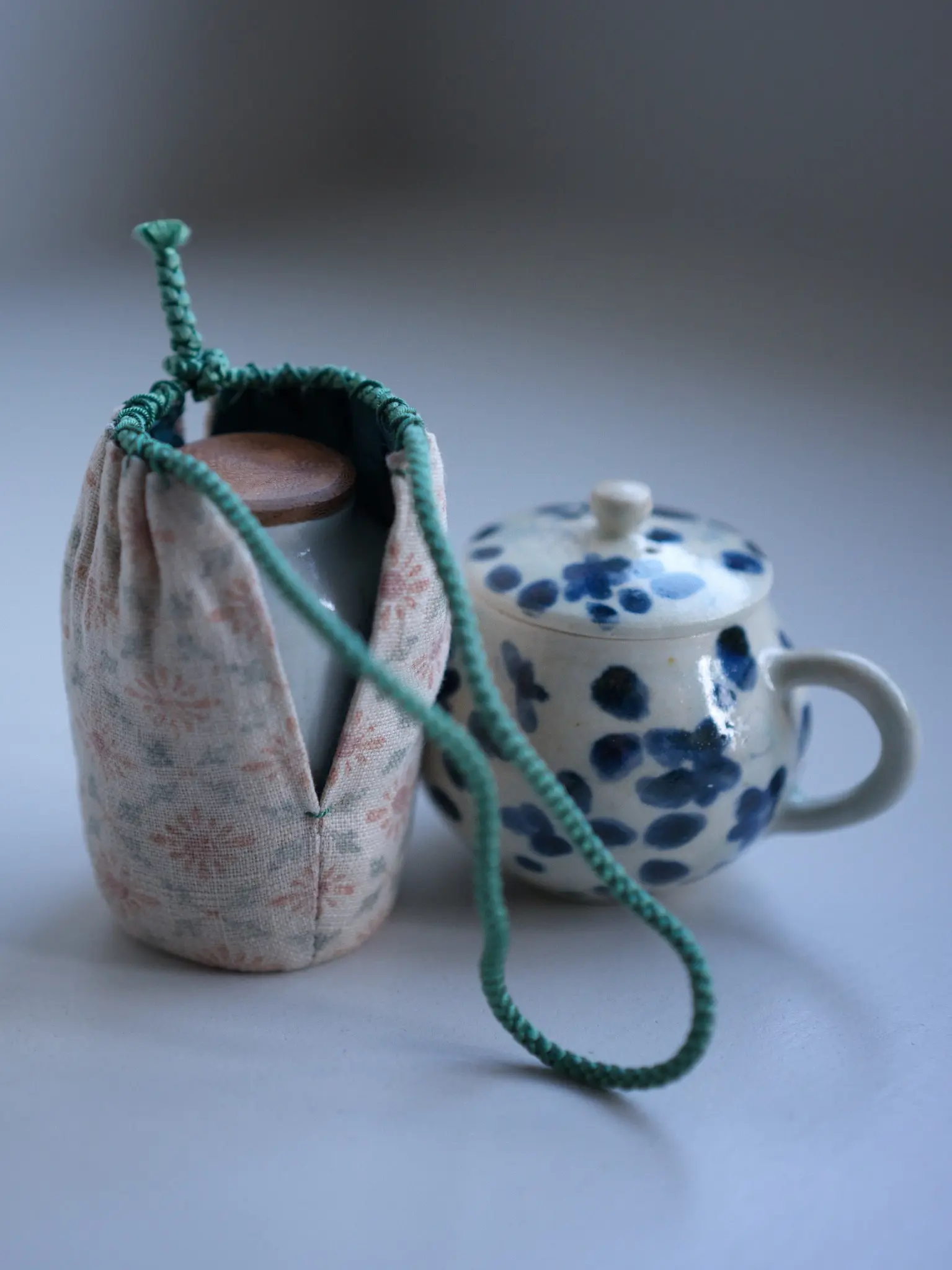
The blue-and-white patterns presented in this exhibition are more vivid than in Yamamoto’s earlier work, with the blue extending freely across the curved surfaces of the vessels. Within the context of Paris, they may evoke familiar European associations with East Asian porcelain, yet the grey tones and fire marks left by the wood-fired kiln give them a distinctly different presence.
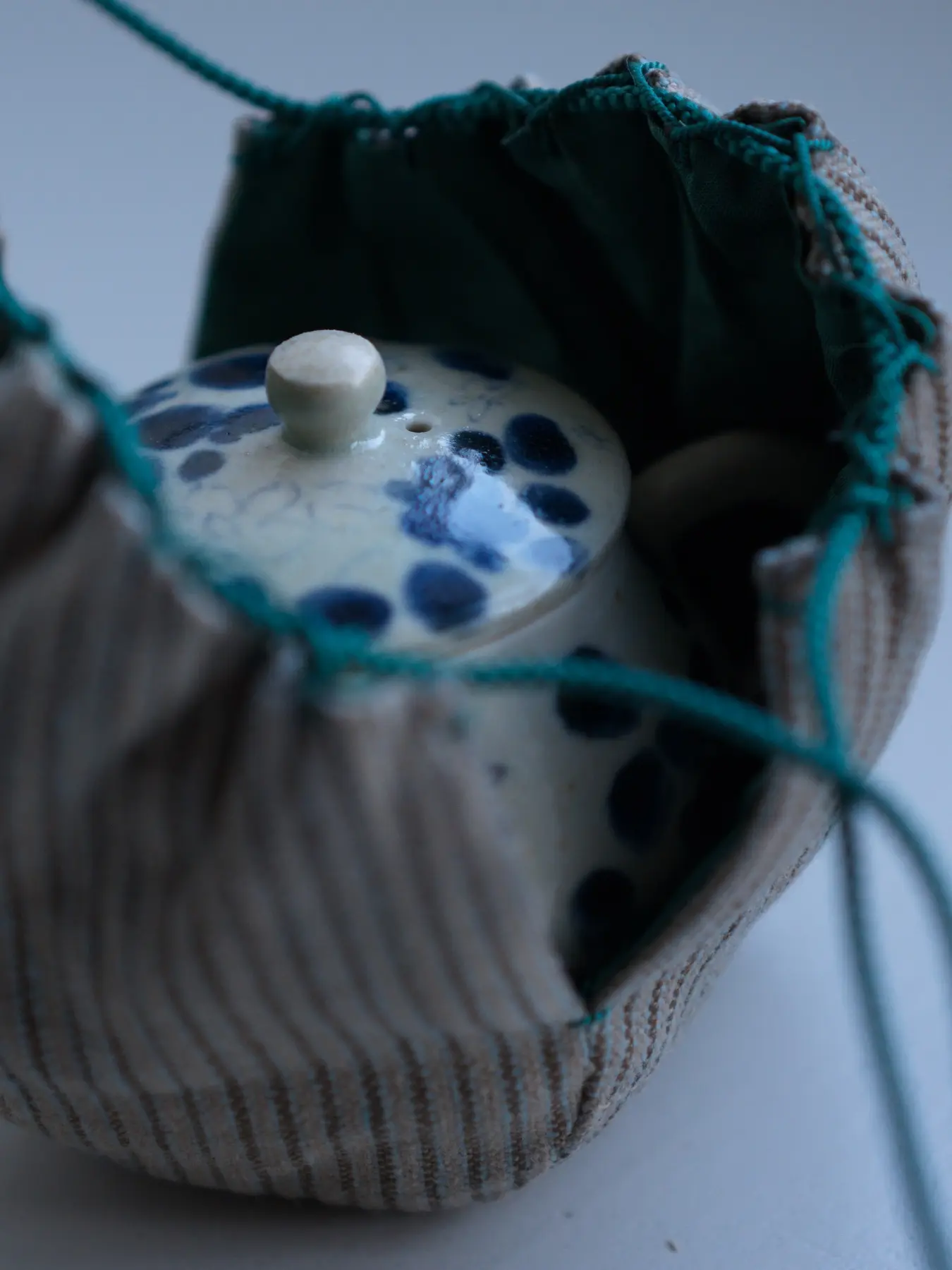
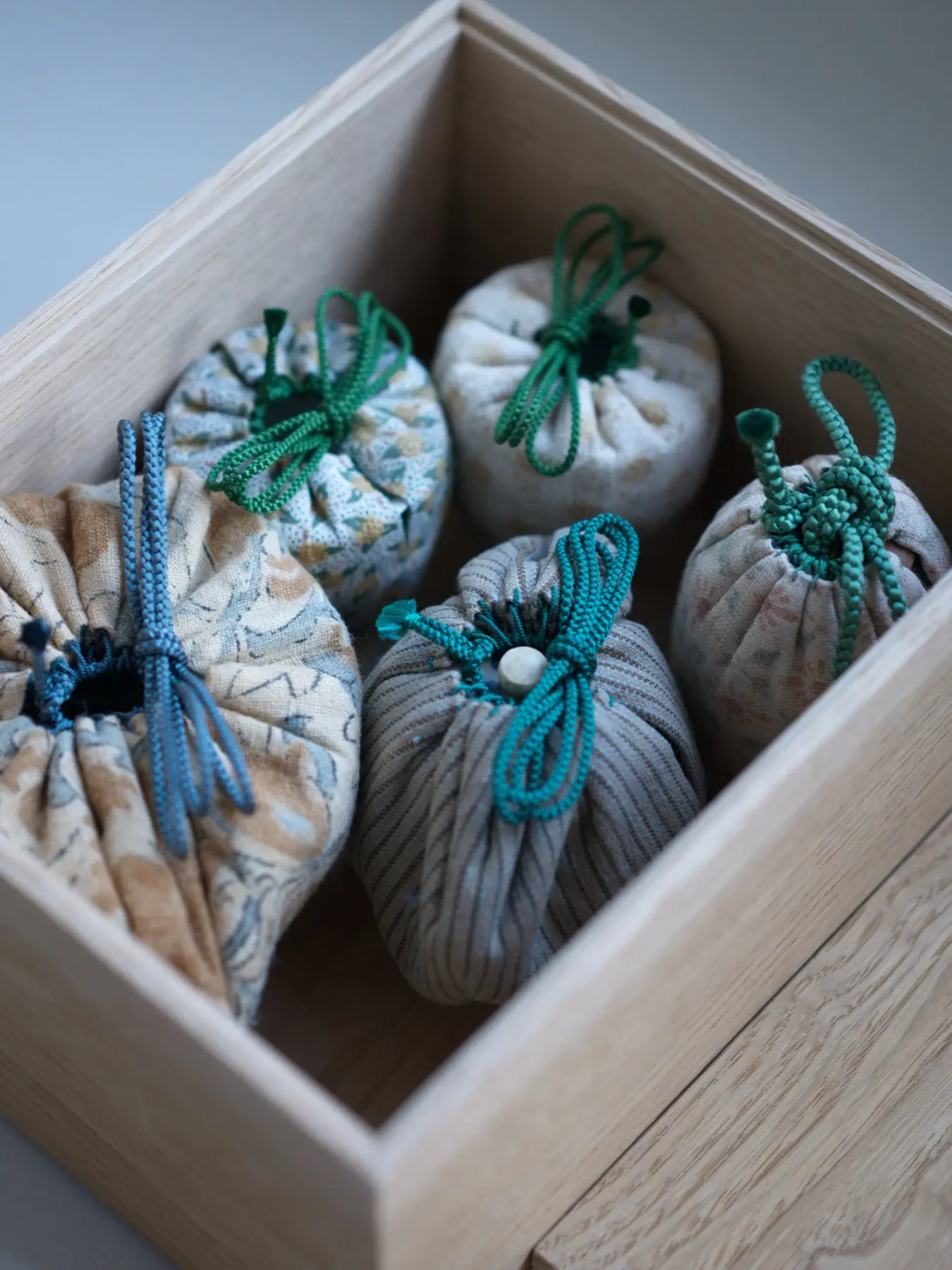
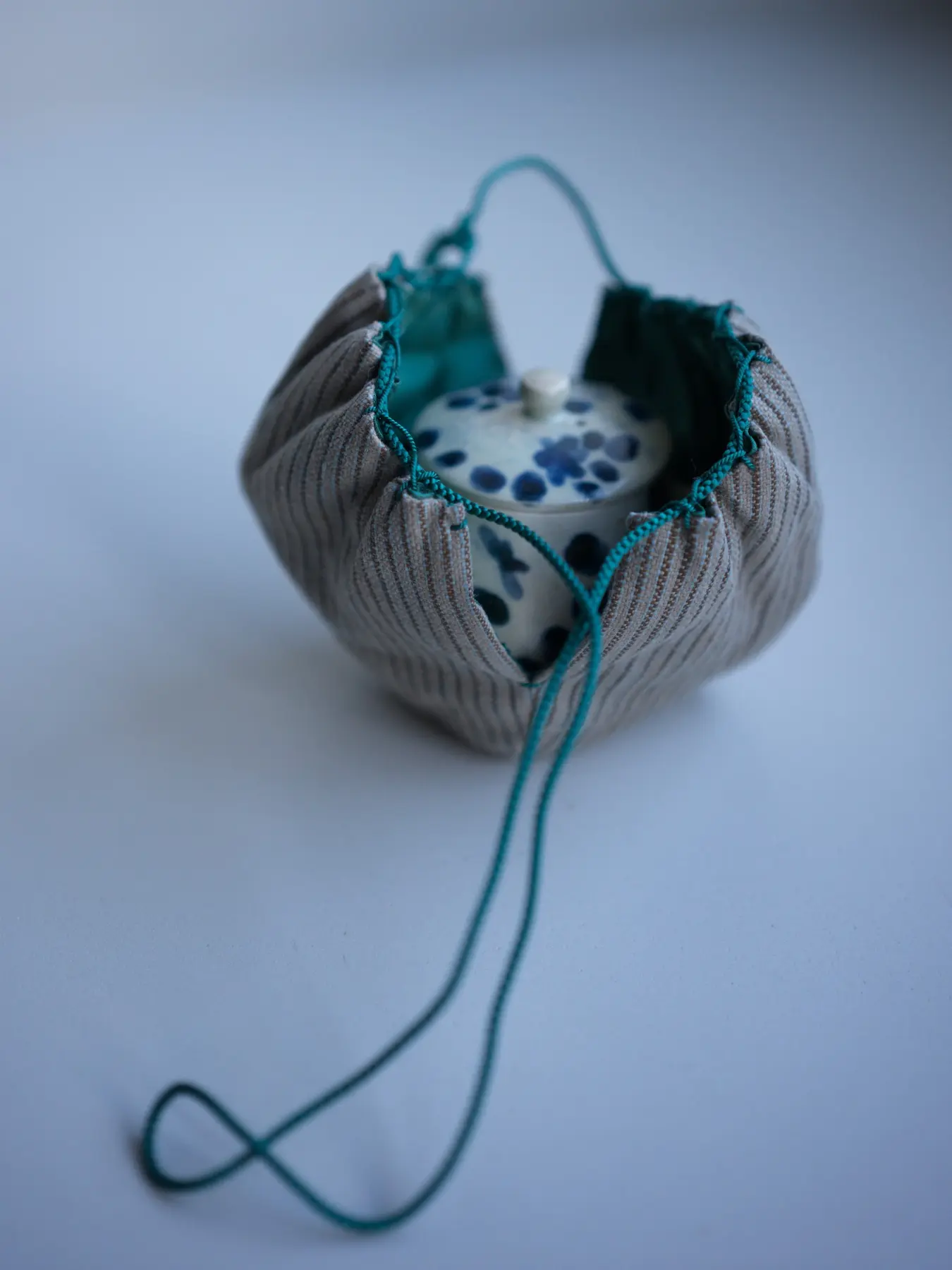
For this exhibition, Yamamoto’s works are organised around a tea chest, with Aldo Cass creating an individual shifuku textile pouch for each vessel. Porcelain, textile and tea chest together form a tea setting that can be gathered, carried and unfolded once more. While wrapped, the objects are protected and temporarily withdrawn from view; when the cords are untied, their blue-and-white decoration and traces of wood firing enter the hands and the light one by one. The place where tea happens can also be gathered into a single box and travel with someone to another city.
08Yi Zhi
Ceramics
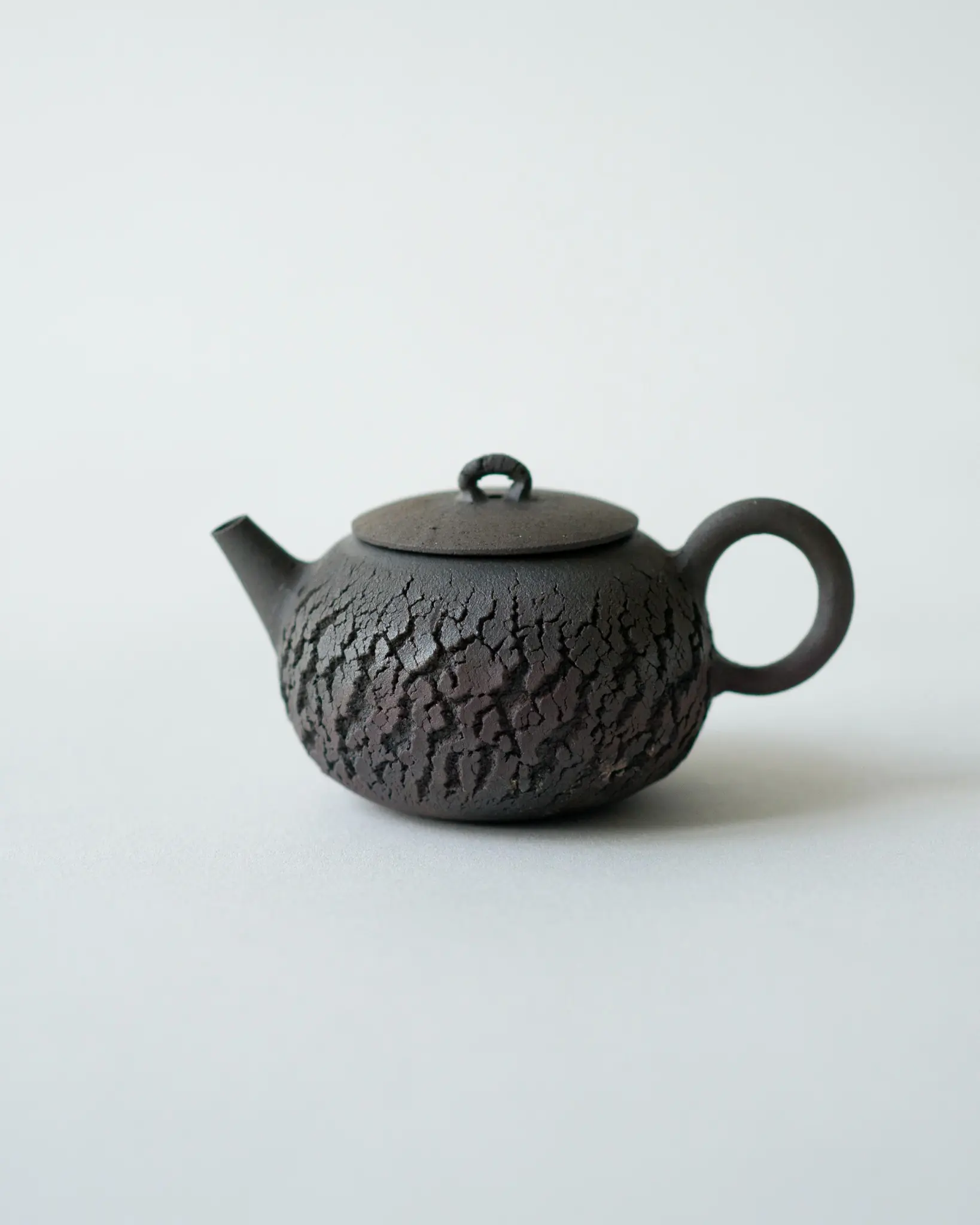
Yi Zhi, whose birth name is Shi Yingzhi, was born in China in 1995. He graduated from a Ceramic Design programme in Jingdezhen in 2016 and began studying wheel-throwing and teapot making that same year, while also developing an interest in bonsai and photography. Since establishing his studio in Jingdezhen in 2017, he has centred his practice on teapots, drawing inspiration from the growth, forms and traces of time found in plants.
Yi Zhi specialises in traditional Jingdezhen wheel-throwing. The body, spout, handle and lid are each thrown in a single operation, with as little subsequent trimming as possible. In the final stage, the body is expanded from within: as the wheel turns, the narrowed clay form suddenly swells outwards, and the shoulder, belly and surface texture emerge simultaneously. There is only one opportunity to perform this action. Too little pressure and the form loses its tension; slightly too much and the wall may crack or even collapse. His low, full-bodied teapot forms demand particularly precise judgement of wall thickness and centre of gravity.
He selects from different materials according to the work, including Yixing zini—purple zisha clay—and sandy earthenware. His Honghuang, or Primordial, texture emerges at the moment when the vessel wall is expanded outwards: particles and fissures within the clay open with it, producing marks that cannot be drawn in advance and are difficult to repeat. Yi Zhi studied bonsai for many years. For him, “withering” and “growth” are not opposites; the aged form of a tree is itself the result of continued growth. Applied to the teapot, roughness therefore speaks not only of damage or age, but also retains a force that continues to grow outwards.
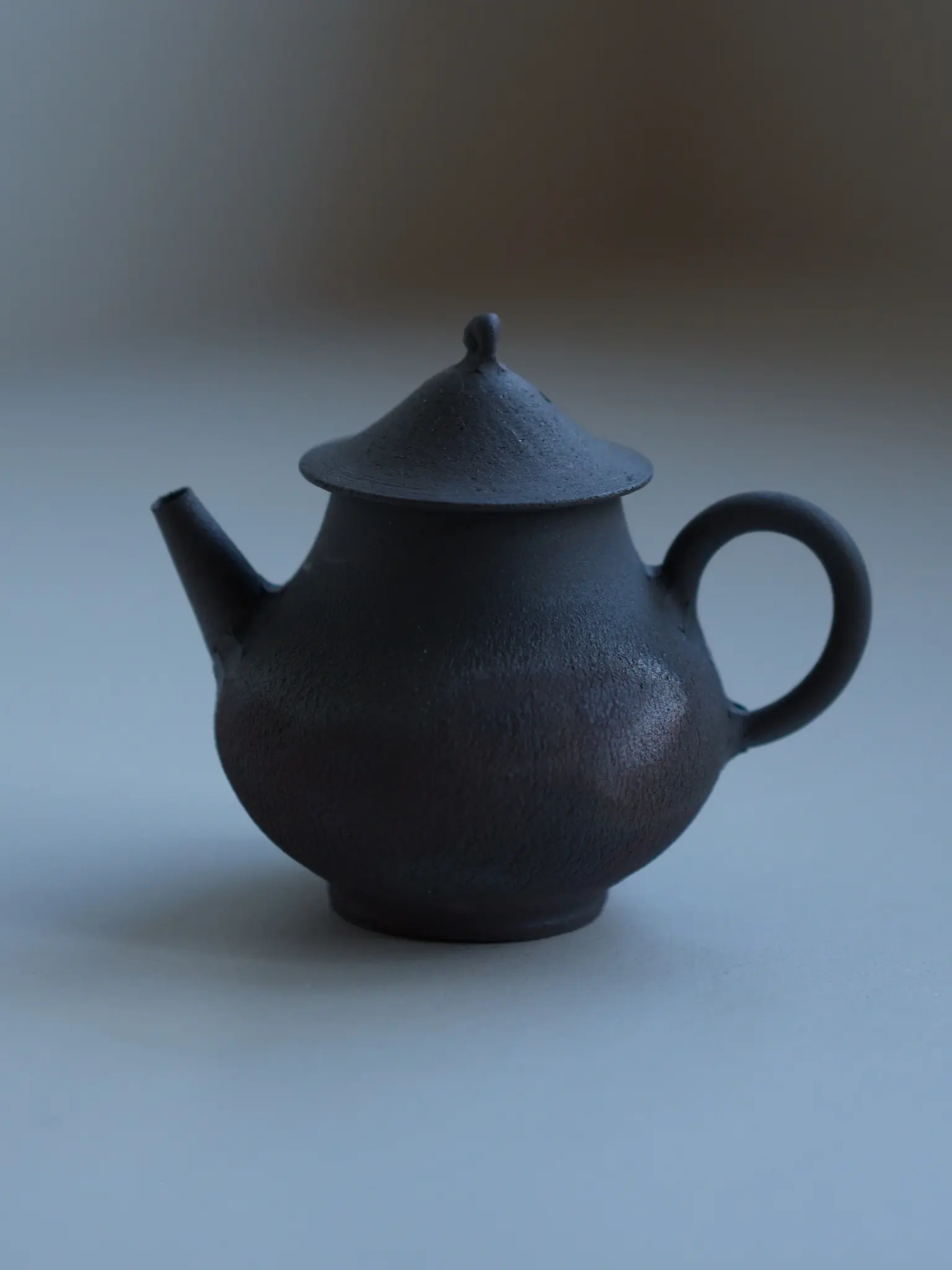
Wood firing gives the work a second formation. Flames and ash leave varying fire colours and degrees of lustre across the surface. The artist can determine the clay and the form, but cannot predetermine where every particle of ash will fall. What matters is not the pursuit of chance for its own sake, but knowing where control should end and allowing the fire to complete the rest.
Yi Zhi applies the precision of Jingdezhen wheel-throwing to zisha and sandy clays that are difficult to throw. Technique is not used to reproduce regular forms, but to push the object towards the edge of imbalance and still allow it to hold together. Its rough surface may be the first quality one notices, yet the work is truly sustained by the subtle proportions between body, spout, handle and lid. Even naturally formed traces must remain answerable to the way a teapot pours, is held and is used.
This exhibition focuses primarily on teapots. Through use, their unglazed surfaces absorb tea and are touched repeatedly by the hands. Their colours gradually deepen, while surfaces that were initially dry and muted slowly become warm and lustrous. This is not the deterioration of an original state, but a continuation of the material’s transformation. Different teas and habits of use develop different patinas, allowing each teapot to become gradually attuned to a particular person’s gestures and way of life.
09Matsuda Sonoko
Glass
Matsuda Sonoko was born in Fukuoka, Japan, in 1986. She studied glass at Tama Art University and completed an MFA in Glass at Tokyo University of the Arts. She subsequently trained at Kanazawa Utatsuyama Kogei Kobo and later worked as a teaching assistant in the Glass Programme at Tama Art University. In 2018, she established her studio in southern Kyoto, where she continues her glass practice.
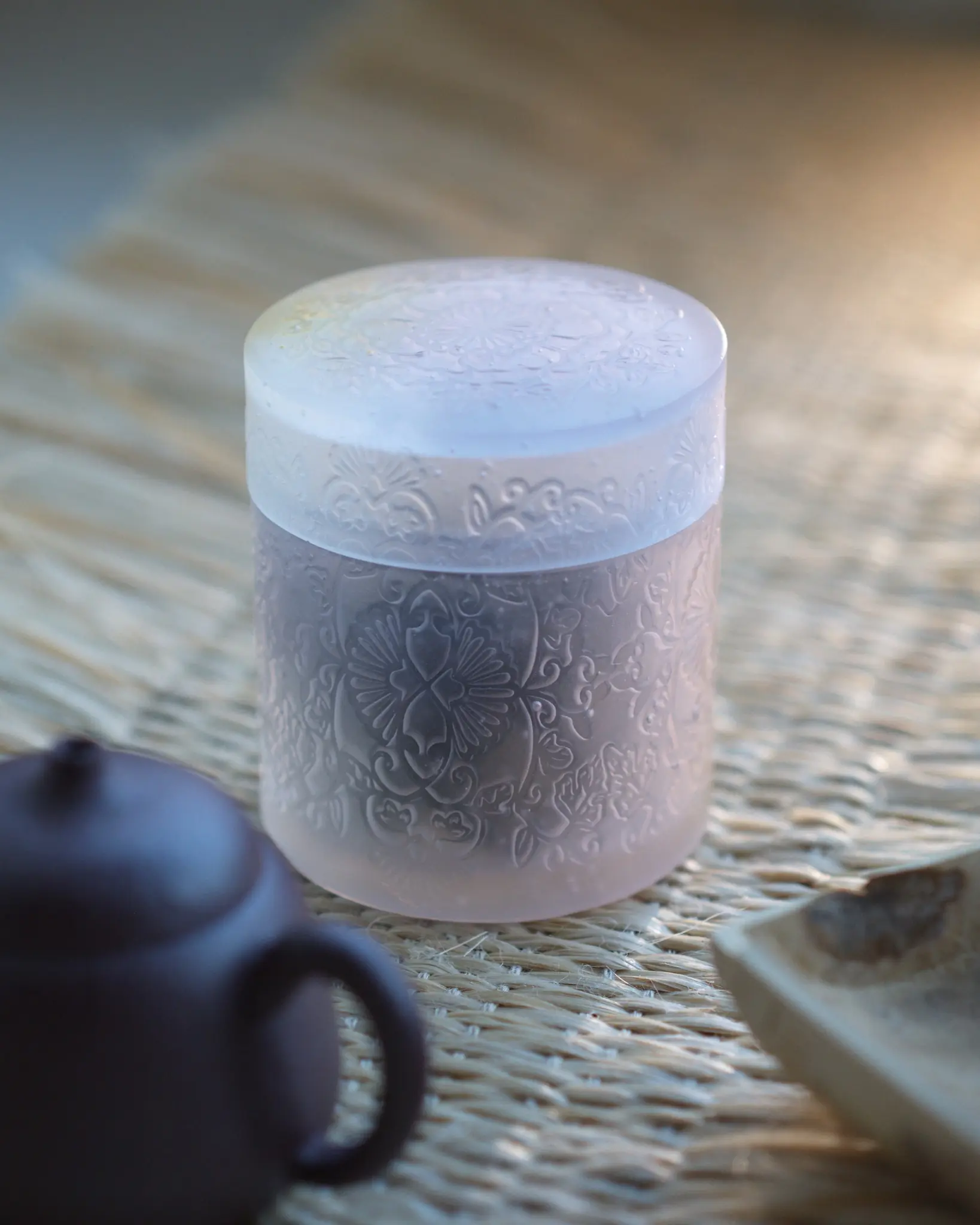
Matsuda has long centred her work on Toki no Hako—“Boxes of Time”. She regards the box as a small, private space that preserves not only objects, but also the irreplaceable time shared between people and things. For this exhibition, she extends this idea into the form of the tea caddy. Tea is removed from its original wrapping and placed within the container to rest and awaken, waiting for its aroma to emerge anew. The tea caddy is therefore not merely an instrument for storage, but also a quiet interval through which tea passes before entering the tea setting.
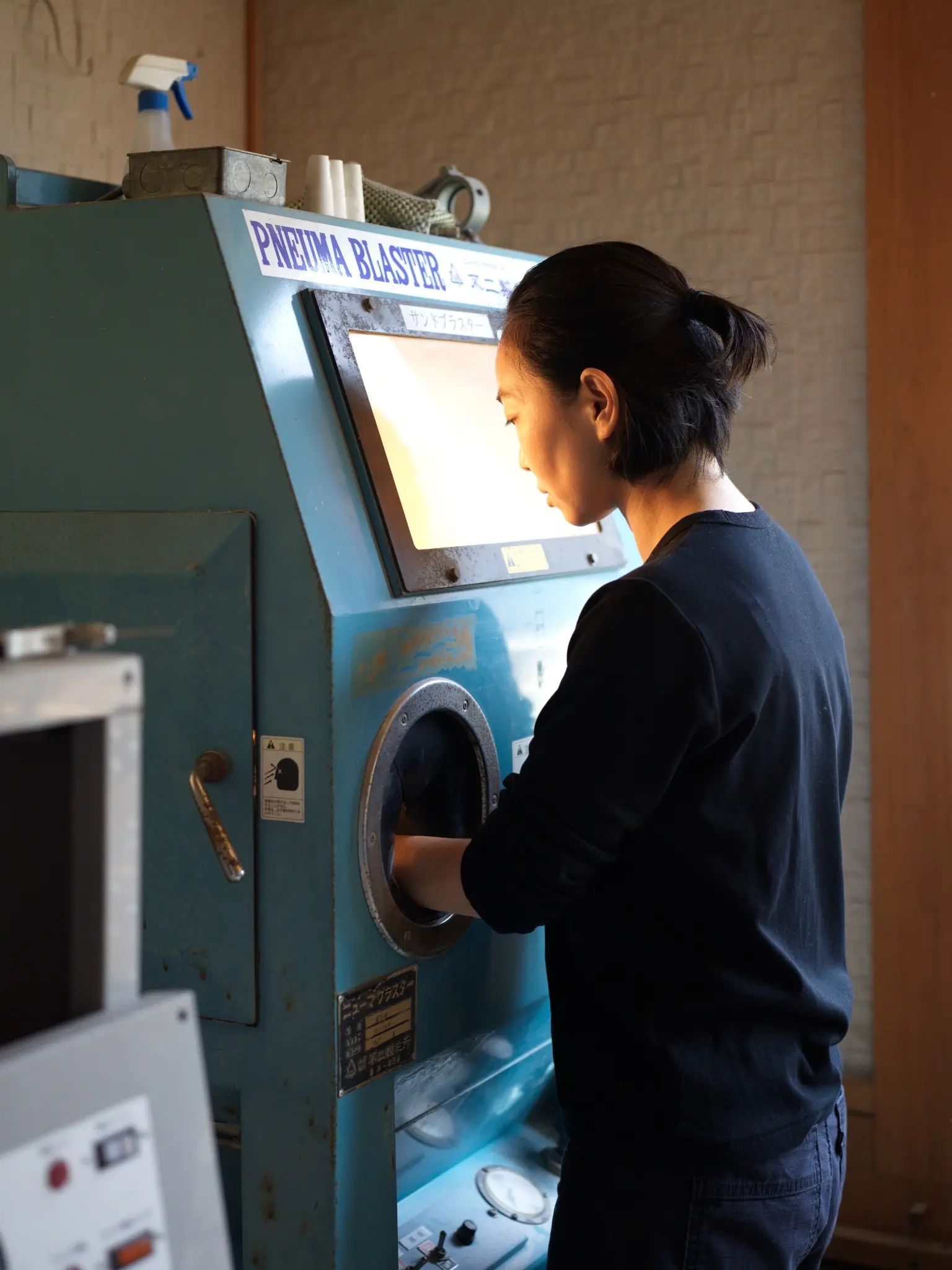
The works are made primarily through kiln casting and pâte de verre, a form of glass-powder casting. Glass is placed inside a plaster mould and fired; once removed, it is repeatedly cut and ground until the body, inner lid and outer lid fit together precisely. Botanical and abstract motifs across the surface are created through drawing, masking and sandblasting. The fine texture left by the fused glass particles means that the material no longer appears merely transparent and hard. Instead, it acquires a softness reminiscent of fine snow, sugar and mist, gathering light within the walls of the vessel.
Matsuda’s practice occupies a space between the functional object and the autonomous artwork. The tea caddy has a clearly defined purpose, yet its expressive life does not end with its function. The single-use mould, prolonged firing and repeated grinding deposit the time of making within the glass. The growth, processing, ageing and awakening of tea are likewise accomplished through time. Material, process and meaning thus echo one another. Through contemporary glass, Matsuda reconsiders the box, the seasons and the act of safekeeping within Japanese object culture, while allowing the user to participate in completing the work’s meaning.
Within Where Tea Happens, Matsuda’s tea caddies direct our attention towards the moments before brewing. Tea does not happen only when water is poured; it also happens when the leaves are taken out, placed within a vessel, allowed to wait and gradually awakened. Light passes through the glass as the tea slowly unfolds within it. A container preserves the time of the past while reserving a beginning for the next cup of tea.
10Wei Zhi
Bamboo
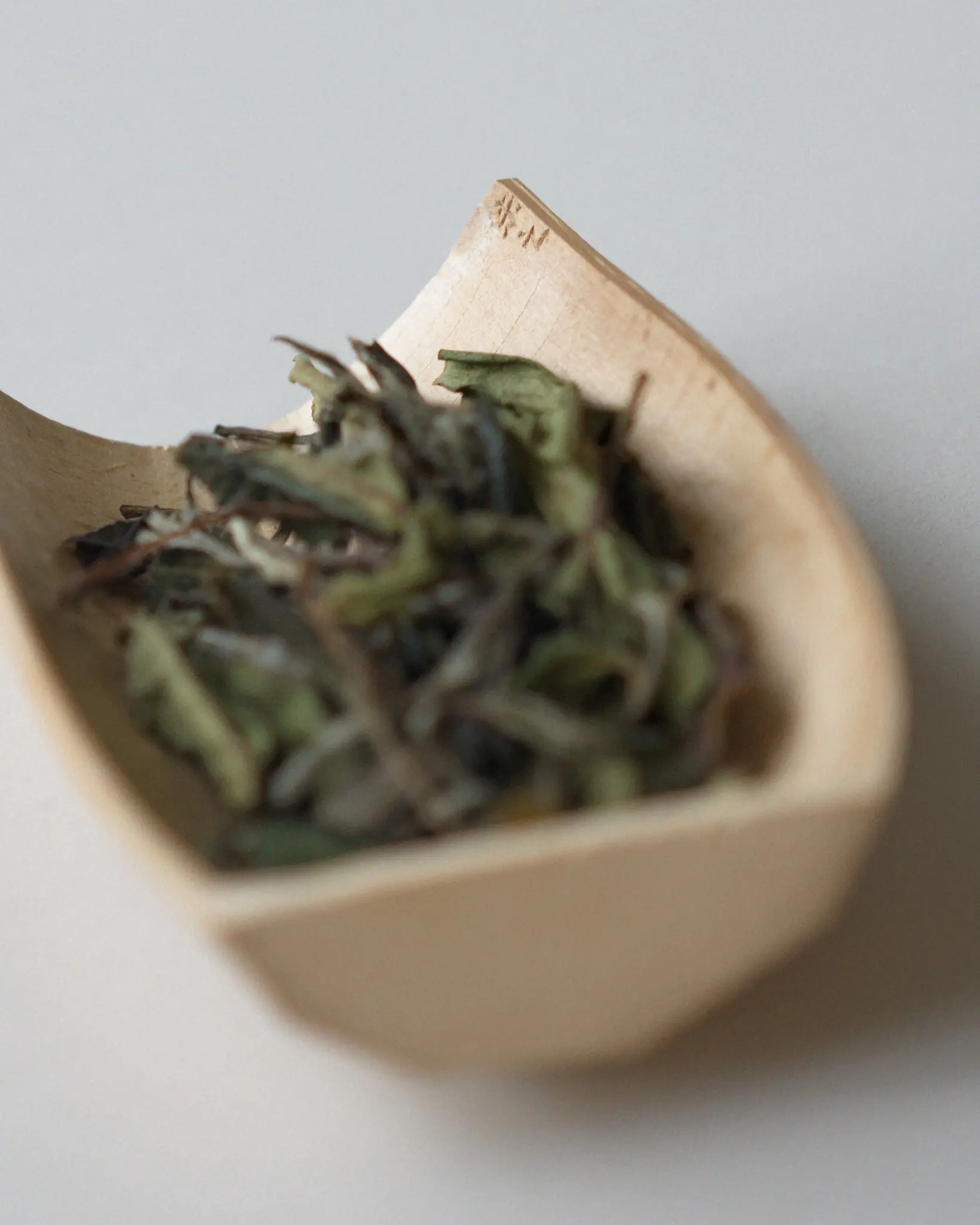
Wei Zhi was born in Yunnan, China, in 1988. After graduating in Art and Design from Beijing Forestry University in 2010, he worked as a landscape designer in Beijing. In 2015, he moved to Hangzhou. Through years of drinking tea, studying kintsugi and encountering historic ceramics, he began making tea scoops from bamboo, later extending his practice to tea needles, lid rests and flower vessels.
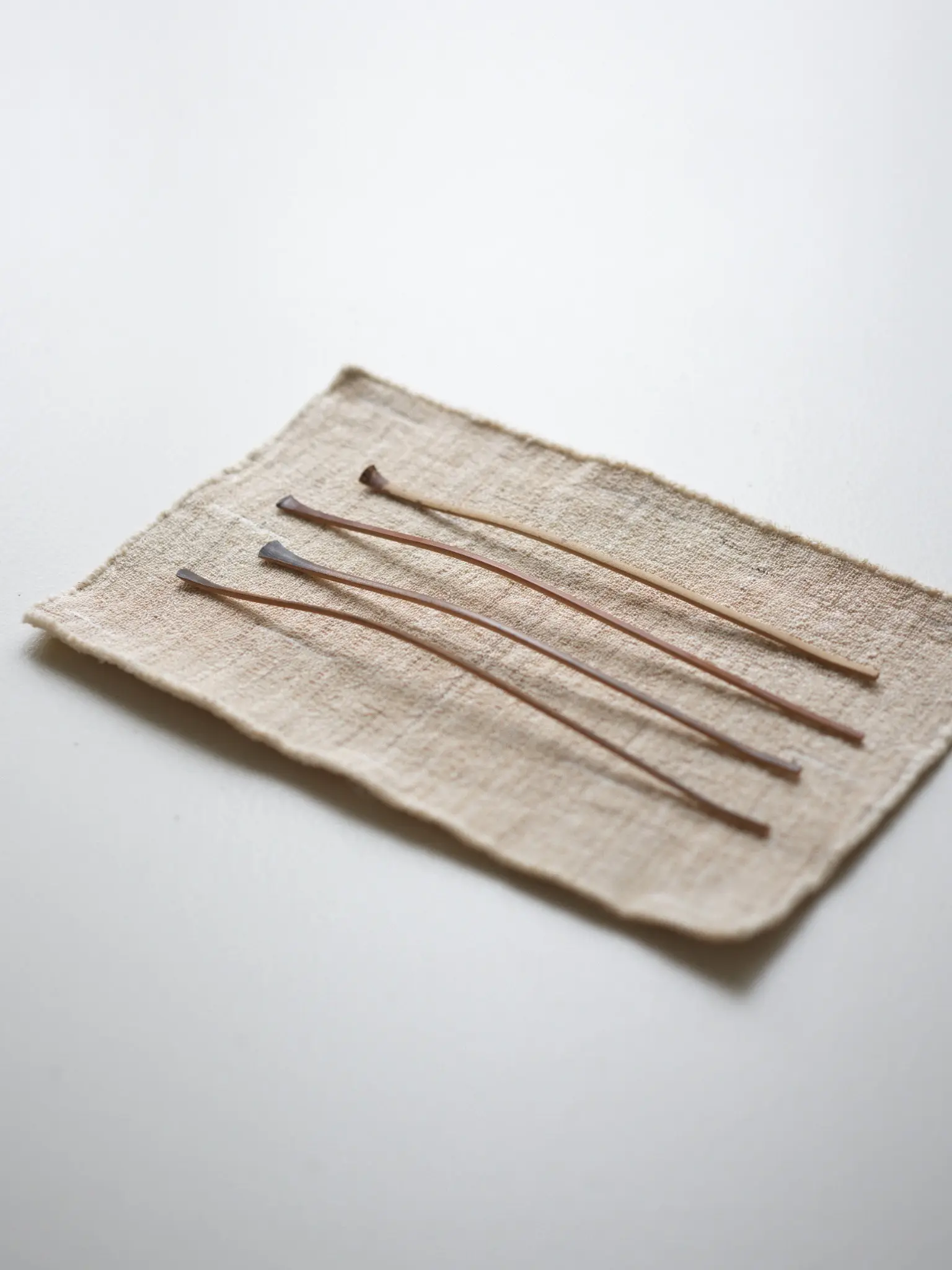
The most natural form of a bamboo tea scoop begins with a section of bamboo split lengthwise. Wei carves along the fibres, working with the outer skin, inner wall, cut edges and nodes while seeking a balance between thickness, openness and curvature. Some pieces retain the bamboo skin and marks of the blade; others are finished with natural lacquer or silver powder. Their colour and lustre continue to change through use. Their scale always remains closely related to the hand: the form must ultimately come into being through the gestures of lifting, tilting and guiding tea leaves into the pot.
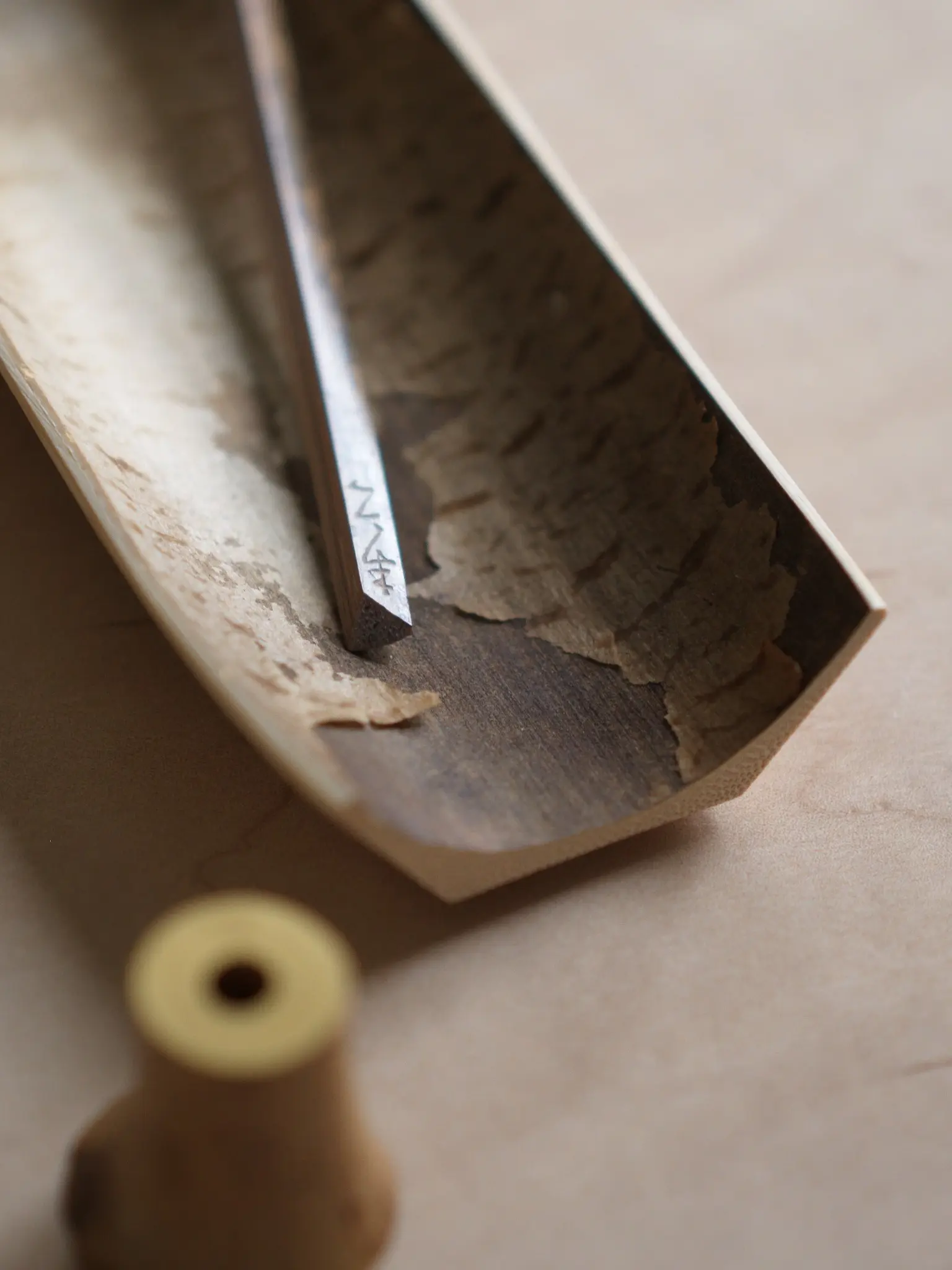
The position of each node, the diameter of the bamboo and the thickness of its walls are both constraints and structural conditions. Every cut is irreversible, and the maker must respond to the material as he works. The subtle variations that result free the objects from the absolute uniformity of industrial production while preserving traces of the plant’s growth.
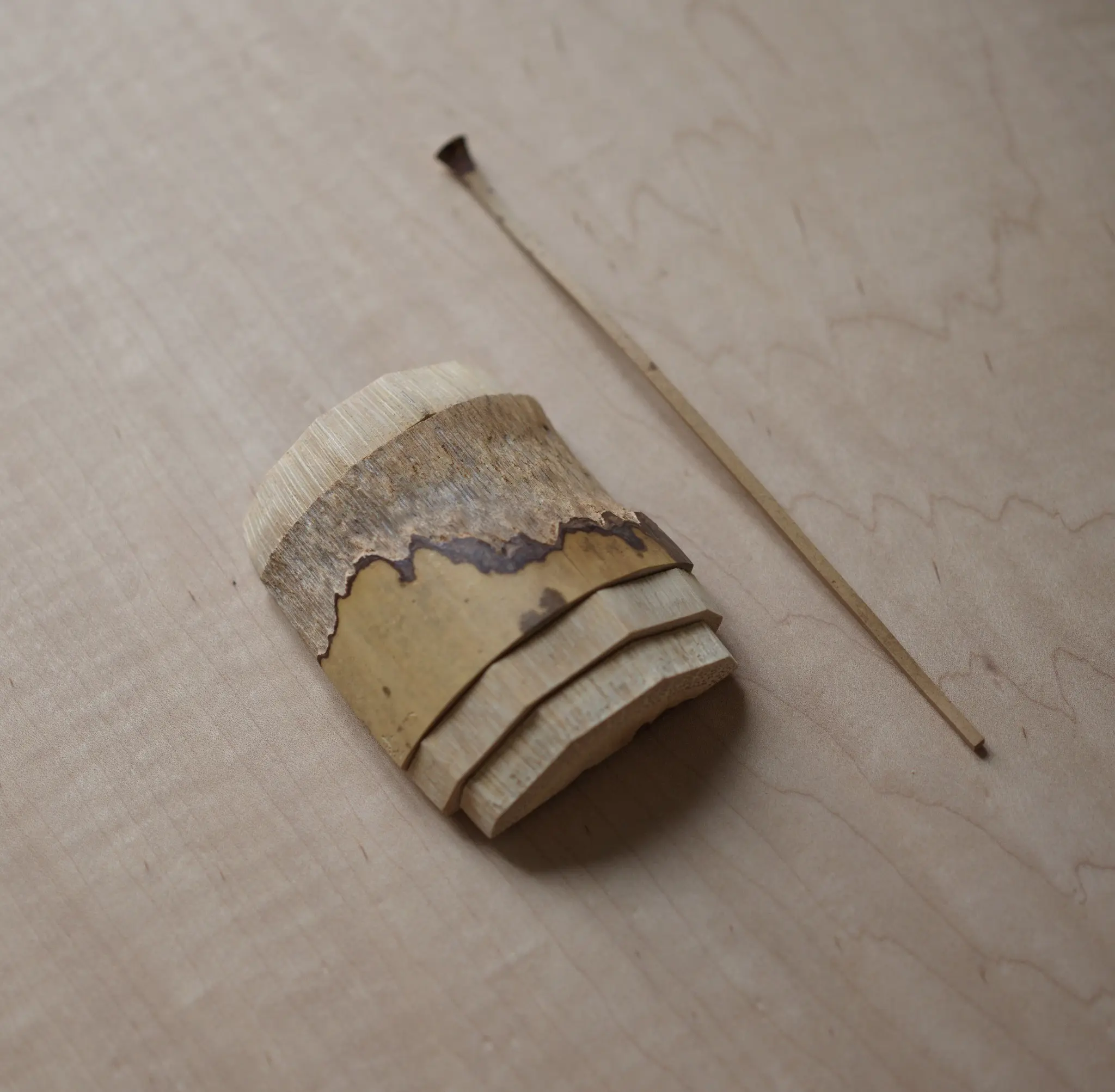
A tea scoop is not indispensable to drinking tea. Leaves can pass directly from the tea caddy into the pot, yet the scoop creates a pause between the two. The tea has left storage but has not yet encountered water; here it can be observed, smelled, measured and passed from one person to another. The scoop becomes a way station before tea enters water, briefly holding the leaves in their final dry form and allowing guests to encounter their colour, shape and aroma before their flavour unfolds.
Wei does not recreate tradition through elaborate carving. Instead, he transforms the tea scoop from within its structure. This small implement moves between functional utensil, flower vessel and sculpture, exploring how usefulness and uselessness may continually give way to one another.
This exhibition presents primarily bamboo tea scoops, each differing in width, curvature, wall thickness and cross-section. Within Where Tea Happens, they shift the beginning of tea to a moment before the pouring of water: choosing, pausing, looking and sharing are already the beginning of a tea gathering.
11Tadaki Yoshiaki
Wood
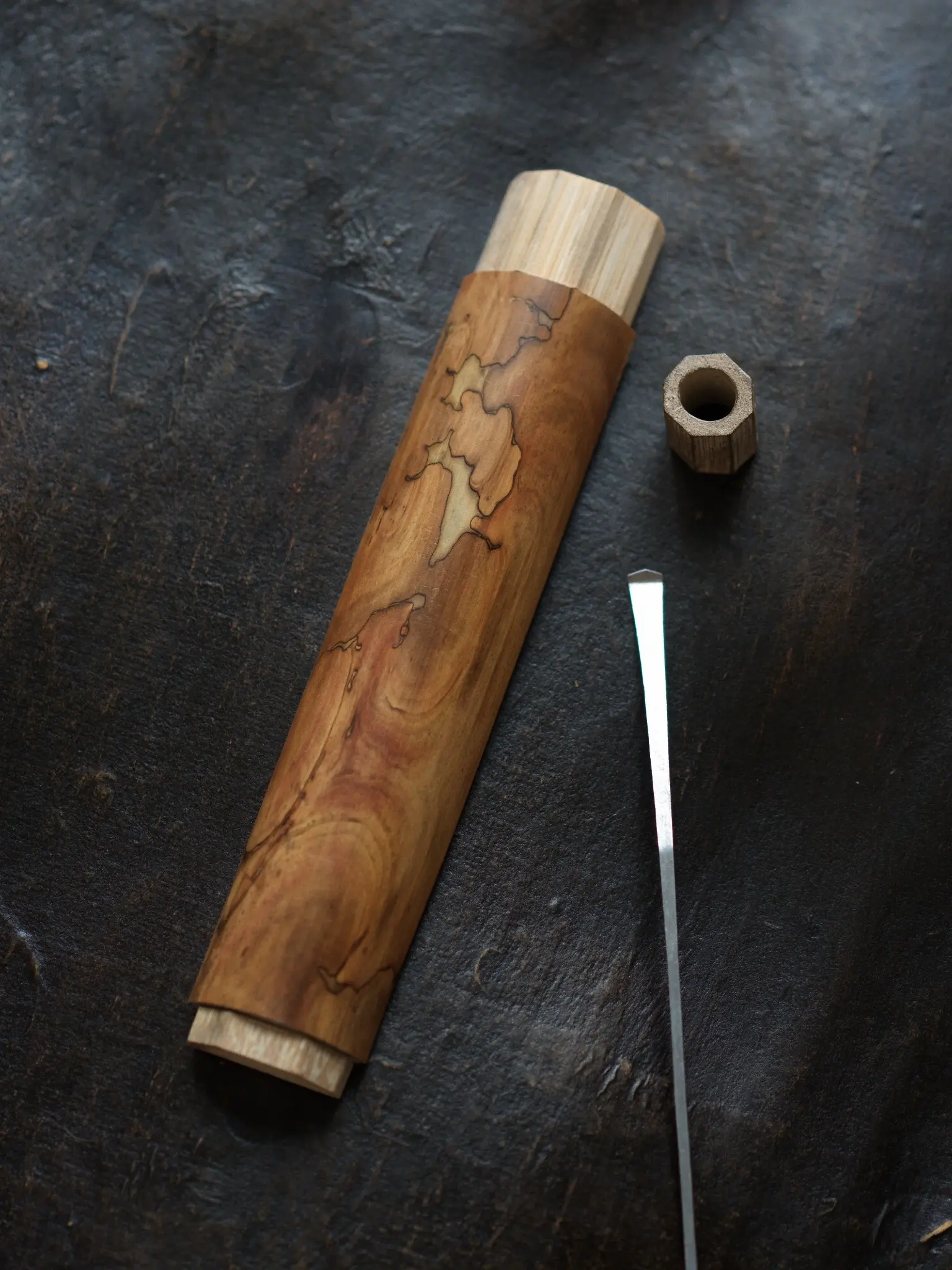
Tadaki Yoshiaki was born in Japan in 1990. In 2010, he began exploring woodcarving independently at home. Rather than following a conventional apprenticeship, he developed his own methods through a sustained dialogue with timber, tools and the demands of daily use. He now works in Saitama Prefecture. His practice encompasses vessels, wooden spoons, tea scoops, confectionery picks, flower vessels and trays, all shaped primarily through hand carving and retaining clear, finely articulated tool marks.
Tadaki does not work only with flawless, evenly grained timber. Reclaimed wood, offcuts and pieces marked by insect damage or decay also enter his practice. A form is not determined in advance and then imposed upon the material; the direction of the grain, the hardness of the wood and the presence of damage all alter the path of the blade. The final form is a decision reached jointly by the maker and that particular piece of wood. Once the wooden body is complete, he treats the surface with raw urushi, vermilion or white lacquer, persimmon tannin or plant dyes. These finishes give the object durability without entirely concealing the original character of the material.
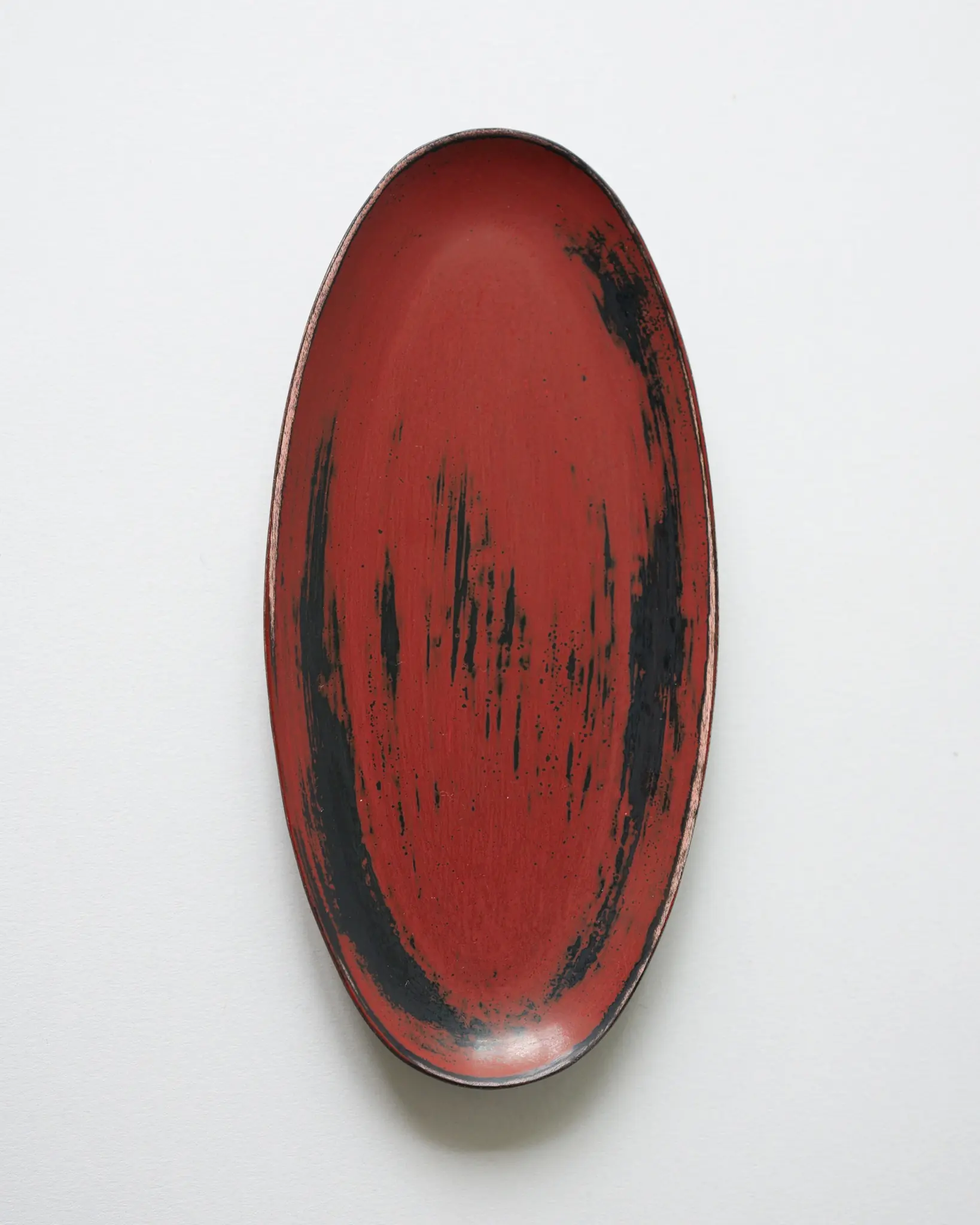
The works presented here are principally finished in red lacquer. Among them, the elongated tea platforms continue the relationship between red and black associated with Negoro lacquerware. In traditional Japanese vermilion-lacquered objects, layers of red lacquer were often applied over a black-lacquer ground. Through prolonged use, the vermilion surface gradually wore thin, allowing the black beneath to emerge. Vermilion lacquer was also frequently used for ritual, memorial and offering vessels, marking occasions set apart from ordinary life.
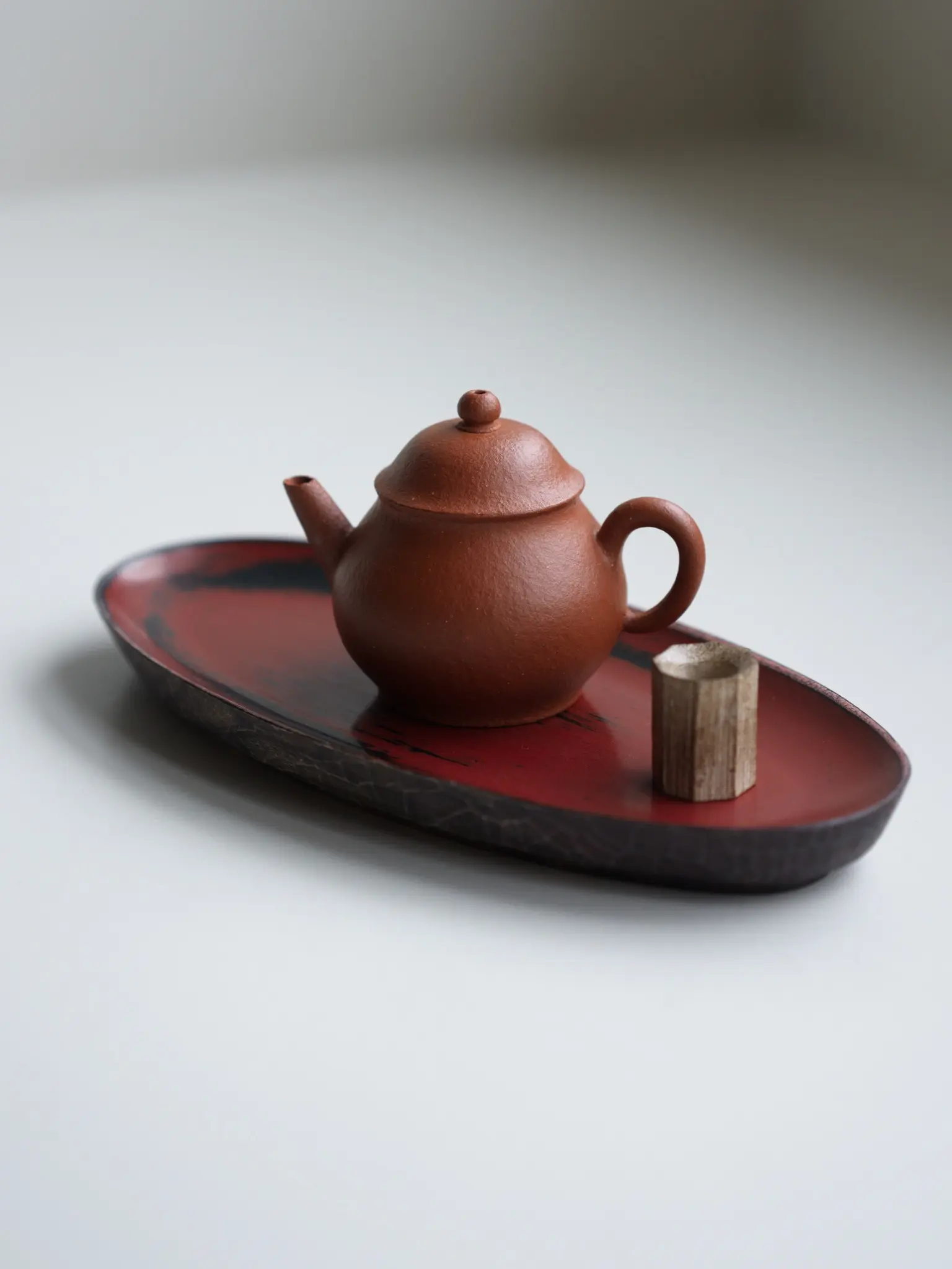
Tadaki draws upon this tradition without seeking the completeness or solemnity of an antique object. Marks of black appear within the muted vermilion, while carvings of varying depth and fineness remain visible along the underside and edges. The lacquer does not smooth away the wood; instead, it brings the movements of the hand into sharper relief.
This treatment creates the particular tension within his work. Red lacquer lends the object a degree of ceremony, while the carved marks return it to humble labour and daily life. The interior provides a level surface on which tea utensils may rest; the exterior reveals the gradual process by which the wooden body was cut into being, stroke by stroke. The work is connected to the temporal sensibility of medieval lacquerware, yet its form also possesses the directness and restraint of contemporary sculpture.
Broad, low and elongated, the tea platform supports a pot and cups while defining a quiet area across the tabletop. Its vermilion surface clarifies the colours of clay, bamboo, wood and tea, while the dark carvings along the edges and underside temper any splendour the red might otherwise suggest. Rather than attracting the eye through elaborate ornament, its horizontal form organises the spacing and order of the objects placed upon it.
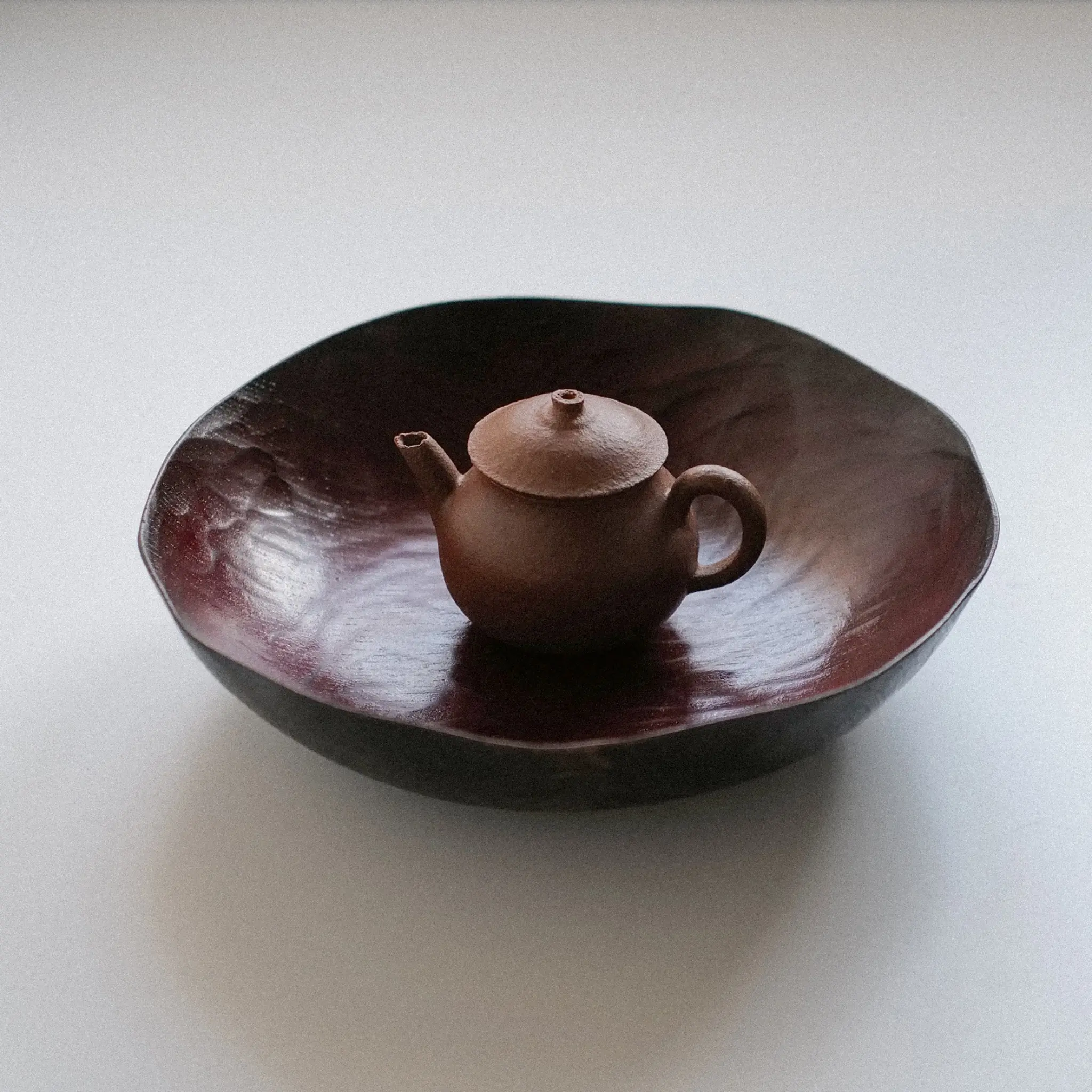
Away from the tea setting, it may also exist as a tray or as an independent object. What is most compelling is that lacquer and blade marks never conceal one another: one carries the memory of ancient lacquerware, while the other preserves the process of wood taking form beneath the knife.
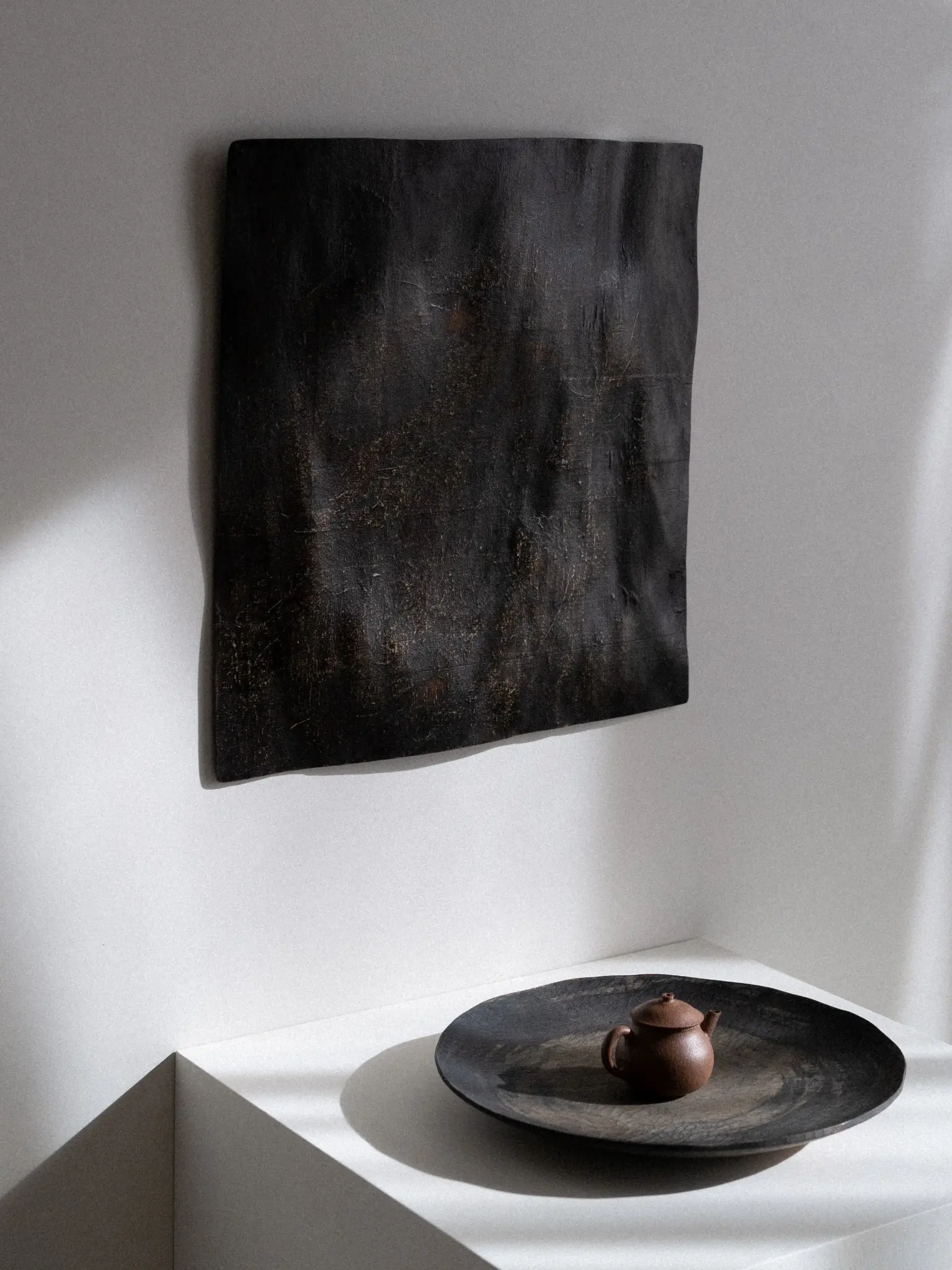
12Urakami Yosuke
Wood
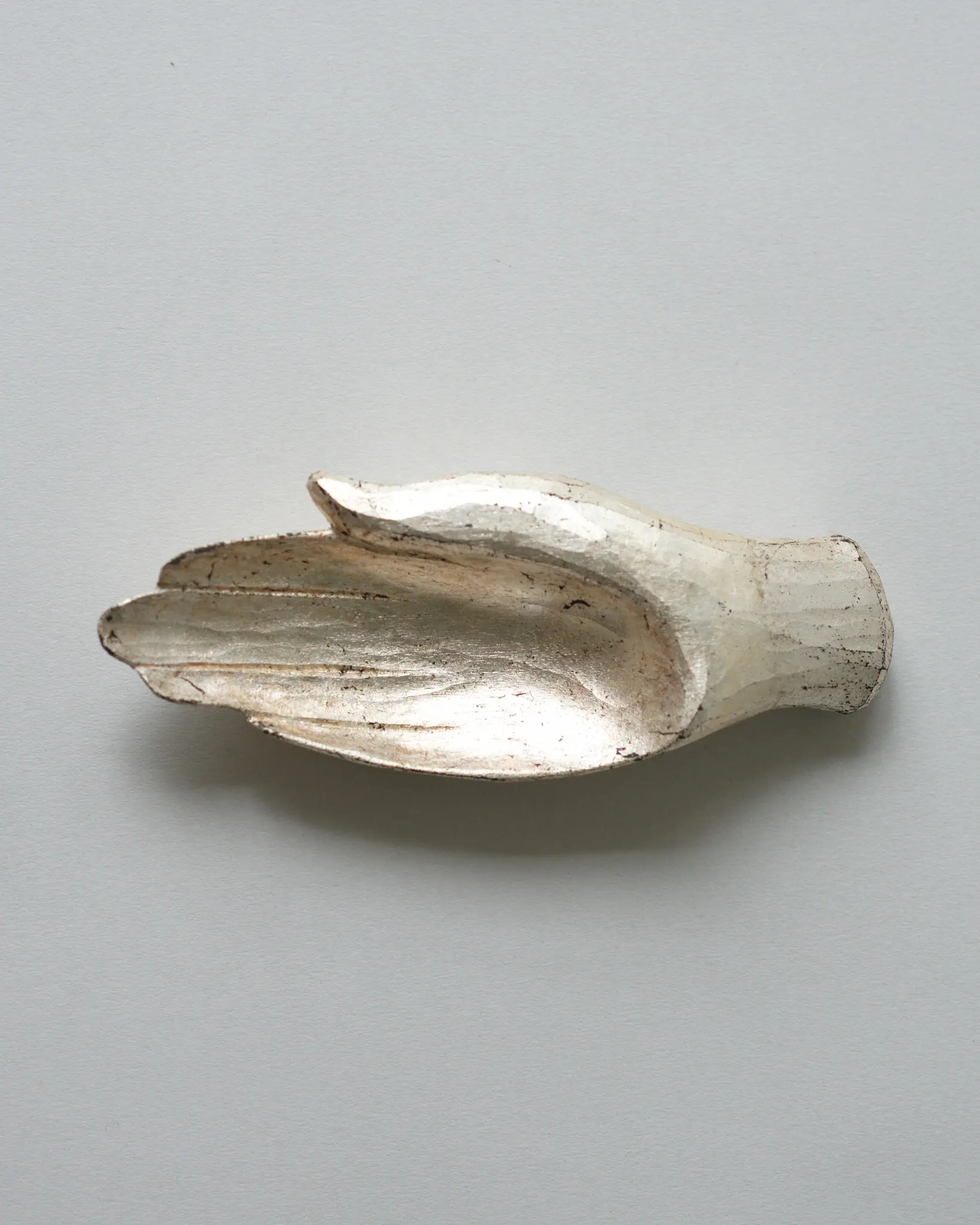
Urakami Yosuke was born in 1985 in the Gotō Islands, Nagasaki Prefecture, and graduated from Kuwasawa Design School in Tokyo. While still a student, he joined a furniture workshop, where he learned about timber construction, edged tools and lacquerwork, remaining in the field for nearly ten years. In 2016, he established an independent practice and moved to Zaō Town in Miyagi Prefecture. He initially worked from a corner of a local kokeshi craftsman’s studio, before converting an old storehouse into his own workshop. He has continued to work there with wood and lacquer ever since.
The Gotō Islands are rich in evergreen broadleaf forests, including native camellias, while Zaō, with its sharply defined seasons, is home to deciduous species such as Japanese horse chestnut, maple and oak. The move from an island landscape to the mountain forests of northeastern Japan broadened Urakami’s understanding of wood. He possesses the stability and precision demanded by furniture making, yet does not regard technical mastery as an end in itself. Instead, he responds to the grain, fissures, warping and play of light within each piece of timber, seeking a different form for every block of wood.
His works are generally cut, hollowed, turned and carved by hand, before being finished with lacquer, silver leaf and repeated polishing. Through smoking and sulphur treatment, the silver leaf changes from a brilliant white to shades of ash grey, brownish gold and colours resembling corrosion. He also layers, scorches and scrapes the leaf before securing it beneath lacquer. Urakami often examines his work by a single beam of light in the dimness of his studio, mindful that an object will usually spend far more time being placed and contemplated than actually used. Light thus becomes part of the making itself.
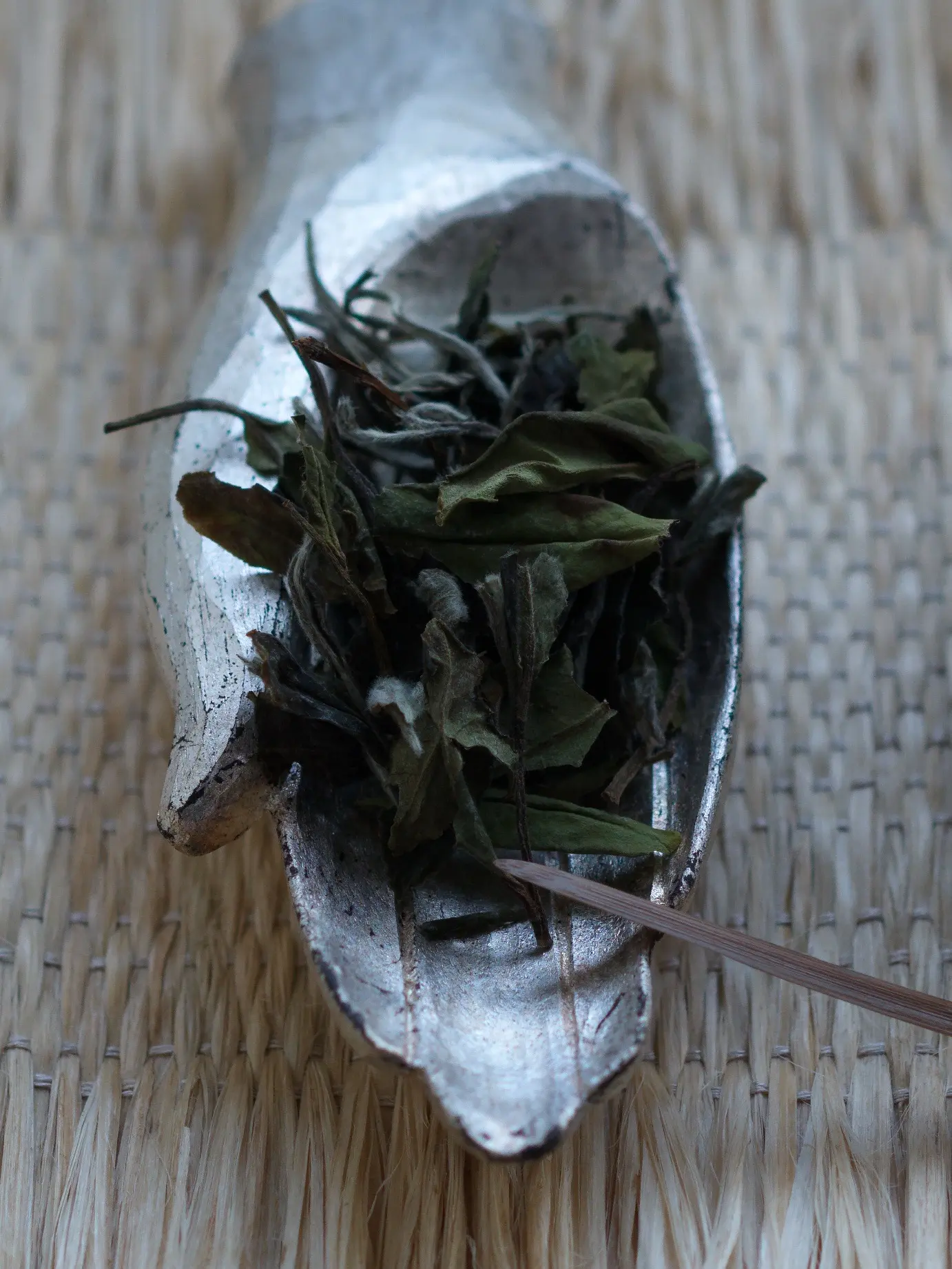
His background in furniture gives each work a disciplined structure, while lacquer and metal leaf introduce chance and uncertainty at the surface. The grain records the growth of the tree; the marks of the blade record the maker’s movements; and the sulphur-treated silver evokes layers of colour accumulated through years of oxidation. Decoration is not applied as something separate from the object, but becomes a second structure in its own right, allowing the work to move between functional vessel, still life and small-scale sculpture. Its contemporary relevance lies precisely in this reconsideration of the boundaries between use and contemplation, the substance of a material and its decorated surface.
The works presented here continue Urakami’s language of wood, lacquer and metal leaf. They include small wooden pieces that may support teaware, as well as objects intended to stand independently. The silver leaf brightens and darkens as the viewing angle changes—at times distinctly metallic, at others resembling a layer of aged lacquer. No single use is prescribed; the final decision is left to the user. Once placed within a tea setting or domestic interior, each work supports tangible objects while quietly receiving the light, gradually finding its own place through the daily acts of positioning and touch.
13Imura Yuko
Textiles
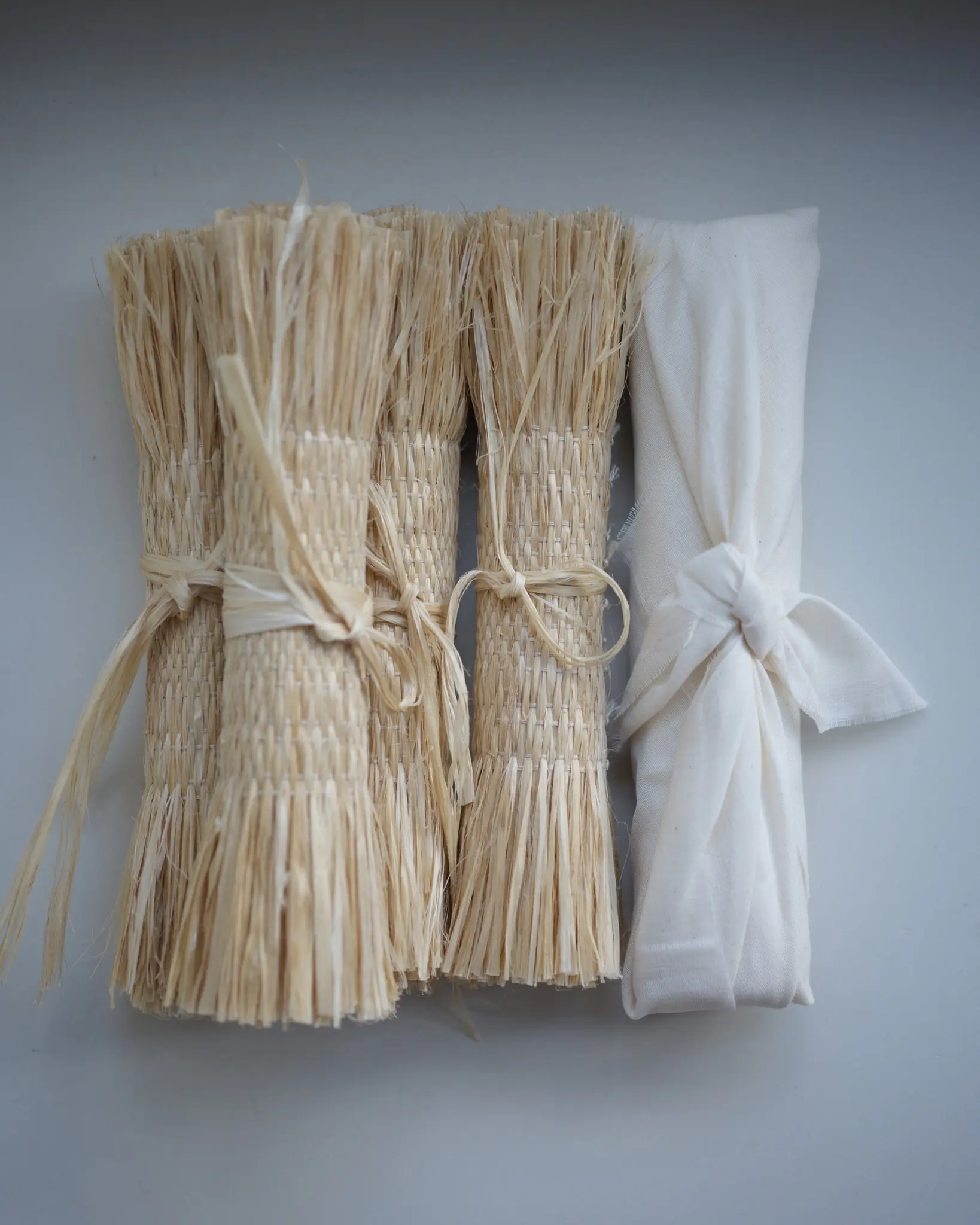
Imura Yuko was born in Osaka in 1975 and continues to live and work there today. She began studying weaving in 2006 and has since pursued the hand-spinning, dyeing and weaving of natural fibres including wool, cotton, hemp and flax. Her work was selected for the Japan Folk Crafts Museum Exhibition in 2016, 2017, 2019 and 2021. Her longstanding practice of tea has also given her an intimate understanding of the subtle yet tangible relationships between cloth, the surface of a table, the vessels placed upon it and the movements of the people around it.
Imura’s making often begins before there is even a thread. She prepares wool and spins cotton by hand; she separates hemp bast fibres bundle by bundle, splits them finer, joins them together and finally sets them upon the loom. Variations in thickness, knots and colour inherent in the fibres are not deliberately erased. Instead, they create a quiet rhythm through the varying tension and density of warp and weft. Some works are also dyed with plants or tea, allowing colour to emerge slowly from within the material itself.
She once gave a white textile the title Awai, an old Japanese word referring to the place between one thing and another, or between one concept and another. The work was inspired by the northern shore of Lake Biwa in winter, where the white surface of the lake seemed to hold the transient and the eternal, the certain and the uncertain—opposites coexisting across a boundary that was present yet almost imperceptible. Imura’s textiles inhabit a similar in-between space. Softness and resilience, irregularity and order, the original character of the plant and the discipline of human weaving do not cancel one another out. What moves us is not the smoothing away of difference, but the ability of every distinct fibre to remain quietly itself within the whole.
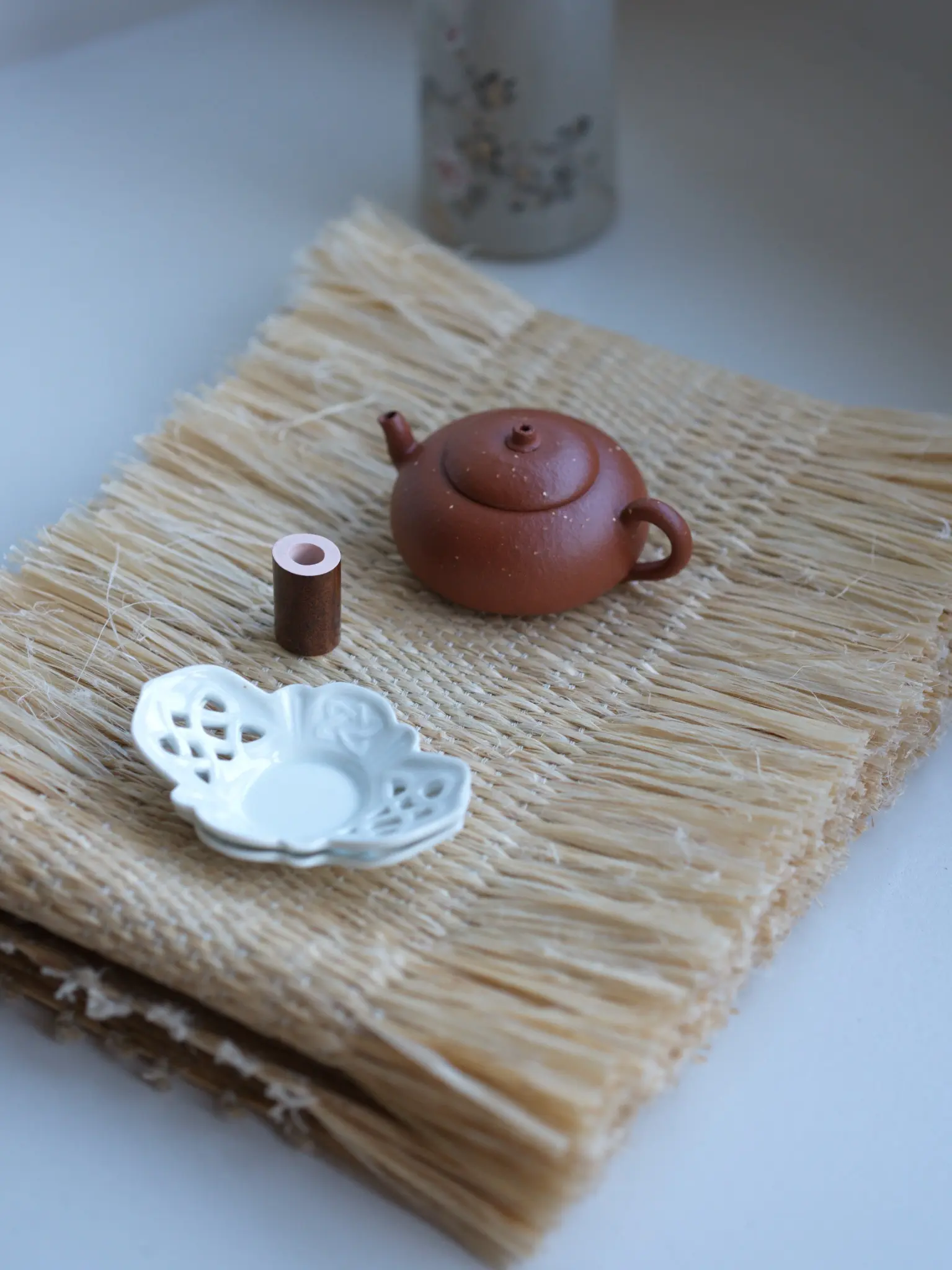
The works presented here are hemp mats. Imura has continued to make these pieces since 2017, using hemp and flax. The thickness of the fibres and the force with which the weft is beaten into place alter the density, relief and lustre of the surface. Rather than refining natural fibres into perfectly uniform specifications, she allows threads of different lengths and thicknesses to find their own positions within the warp and weft. The works may appear similar, but no two are ever truly alike. Uneven fibres gather in quiet rows, forming a landscape to which she returns again and again.
When unfolded, a hemp mat can support several vessels, creating a broad and tranquil field across the tabletop. It appears simple, yet closer attention reveals that no part is repeated exactly—like many individuals standing side by side, each retaining its difference while together forming an order.
14You Sasa
Textiles
You Sasa was born in Henan in 1988. She graduated in Art and Design from Xi’an Technological University in 2009 and worked in interior design during the early years of her career. Between 2014 and 2022, she practised kintsugi restoration; in 2022, she turned towards textiles, creating tea cloths, garments and spatial works. She now lives and works in Hangzhou. Her experience in interior design shaped her sensitivity to the scale of objects in relation to space, while restoration taught her to understand how materials are joined, how damage may be held, and how something incomplete can be made whole again.
She works with natural fibres including silk, wool, cotton, hemp and ramie, as well as antique cloth, handwoven fabrics and naturally dyed textiles. Unlike a weaver who begins with yarn, You more often starts with cloth that already exists, reorganising it through cutting, layering, stitching, turning and washing. Different fabrics shrink at different rates in water, producing folds, undulations and subtle distortions across the surface. Seams, raw edges and loose threads are not entirely concealed: they record how a piece of cloth was taken apart and how it came to form a new whole.
Her work does not treat textile as a passive background beneath objects, but as a movable space in its own right. Once a tea cloth is unfolded, distances emerge between the vessels, while the hands gain a field within which to move. Rather than drawing the eye through emphatic patterns, the cloth uses texture, boundaries and minute variations to adjust the way people and objects inhabit a shared setting. Having once worked as an interior designer, You now condenses space into a single expanse of fabric: the room itself need not be altered; by rearranging the tabletop, a different order can arise within everyday life.
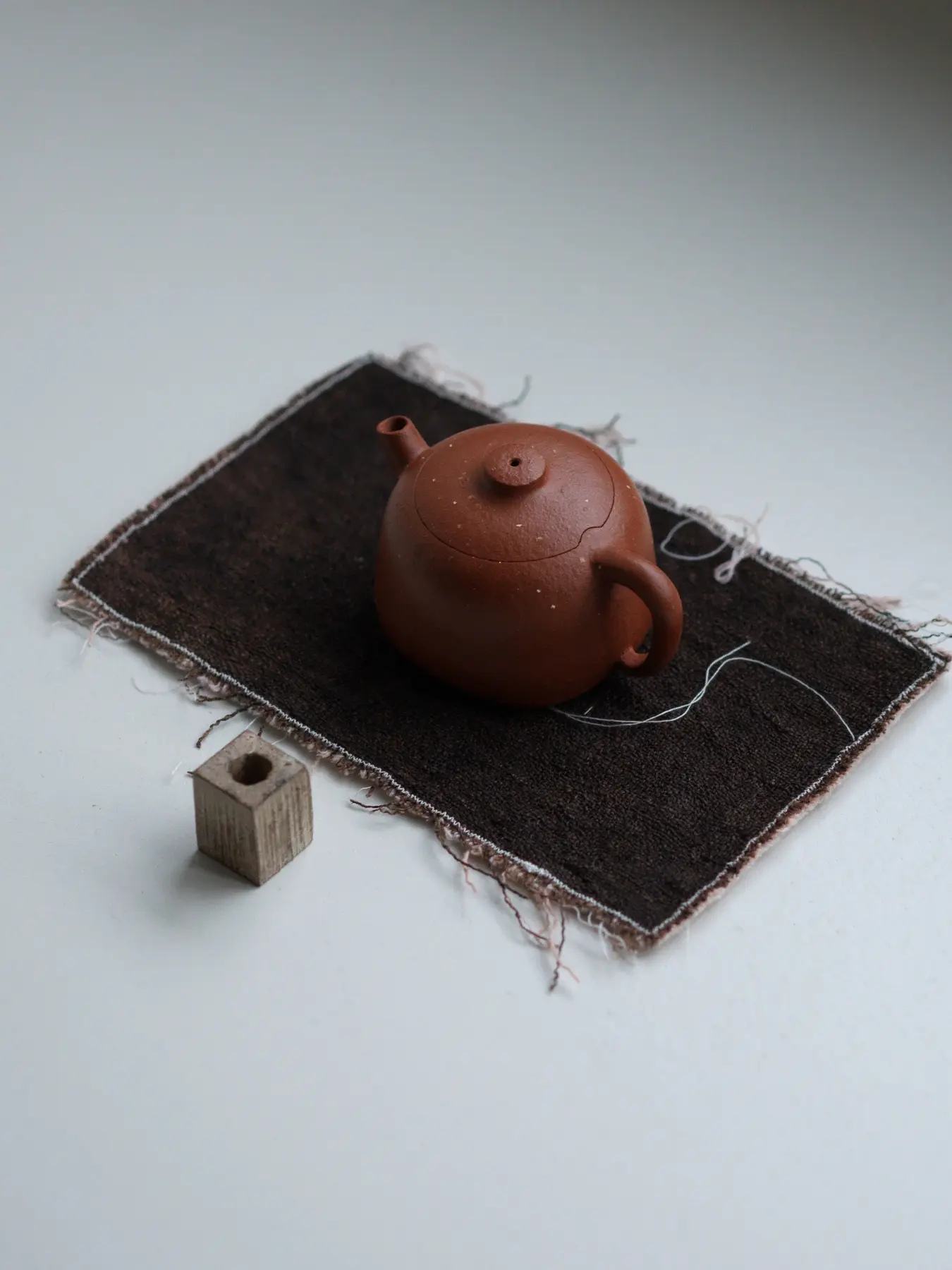
The works presented here include tea cloths and Thread Fragments. The tea cloths are restrained in colour, bringing together antique fabrics, dyed textiles and fibres of varying textures. Their wrinkles and edges preserve the individuality of every piece.
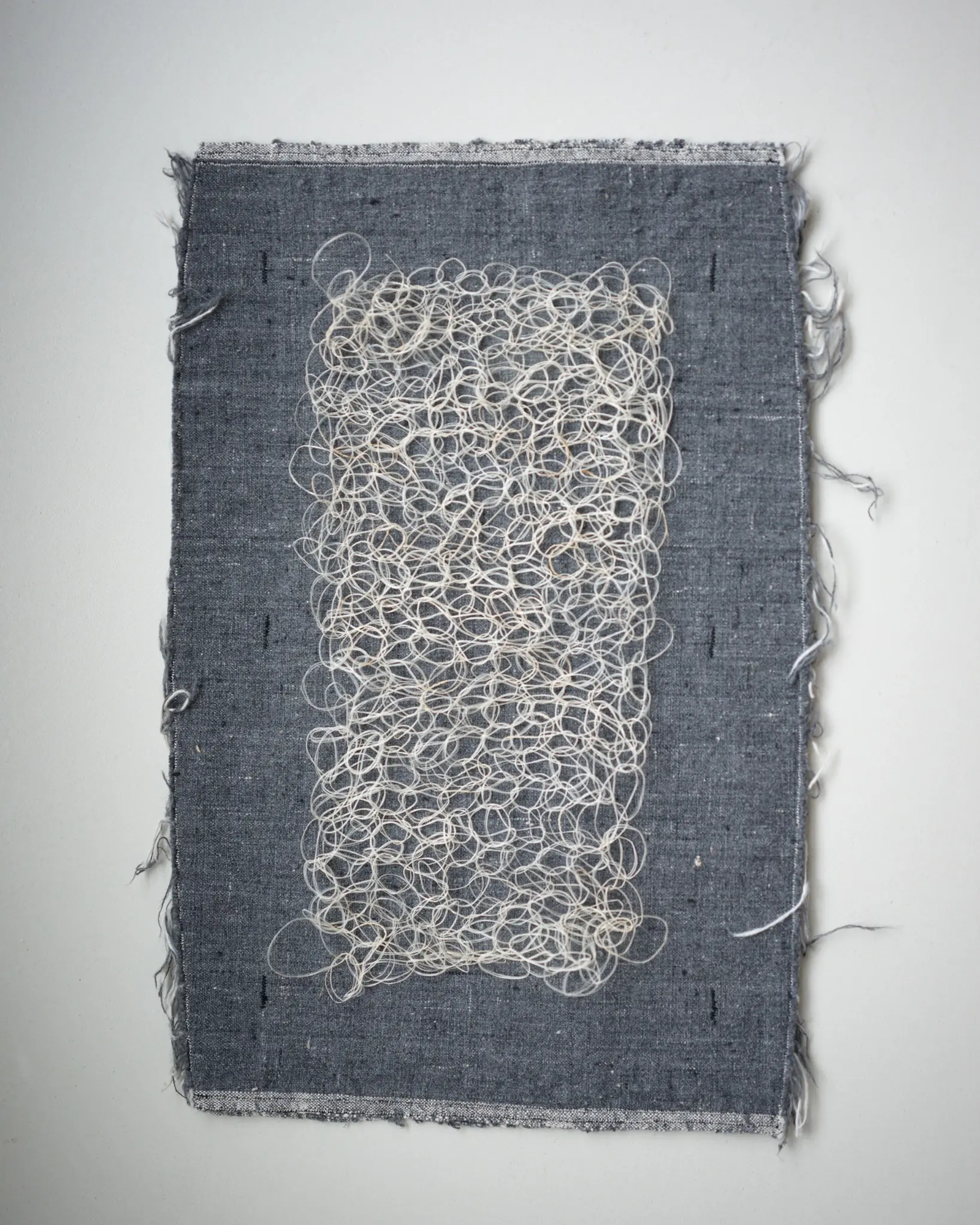
The Thread Fragments move further away from the structure of a complete textile. Fine threads gather, disperse and intertwine to form almost transparent layers. There is no prescribed front or back: one side reveals the direction in which the threads travel, while the other exposes knots, joins and lingering loose ends. Each side becomes a landscape in its own right.
15Aldo Cass
Textiles
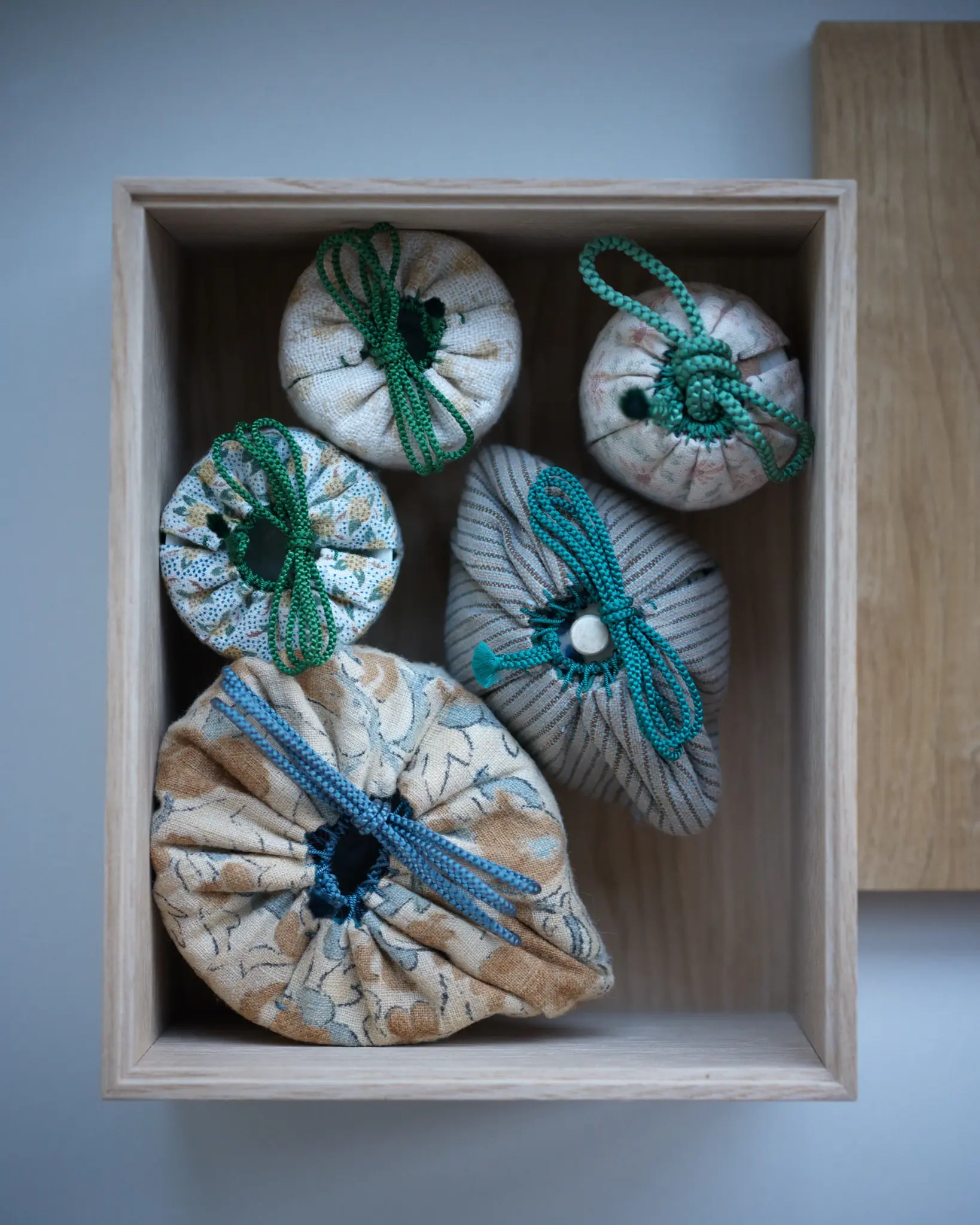
Aldo Cass was born in Sinaloa, Mexico, in 1993. Now based in Tokyo, he works between Japan and Europe. He began his career in design and, after moving to Japan in 2017, became increasingly involved with fibre crafts. He later received an MA in Design from Chiba University and studied the making of shifuku under Eiko Shimizu. Alongside his textile practice, he has long engaged with Chinese tea, gradually developing a distinctive and open aesthetic through the selection and use of vessels and the composition of tea settings. What distinguishes his work is the way he applies the training of a contemporary designer to reconsider proportion and the boundaries between object and textile.
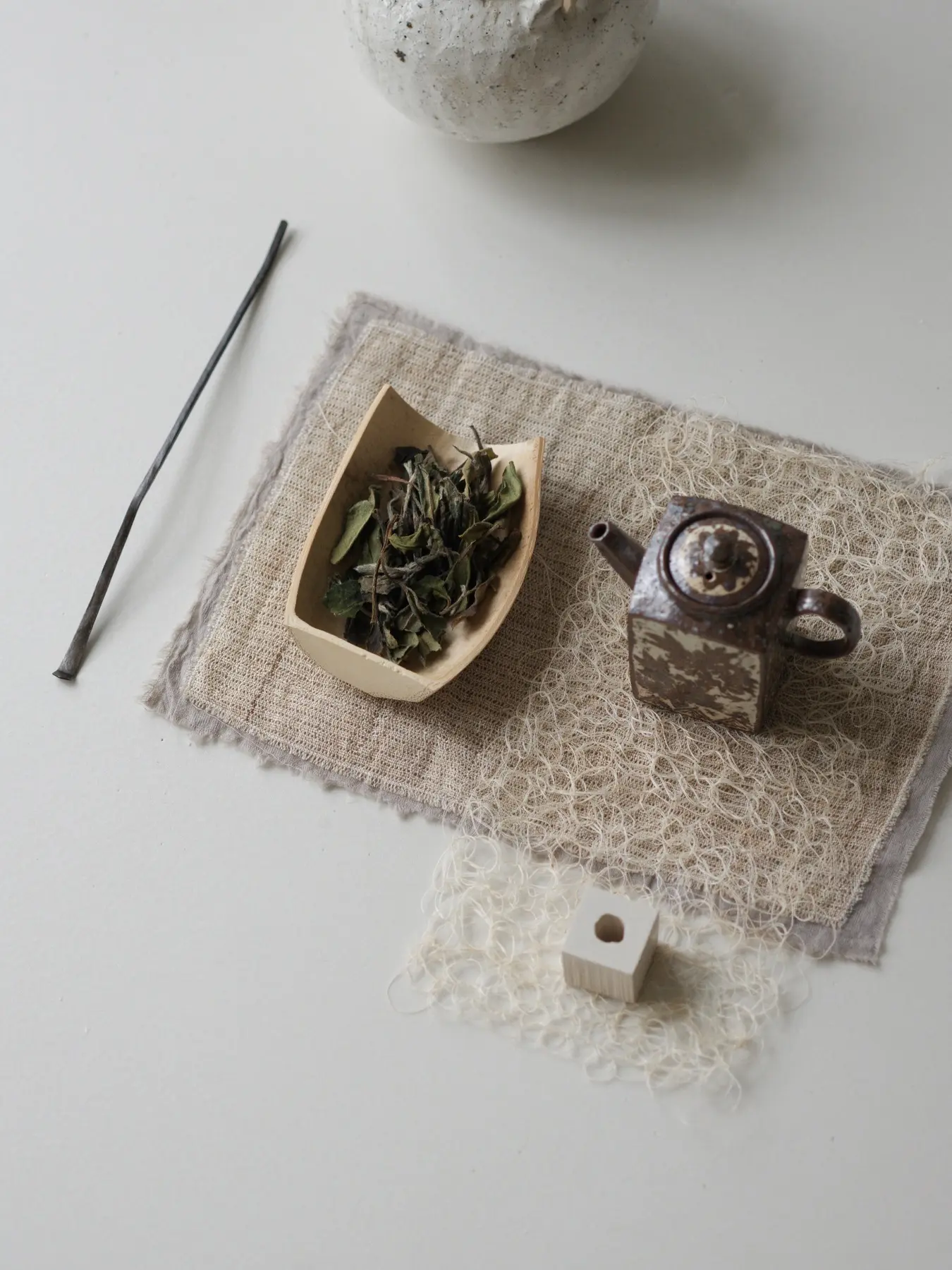
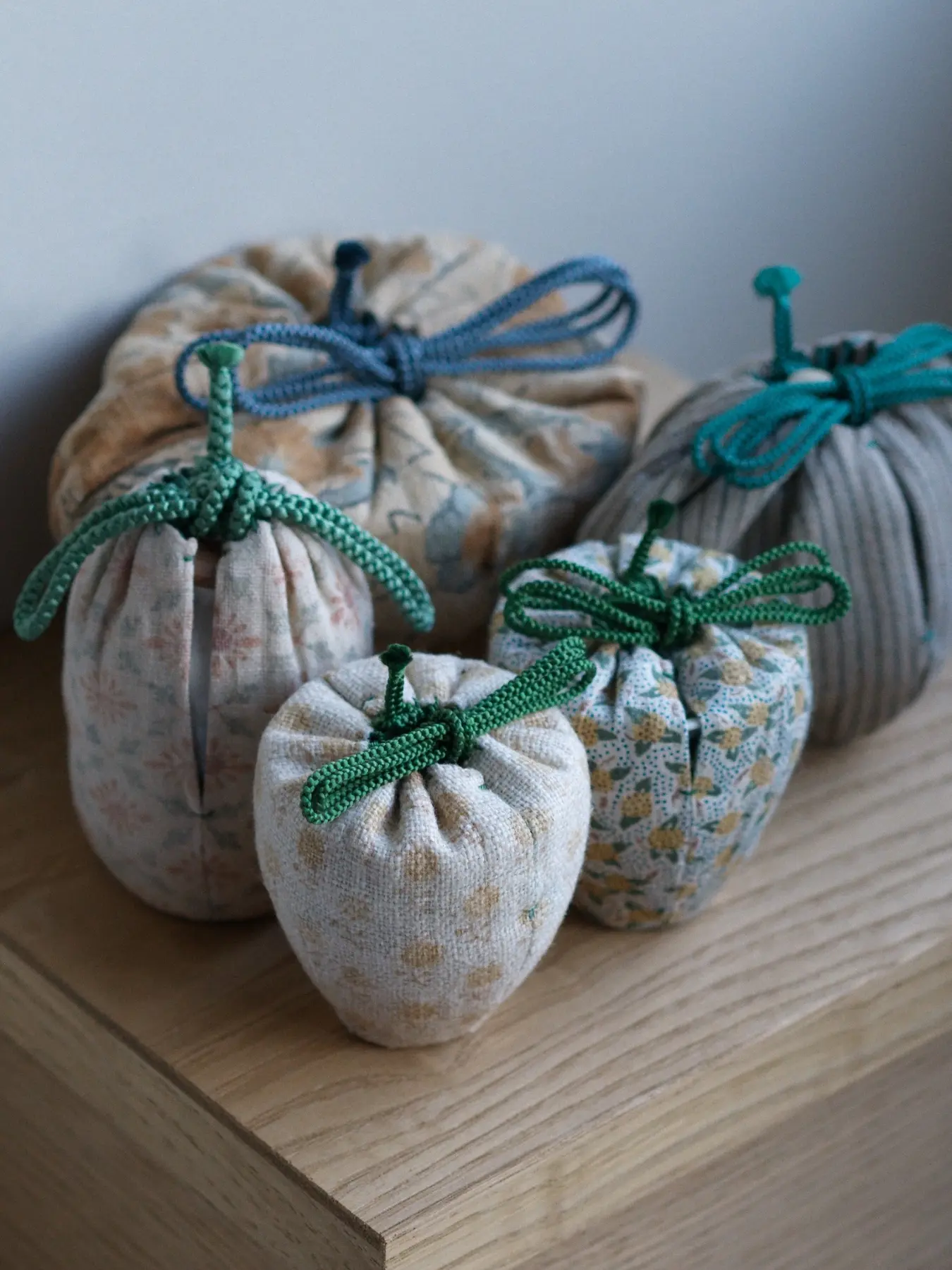
Aldo collects textiles from around the world, including European chintzes and striped silks, fragments of antique Japanese kimono and Indian patola cloth. Fabrics from different regions, periods and cultural contexts are removed from their original settings and brought into new relationships with the work of ceramic artists. Beginning with the form, glaze, texture and overall presence of each vessel, he carefully considers whether textile and object should echo or contrast with one another. Through sewing, piecing and embroidery, he then creates a unique, individually fitted shifuku for each piece.
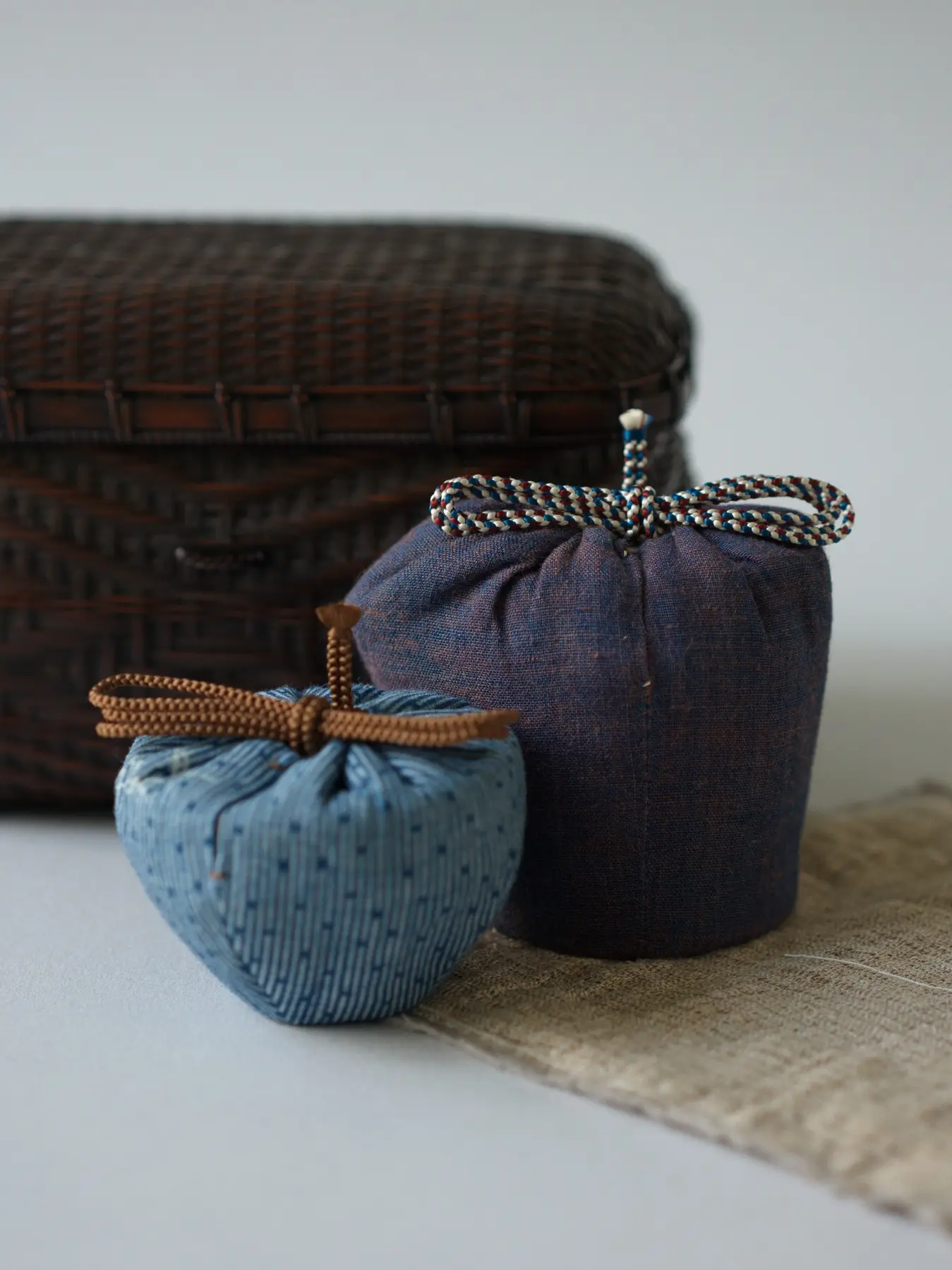
Contemporary society often understands beauty in terms of form, ornament and visual stimulation. The beauty of shifuku, however, emerges through repeated acts of wrapping, unwrapping, carrying and protecting. It expresses not the possession of an object, but a willingness to devote time to learning how to live with it. A shifuku is therefore also a form of care.
Within the urban context of Paris, shifuku may also be understood as a form of haute couture for objects. A fashion designer studies the proportions, posture and character of the human body; Aldo begins with the contour, shoulder, rim, glaze, texture and weight of a vessel, selecting the fabric and determining the structure and method of construction accordingly. Clothing does more than conceal the body: it shapes how a person enters public space and expresses the self. In the same way, a shifuku changes how an object enters the tea setting. While wrapped, the vessel remains hidden within the textile and carefully protected. Only when the cord is untied does it gradually emerge into the hands, onto the table and into view. Untying, removing, contemplating and using: these are the first moments in which tea begins to happen.
For this exhibition, Aldo has collaborated with several of the participating ceramic artists. These works remind us that the place where tea happens need not be a permanent tearoom. A tea setting can be folded, wrapped and carried, then opened once again in another place.
During the exhibition, Aldo will also host a tea gathering shaped by his own aesthetic sensibility and understanding of objects. The vessels will move from display back into actual use, allowing tea to happen fully in the encounter between people and things.
About Shifuku
Shifuku, pronounced しふく in Japanese and sometimes written with the alternative characters 仕服, generally refers to a textile pouch made individually to fit the form of a tea caddy, tea bowl, usucha-ki or another tea utensil. The most characteristic example is the pouch made for a ceramic chaire, the caddy used to hold matcha for the preparation of thick tea. A shifuku does not simply disappear into storage. At the end of the thick-tea procedure, it is presented to the guests together with the chaire and tea scoop for haiken—the act of holding and closely appreciating the objects. The shifuku is therefore itself a tea utensil with an independent aesthetic value.
The development of shifuku is closely connected to the esteem in which Chinese karamono chaire were held from the Muromachi period onwards. During the eras of Oda Nobunaga and Toyotomi Hideyoshi, celebrated tea caddies could function as political gifts and symbols of status. The pouches that protected them consequently evolved from practical coverings into objects of appreciation in their own right.
By the Edo period, records of a celebrated tea utensil documented not only the vessel itself but also its accompanying shifuku, turned wooden case, inner and outer boxes, wrapping cloths and other accessories. This complete ensemble, transmitted together with the object, is generally known as its shidai.
Traditional shifuku were often made from meibutsu-gire, or “famed textiles.” These were not merely old and luxurious fabrics, but precious textiles associated with celebrated tea utensils, temples, tea practitioners or particular lines of provenance. They were named, classified and repeatedly reproduced. According to the
Tokyo National Museum, their origins included China, India, Iran and other regions. Once brought to Japan, these foreign textiles were cut anew, given names and placed in new relationships with tea utensils.
A shifuku is therefore a miniature history of cultural exchange: materials travelled across Asia and, at times, from as far as Europe, before acquiring new identities within the tearoom.
A celebrated tea utensil was not necessarily accompanied by only one shifuku. Successive owners, living in different periods, might each commission new “clothing” for the same object.
Tea gatherings
Three tea practitioners, each having come to tea by a different path, will present their own tea gatherings during the exhibition.
Meet the tea practitioners
Imaizumi Katsuhito
A Japanese tea practitioner, Imaizumi Katsuhito was born in Aichi Prefecture in 1988 and is now based in Paris. He studied cooking and agriculture in his early years, experiences that led him towards tea as an essential element of Japanese food culture. He later worked at Sakurai Japanese Tea Experience in Tokyo, travelling through tea-producing regions in Japan and abroad and meeting tea farmers and makers. He subsequently participated in the founding of OGATA Paris, where he was responsible for the selection of teas and the overall composition of space, utensils, service and the tea experience. Since becoming independent in 2024, he has directed Cha to and Through The Tea, hosting tea gatherings and workshops in different countries from his base in Paris.
Imaizumi regards tea as a means of awakening the senses and reconnecting people with nature. His gatherings do not rush to explain. Instead, they invite participants to enter the experience fully: to feel their breathing and the movements of their hands, listen to the sound of water, notice the temperature of the air and attend to the subtle way tea gradually unfolds in the mouth. In a world ceaselessly driven by speed and efficiency, tea offers another kind of time—one in which we may slow down and perceive ourselves, others and the things around us more deeply.
The spirit of zanshin runs throughout his tea practice: an action may have ended, yet attention and care remain. It is present in the way an object is gently set down, in the rhythm of pouring water, in the distance between host and guest, and in the lingering resonance after the gathering has ended.
For this exhibition, Imaizumi will bring together tea, objects and perception to form a quiet space. When the gathering is over, what remains with the guests may be more than flavour: perhaps a subtle sensitivity awakened by silence.
Zhan Sixiang
A Chinese tea practitioner, Zhan Sixiang lived in Europe for fifteen years and has long been devoted to sharing Chinese tea internationally, while exploring the relationship between tea and cooking. He is now based in Beijing, where he serves as Brand Director of Xiyun Hotel. Over the years, he has travelled extensively through China’s tea mountains, working alongside tea farmers and tea makers in search of tea at its source.
For Zhan, tea begins in mountain forests, soil and climate. More than established forms, he values the untamed character carried by a tea and the many expressions imparted to it by terroir, methods of production and time.
Zhan approaches Chinese tea with the sensibility and freedom of a contemporary tea practitioner. He understands brewing as an act of listening: as water enters the leaves and fragrance gradually unfolds, the climate of the place of origin, the growth of the plant and the craft of the tea maker reveal themselves within the cup. The tea setting is not a re-enactment of tradition, but a space in which taste, objects and people may meet anew.
This gathering, entitled A Trio of Teas, takes fragrance as the melody running through three successive tea settings. A nine-times-scented jasmine tea brings flower and leaf together over nine nights. Oriental Beauty develops aromas of ripe fruit and honey through the kiss of insects. Beidou No. 1, a Wuyi rock tea, reveals its profound yan yun—its “rock rhyme”—through the encounter of mineral soil, roasting and water.
Flower, insect and stone each participate in the making of tea in a different way. Together, they tell the story of how a single leaf receives nature and responds to it.
Aldo Cass
A fibre artist, designer and tea practitioner, Aldo Cass was born in Sinaloa, Mexico, in 1993 and is now based in Tokyo. After moving to Japan in 2017, he began working with fibre crafts and later received an MA in Design from Chiba University. Since 2023, he has studied natural tea practice with tea practitioner Naoko Ideno.
In recent years, Aldo has regularly hosted Chinese tea gatherings in Tokyo, Kyoto and elsewhere, giving them the name Tea Talk. Rather than centring on a strict formal procedure, his gatherings place greater emphasis on drinking together, conversation and the connections that arise naturally between people. Even when participants do not fully share a language, they can still share a quiet and open interval through the temperature, fragrance and flavour of a cup of tea. Tea exists not only in the cup, but also in the relationships created by each encounter.
In this exhibition, Aldo appears both as a participating artist and as a tea practitioner, bringing Chinese tea and the exhibited objects together within a single tea setting.
Where does tea happen? Perhaps it happens at the moment when people from different cultural and linguistic backgrounds gather around a table and choose to share a measure of time.
Programme and booking details will be announced shortly.